
Turning Multi-Step Processes into End-to-End Flows
Most organizations have invested heavily in ERP systems to streamline operations and improve efficiency. Yet, many everyday business processes still involve manual effort. Employees switch between multiple screens, chase approvals through emails, update information across systems, and spend valuable time coordinating tasks that should already be connected.
The challenge isn’t that ERP systems lack data. In fact, they hold vast amounts of operational information across procurement, finance, supply chain, manufacturing, and customer operations. The real challenge is turning that information into action without requiring people to manage every step along the way.
As business environments become more dynamic, these manual handoffs and disconnected workflows create delays, reduce productivity, and make it harder for organizations to respond quickly to change.
According to McKinsey, organizations generating the greatest value from AI are redesigning workflows rather than automating individual tasks, with top-performing companies reporting EBIT improvements of more than 5% through AI-enabled operational transformation.
This shift is giving rise to a new operating model, AI Ops for ERP. AI Ops connects processes, decisions, and actions across the ERP landscape. The goal is to transform complex, multi-step workflows into intelligent end-to-end processes that can monitor, analyze, decide, and execute with minimal human intervention.
The Growing Gap Between ERP Systems and Business Agility
ERP systems are excellent at managing transactions, but today’s businesses need more than transaction processing. They need the ability to respond quickly to changing market conditions, customer demands, and operational disruptions.
The challenge is that many ERP-driven processes still rely on manual approvals, departmental handoffs, and predefined workflows. A simple procurement request, inventory shortage, or supplier issue can trigger multiple steps across teams, creating delays that impact business performance.
Most ERP systems already contain the insights needed to make better decisions. The real challenge is turning those insights into action without requiring employees to coordinate every step manually.
This is why ERP modernization is increasingly being viewed as a business transformation initiative rather than a technology upgrade. Deloitte’s Future of ERP research highlights a growing focus on agility, decision intelligence, and operational responsiveness as key drivers of ERP investment.
To bridge this gap, organizations need ERP environments that can do more than record transactions. They need intelligent systems capable of orchestrating workflows, automating decisions, and enabling business processes to move at the speed of business.
Deloitte’s Future of ERP research indicates that organizations increasingly view ERP modernization as a business transformation effort focused on agility, decision intelligence, and operational responsiveness rather than simply upgrading technology platforms.
AI Ops for ERP
AI Ops for ERP represents the convergence of artificial intelligence, workflow orchestration, process intelligence, predictive analytics, and enterprise automation. Instead of automating individual activities, AI Ops continuously manages the entire process lifecycle.
The system can
- Understand business context
- Analyze historical patterns
- Predict outcomes
- Identify exceptions
- Recommend actions
- Trigger workflows
- Coordinate cross-functional processes
- Learn from operational feedback
Oracle’s AI-powered enterprise applications increasingly automate operational decisions across finance, procurement, and supply chain functions, while SAP’s Business AI strategy focuses on embedding intelligent decision-making directly into business workflows. Microsoft’s enterprise AI initiatives similarly emphasize workflow transformation rather than isolated productivity improvements.
Rather than requiring employees to guide every step manually, AI-enabled ERP systems can manage workflows from initiation through completion. This creates true end-to-end operational flows.
The Five Layers of AI Ops for ERP Transformation
AI Ops for ERP is a connected operational framework that enables enterprises to move to intelligent process execution.
While implementations vary across organizations, successful AI Ops initiatives typically operate across five interconnected layers that work together to create end-to-end operational agility.
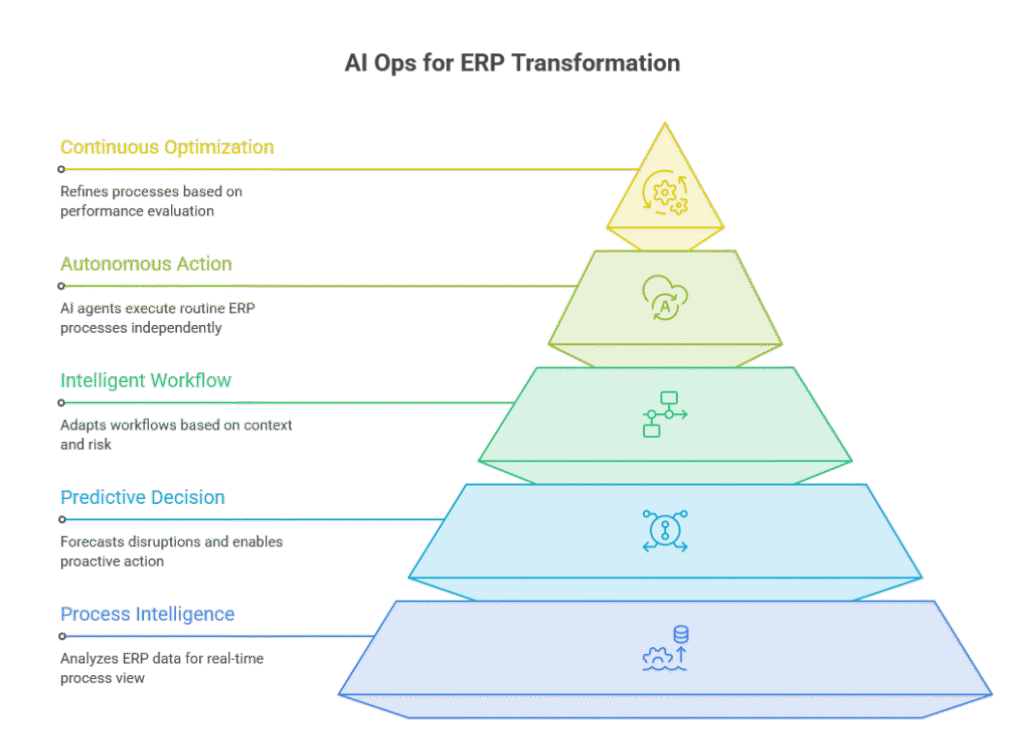
Process Intelligence Layer
Before organizations can automate processes, they need visibility into how work flows across the enterprise.
Many ERP workflows evolve, creating gaps between documented processes and real-world execution. Manual workarounds, approval bottlenecks, and process deviations often remain hidden until they impact performance.
AI-powered process intelligence analyzes ERP transactions, workflow histories, user interactions, and system events to create a real-time view of operational processes.
This visibility helps organizations identify bottlenecks, approval delays, rework loops, and inefficiencies that traditional reporting often misses. Without this foundation, automation efforts risk addressing symptoms rather than root causes.
Predictive Decision Layer
ERP systems traditionally provide historical visibility. AI Ops introduces predictive visibility.
Machine learning models can forecast
- Inventory shortages
- Supplier risks
- Payment delays
- Demand fluctuations
- Production bottlenecks
- Revenue impacts
Instead of reacting to disruptions after they occur, organizations gain the ability to act proactively. The ERP system can automatically initiate alternative sourcing workflows before production is impacted.
Intelligent Workflow Layer
Many ERP workflows still depend on static rules and predefined approval paths. While effective for standardization, they often lack the flexibility needed to respond to changing business conditions.
AI workflows introduce context-aware decision-making. Rather than treating every transaction the same way, the system evaluates factors such as transaction value, risk exposure, supplier performance, contract compliance, and business urgency.
This enables workflows to adapt dynamically. Low-risk activities can move forward automatically, while higher-risk scenarios are routed for review with AI-generated recommendations.
Autonomous Action Layer
The next stage involves autonomous execution.
AI agents integrated with ERP platforms can
- Generate purchase orders
- Schedule production runs
- Allocate inventory
- Resolve exceptions
- Trigger procurement actions
- Update records
- Coordinate supplier communications
Rather than requiring employees to manually initiate every action, AI can execute routine processes independently while escalating exceptions when human judgment is needed. This allows teams to spend less time managing operations and more time focusing on strategic priorities.
Continuous Optimization Layer
The most mature AI Ops environments do more than automate processes; they continuously improve them.
Machine learning models evaluate workflow outcomes, operational performance, exception rates, business KPIs, and user feedback to identify opportunities for optimization.
Over time, the system refines decision-making, improves process efficiency, and adapts to changing business conditions.
This creates a self-improving operational environment where ERP workflows become smarter, faster, and more effective with every cycle.
Together, these five layers transform ERP systems from transaction-processing platforms into intelligent operational ecosystems capable of driving end-to-end business outcomes.
| AI Ops Layer | Primary Purpose | What It Analyzes / Executes | Business Value |
| Process Intelligence Layer | Understand how work actually flows across ERP processes | ERP transaction logs, workflow histories, user interactions, system events, approval patterns | Identifies hidden inefficiencies, bottlenecks, process deviations, and rework loops |
| Predictive Decision Layer | Anticipate issues before they impact operations | Historical ERP data, operational trends, supplier performance, inventory levels, demand signals | Enables proactive decision-making and risk mitigation |
| Intelligent Workflow Layer | Dynamically adapt workflows based on business context | Transaction value, risk profiles, vendor history, contract compliance, business priorities | Accelerates process execution while maintaining governance |
| Autonomous Action Layer | Execute operational tasks with minimal human intervention | ERP workflows, business rules, AI recommendations, real-time operational events | Reduces manual effort and improves operational efficiency |
| Continuous Optimization Layer | Continuously improve process performance and outcomes | Workflow results, business KPIs, exception rates, user feedback, operational metrics | Creates self-improving ERP operations and sustained efficiency gains |
High-Impact ERP Processes Being Transformed by AI Ops
While AI Ops can influence nearly every ERP function, several areas are delivering particularly strong business outcomes.
Procurement and Source-to-Pay
Procurement workflows often involve multiple departments and extensive approval cycles.
AI Ops can
- Predict purchasing needs
- Recommend suppliers
- Automate sourcing decisions
- Detect contract deviations
- Accelerate approvals
- Reduce procurement cycle times
Finance and Accounts Payable
Finance teams spend significant effort on processing transactions and managing exceptions.
AI ERP operations can
- Match invoices automatically
- Detect anomalies
- Predict cash flow risks
- Recommend payment prioritization
- Reduce manual reconciliations
This enables finance professionals to focus more on strategic planning and financial analysis.
Inventory and Supply Chain Management
Inventory optimization remains one of the most complex ERP challenges.
AI Ops enables
- Dynamic inventory allocation
- Demand forecasting
- Warehouse optimization
- Replenishment automation
Organizations gain greater resilience while reducing excess inventory costs.
Manufacturing Operations
Manufacturers increasingly rely on AI ERP workflows to coordinate production activities.
Capabilities include
- Resource allocation
- Material planning
- Quality monitoring
- Maintenance forecasting
This helps improve throughput while reducing operational inefficiencies.
Customer Order Management
Customer expectations continue to increase.
AI Ops can improve order fulfillment by
- Predicting delivery risks
- Prioritizing high-value orders
- Managing inventory availability
- Coordinating logistics workflows
- Resolving fulfillment exceptions
This creates faster and more reliable customer experiences.
The Business Impact of End-to-End ERP Flows
Organizations implementing AI Ops for ERP are pursuing more than automation. They are building operational agility.
According to IBM’s Global AI Adoption Index, organizations deploying AI across operational processes report on measurable improvements in efficiency, scalability, and decision-making capabilities.
Key benefits typically include
Faster Cycle Times
AI eliminates delays between process stages. Approvals, validations, and workflow transitions occur automatically, reducing overall completion times.
Reduced Operational Costs
Manual effort decreases significantly. Employees spend less time on repetitive tasks and more time on value-generating activities.
Improved Decision Quality
AI models analyze far more variables than traditional rule-based systems. This enables more accurate and consistent decisions.
Greater Process Visibility
Real-time operational intelligence provides leadership teams with greater transparency across business functions.
Enhanced Scalability
Organizations can manage growing transaction volumes without proportional increases in staffing requirements.
Stronger Compliance
AI continuously monitors workflows for policy violations, audit risks, and process deviations.
Final Thoughts
The future of ERP is about enabling complete business processes to operate as intelligent, connected, and adaptive workflows.
AI Ops for ERP bridges the gap between fragmented automation and true operational orchestration. By combining process intelligence, predictive analytics, intelligent workflows, autonomous actions, and continuous optimization, organizations can transform complex multi-step activities into seamless end-to-end flows.
SAP’s vision of the Autonomous Enterprise, Oracle’s AI agents embedded across enterprise applications, and Microsoft’s Copilot-powered workflow automation initiatives all point toward a future where ERP systems evolve from systems of record into systems of action.
For enterprise leaders, AI Ops creates the foundation for faster decision-making, greater operational resilience, improved customer experiences, and scalable growth.
As ERP environments become increasingly intelligent, organizations that invest in AI operational models today will be better positioned to compete in a future where business processes are not merely automated; they are autonomous.
Frequently Asked Questions (FAQs)
1. What is AI Ops for ERP?
AI Ops for ERP is the application of artificial intelligence, process intelligence, workflow automation, and autonomous decision-making to ERP environments. Unlike traditional ERP automation, which focuses on individual tasks, AI Ops orchestrates entire business processes from initiation to completion, enabling faster and more intelligent operations.
2. How is AI Ops different from traditional ERP automation?
Traditional ERP automation relies on predefined rules and static workflows to automate specific tasks. AI Ops goes a step further by analyzing business context, predicting outcomes, making recommendations, and executing actions across multiple systems and departments. It transforms task automation into end-to-end process orchestration.
3. Which ERP processes can benefit the most from AI Ops?
AI Ops can deliver significant value across procurement, accounts payable, supply chain management, inventory planning, manufacturing operations, customer order management, and finance. Any process involving multiple approvals, handoffs, decisions, or exceptions is a strong candidate for AI-driven optimization.
4. Can AI Ops work with existing ERP platforms?
Yes. AI Ops is designed to augment existing ERP investments rather than replace them. Modern AI solutions can integrate with platforms such as SAP, Oracle, Microsoft Dynamics, Infor, and other enterprise systems to enhance workflow intelligence, decision-making, and process automation.
5. What are the business benefits of implementing AI Ops for ERP?
Organizations adopting AI Ops can reduce process cycle times, improve operational efficiency, increase decision accuracy, minimize manual effort, strengthen compliance, and gain greater visibility across enterprise operations. The outcome is improved business agility and a more scalable operating model.
6. Is AI Ops leading toward autonomous ERP operations?
Yes. AI Ops is a foundational step toward autonomous enterprise operations. By combining process intelligence, predictive analytics, intelligent workflows, autonomous actions, and continuous optimization, organizations can enable ERP systems to manage routine operational processes with minimal human intervention while maintaining governance and oversight.
