
From Manual Errors to <2% Error Rates in Industrial Supply Chains
In industrial equipment manufacturing, a Bill of Materials (BOM) is much more than a structured list of parts and components. It acts as the operational blueprint that connects engineering design, procurement planning, supplier coordination, inventory management, manufacturing execution, and product delivery.
Every downstream activity depends on the accuracy of this information. When a BOM contains errors, the impact extends far beyond engineering and often creates ripple effects across the entire supply chain.
A missing supplier reference, an outdated revision, or an incorrect component selection may appear to be a small issue during the design stage. However, these errors can lead to procurement delays, production downtime, inventory imbalances, compliance concerns, and unplanned cost increases.
However, leading industrial technology providers such as Siemens, Autodesk, PTC, SAP, and Oracle are accelerating the adoption of AI engineering and supply chain platforms that improve BOM accuracy, supplier collaboration, and manufacturing readiness.
Today, AI-powered BOM copilots are transforming this process.
By combining machine learning, contextual engineering intelligence, supplier data integration, and automation workflows, organizations are reducing BOM-related errors to below 2%, while accelerating procurement cycles and improving manufacturing readiness.
This blog explores how AI copilots improve BOM creation, where manual processes fail, the technologies behind intelligent BOM management, and why industrial supply chains are rapidly adopting AI engineering workflows.
How AI BOM Copilots Are Transforming Engineering and Supply Chain Workflows
A BOM copilot is an AI-powered system that helps engineering, procurement, and supply chain teams create, validate, optimize, and manage Bills of Materials (BOMs) with minimal manual intervention.
Unlike traditional BOM software that mainly stores component data, AI copilots continuously learn from historical BOMs, ERP, and PLM records, engineering drawings, procurement histories, supplier databases, and compliance requirements to improve decision-making across the product lifecycle.
Leading enterprise software companies such as Dassault Systèmes, Infor, and IBM are increasingly integrating AI intelligence into PLM, ERP, and manufacturing ecosystems to help industrial manufacturers streamline engineering and procurement workflows.
AI copilots can identify duplicate parts, detect revision mismatches, recommend approved components, and predict sourcing risks in real time by combining machine learning, contextual engineering intelligence, and supplier data integration. This reduces manual effort while improving BOM accuracy and manufacturing readiness.
In industrial equipment manufacturing, where BOMs often include thousands of electrical, mechanical, hydraulic, and electronic components, even small errors can create procurement delays and production disruptions.
AI BOM management helps manufacturers reduce BOM-related errors to below 2% while improving supply chain efficiency, sourcing visibility, and operational scalability.
Key BOM Management Challenges in Industrial Equipment Manufacturing
| Manual BOM Management Challenge | Why It Happens in Industrial Equipment Manufacturing | Supply Chain and Procurement Impact | AI BOM Copilot Benefit |
| Duplicate Components and SKU Proliferation | Different engineering teams use inconsistent naming conventions for the same component across ERP, PLM, and procurement systems. | Creates excess inventory, duplicate SKUs, procurement confusion, supplier fragmentation, and higher warehouse carrying costs. | AI-powered BOM copilots automatically identify duplicate parts, standardize component data, and recommend approved existing components. |
| Revision Mismatches Across Engineering and Procurement Systems | Engineering changes are not synchronized in real time with procurement, manufacturing, or supplier systems. | Leads to obsolete component purchases, incorrect product assemblies, production downtime, rework costs, and compliance risks. | AI BOM management systems validate revisions instantly and synchronize engineering updates across supply chain workflows. |
| Lack of Real-Time Supplier Intelligence | Traditional BOM creation processes rarely include live supplier data, sourcing risks, or component lifecycle insights. | Causes sourcing delays, material shortages, supplier dependency risks, and manufacturing schedule disruptions. | AI copilots integrate supplier intelligence, lead-time analytics, lifecycle data, and alternate sourcing recommendations directly into BOM workflows. |
| Manual Data Entry Errors in BOM Creation | Engineers manually enter quantities, units, supplier references, and compliance information across disconnected systems. | Results in procurement inaccuracies, compliance gaps, incorrect orders, inventory mismatches, and operational inefficiencies. | AI-assisted BOM validation automatically detects missing data, incorrect quantities, invalid part numbers, and documentation inconsistencies. |
| Engineering and Supply Chain Misalignment | Engineering teams prioritize design functionality, while procurement teams focus on sourcing feasibility, cost optimization, and supplier availability. | Slows decision-making, increases sourcing complexity, and reduces supply chain agility across manufacturing operations. | AI-powered BOM copilots create a unified intelligence layer connecting engineering, procurement, inventory, and supplier management teams. |
| Limited BOM Visibility Across Enterprise Systems | BOM data remains fragmented across spreadsheets, ERP systems, CAD tools, and supplier databases. | Reduces operational visibility, delays procurement decisions, and increases dependency on manual coordination. | AI BOM automation centralizes data visibility and enables real-time collaboration across engineering and supply chain operations. |
| Component Obsolescence and Lifecycle Risks | Manual BOM workflows often fail to monitor lifecycle status or future component availability. | Creates last-minute sourcing disruptions, redesign costs, and production planning challenges. | AI copilots proactively identify obsolete components and recommend validated alternatives before disruptions occur. |
How AI Copilots Reduce BOM Error Rates Below 2%
AI-powered BOM copilots are transforming BOM creation into an intelligent, real-time engineering and supply chain workflow.
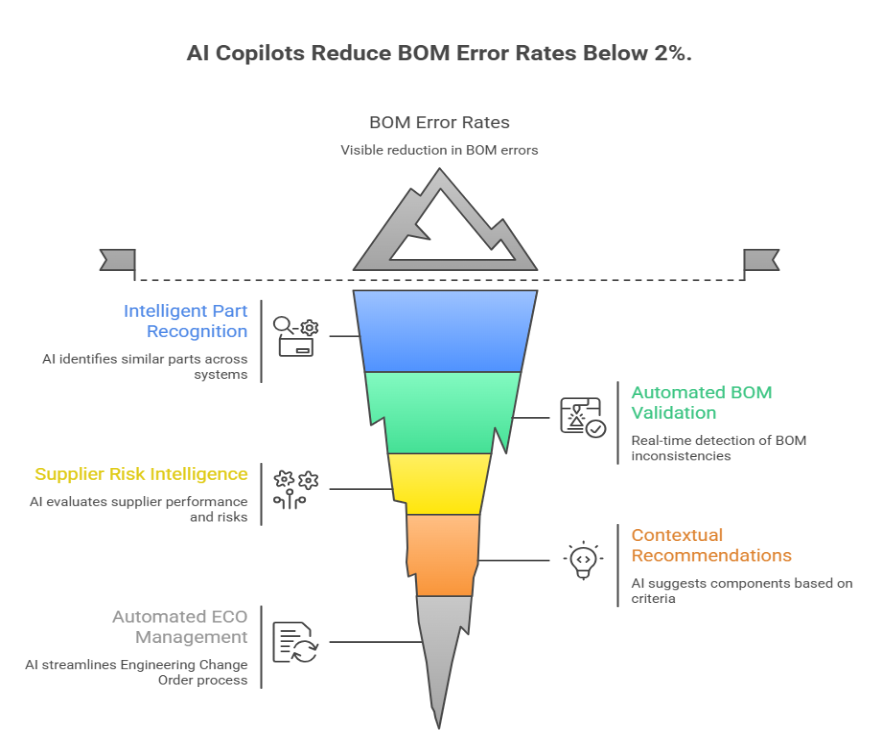
Intelligent Part Recognition and Component Standardization
AI copilots solve this by analyzing CAD files, technical drawings, legacy BOMs, supplier catalogs, and natural language engineering descriptions to identify similar or identical parts across systems.
The AI automatically recommends approved alternatives, existing inventory matches, and standardized part references, helping engineering teams avoid duplicate SKUs and inconsistent component naming.
This significantly improves inventory optimization and procurement efficiency while reducing unnecessary sourcing complexity.
Automated BOM Validation in Real Time
AI copilots shift this process upstream by continuously validating BOM structures during creation.
The system automatically detects
- Missing component attributes
- Quantity inconsistencies
- Invalid supplier mappings
- Revision conflicts
- Unit mismatches
- Compliance documentation gaps
This proactive validation reduces engineering rework, improves BOM accuracy, and minimizes downstream production disruptions.
Real-Time Supplier and Sourcing Risk Intelligence
Modern AI BOM copilots integrate directly with supplier management and procurement systems, enabling engineering teams to make sourcing-aware decisions much earlier in the product lifecycle.
Technology leaders such as Kinaxis and Blue Yonder are helping manufacturers improve supply chain visibility and predictive decision-making through AI-powered planning and supply chain orchestration platforms.
AI continuously evaluates
- Supplier lead times
- Inventory availability
- Delivery performance
- Price volatility
- Regional sourcing risks
- Component end-of-life alerts
This real-time intelligence helps manufacturers reduce procurement delays, avoid supply shortages, and improve supply chain resilience across global sourcing networks.
Contextual Component Recommendations
AI copilots provide intelligent component recommendations based on historical sourcing performance, manufacturing compatibility, approved vendor lists, sustainability goals, compliance standards, and cost optimization strategies.
Instead of manually searching through thousands of components, engineers receive contextual recommendations instantly within the BOM workflow. This accelerates decision-making while improving sourcing consistency and manufacturing readiness.
Automated Engineering Change Management
AI copilots streamline Engineering Change Order (ECO) management by automatically identifying impacted BOMs, notifying procurement teams, recommending replacement components, updating downstream systems, and flagging potential sourcing disruptions in real time.
This enables faster cross-functional coordination between engineering, procurement, and manufacturing teams while reducing the operational risks associated with revision mismatches and outdated component data.
How AI BOM Copilots Connect Engineering and Supply Chain Intelligence
| Operational Area | How AI BOM Copilots Are Used | Business Impact Across Industrial Supply Chains |
| Engineering and BOM Creation | AI automates BOM generation, validates component structures, and identifies design inconsistencies in real time. | Faster BOM creation, fewer engineering errors, improved design accuracy, and reduced manual workload. |
| Procurement and Supplier Management | AI integrates supplier intelligence, sourcing analytics, and approved vendor recommendations into BOM workflows. | Better sourcing visibility, optimized supplier selection, lower procurement delays, and improved supply chain resilience. |
| Manufacturing and Production Operations | AI synchronizes BOM revisions with manufacturing systems and production schedules. | Improved production readiness, reduced assembly errors, minimized downtime, and faster manufacturing execution. |
| Inventory and Material Planning | AI identifies duplicate parts, standardizes component data, and improves inventory visibility across systems. | Reduced excess inventory, lower warehouse costs, and improved material utilization. |
| Quality and Compliance Management | AI validates BOMs against compliance standards, approved supplier lists, and engineering requirements. | Stronger compliance readiness, improved traceability, and reduced quality risks. |
| Supply Chain Planning and Forecasting | AI analyzes procurement history, supplier performance, and sourcing trends for predictive planning. | Better forecasting accuracy, proactive risk mitigation, and improved demand planning efficiency. |
| Engineering Change Order (ECO) Management | AI tracks revision changes, impacted BOMs, and sourcing implications automatically. | Faster change management, reduced rework costs, and improved cross-functional coordination. |
| Cost Optimization and Profitability | AI recommends sourcing-efficient and cost-optimized components during BOM creation. | Improved product profitability, lower sourcing costs, and smarter operational decision-making. |
Measurable Business Impact of AI BOM Copilots in Industrial Supply Chains
Organizations adopting AI-powered BOM copilots are achieving significant improvements across engineering, procurement, inventory management, and manufacturing operations.
By automating BOM validation, supplier intelligence, and engineering change workflows, manufacturers are reducing operational inefficiencies while improving supply chain accuracy and responsiveness.
| Performance Metric | Traditional BOM Process | AI BOM Copilot Process | Operational Business Impact |
| BOM Error Rate | 10–15% error rate | Below 2% | Improved BOM accuracy, fewer production disruptions, and reduced engineering rework. |
| BOM Creation Time | Several days | Few hours | Faster product development cycles and accelerated manufacturing readiness. |
| Duplicate Component Creation | High | Significantly reduced | Lower inventory costs, improved SKU standardization, and better warehouse efficiency. |
| Supplier Validation | Manual validation workflows | Automated supplier intelligence | Faster sourcing decisions and improved procurement accuracy. |
| Engineering Change Processing | Slow and fragmented | Near real-time updates | Faster ECO management and stronger cross-functional coordination. |
| Procurement Delays | Frequent sourcing disruptions | Reduced substantially | Improved supply chain agility and manufacturing continuity. |
| Inventory Optimization | Limited visibility | AI inventory insights | Reduced excess stock and improved material planning efficiency. |
| Manufacturing Readiness | Delayed due to BOM inconsistencies | Faster production alignment | Improved operational efficiency and reduced downtime risks. |
Final Thoughts
AI-powered BOM copilots are emerging as a scalable solution by transforming BOM management into an intelligent, real-time, and supply chain-aware process.
By combining machine learning, supplier intelligence, automated validation, and predictive analytics, these systems help organizations reduce BOM-related error rates to below 2%, improve sourcing visibility, accelerate engineering workflows, and strengthen manufacturing readiness.
More importantly, AI BOM copilots create stronger alignment between engineering, procurement, inventory planning, and manufacturing operations. This enables industrial manufacturers to operate with greater speed, accuracy, resilience, and supply chain agility.
Organizations investing in AI BOM intelligence are building the foundation for smarter, more connected, and more resilient industrial supply chain ecosystems prepared for the future of intelligent manufacturing.
FAQs
1. What is an AI copilot for BOM creation?
An AI copilot for BOM creation is an intelligent system that helps engineering and supply chain teams automate, validate, and optimize Bills of Materials using machine learning, supplier intelligence, and predictive analytics.
2. How does AI reduce BOM errors in supply chains?
AI reduces BOM errors by automatically validating component data, identifying duplicates, checking supplier availability, detecting revision mismatches, and recommending approved components in real time.
3. Why is BOM accuracy important in industrial equipment manufacturing?
Accurate BOMs help manufacturers avoid procurement delays, inventory duplication, production downtime, compliance issues, and costly engineering rework.
4. Can AI copilots integrate with ERP and PLM systems?
Yes. Modern AI BOM copilots integrate with ERP, PLM, CAD, procurement, and supplier management systems to create unified engineering and supply chain workflows.
5. What industries benefit from AI-powered BOM management?
Industries with highly complex products and multi-tier supply chains benefit the most, including industrial equipment manufacturing, aerospace, automotive, electronics, automation systems, and heavy machinery production.
6. What are the business benefits of AI-assisted BOM creation?
Major benefits include lower BOM error rates, faster engineering workflows, improved supplier visibility, reduced procurement delays, lower inventory costs, and stronger manufacturing readiness.
