Controlled Knowledge Flows with GenE
Generative AI has quickly moved to enterprise adoption. Organizations across industries are deploying AI assistants, copilots, and intelligent search solutions to unlock knowledge, accelerate decision-making, and improve productivity. As adoption grows, so do concerns around security, governance, and data privacy.
Business leaders are asking difficult but necessary questions
- How do we prevent sensitive information from being exposed to unauthorized users?
- How can employees access trusted enterprise knowledge without risking data leakage?
- Can organizations benefit from Generative AI without sending proprietary data to public models?
- How do we ensure AI responses remain accurate, explainable, and compliant?
According to IBM’s Cost of a Data Breach Report, data breaches continue to cost organizations millions of dollars annually, while increasing regulatory scrutiny is forcing businesses to rethink how AI interacts with sensitive information.
At the same time, Gartner predicts that organizations will increasingly prioritize AI governance, security, and trust as key drivers of adoption over the next several years.
Secure Retrieval-Augmented Generation (Secure RAG) and Private AI enable organizations to create controlled knowledge flows, ensuring that AI systems access the right information for the right users at the right time, without compromising security or compliance.
At the center of this approach is GenE, an enterprise AI framework designed to deliver secure, context-aware, and governed AI experiences across organizational knowledge ecosystems.
This blog explores how Secure RAG and Private AI enable organizations to create controlled knowledge flows with GenE, ensuring secure access to enterprise information, trusted AI responses, governance compliance, and actionable business intelligence at scale.
Why Enterprise AI Needs More Than Large Language Models
Large Language Models (LLMs) are powerful, but they have a fundamental limitation that they do not inherently understand an organization’s internal knowledge.
Policies, contracts, engineering documents, operational procedures, research reports, customer records, and proprietary intellectual property all exist outside the model’s training data.
Without access to current enterprise information, AI systems risk generating
- Incomplete answers
- Outdated recommendations
- Hallucinated responses
- Compliance violations
- Security risks
This challenge becomes even greater in regulated industries where accuracy, traceability, and data governance are mandatory.
Organizations need AI systems that can reason using trusted enterprise knowledge while maintaining strict control over information access. This requirement has fueled the rise of Retrieval-Augmented Generation.
The Security Challenge in Enterprise Knowledge Access
| Challenge Area | The Problem | Business Impact |
| Knowledge Silos | Enterprise information is spread across multiple systems, including SharePoint repositories, ERP platforms, CRM applications, knowledge bases, document management systems, and collaboration tools. | Employees spend significant time searching for information, resulting in reduced productivity, slower decision-making, and inconsistent access to knowledge. |
| Access Control Complexity | Different users require access to different information. Finance teams may need access to financial forecasts, HR teams to employee records, and operations teams to supply chain data. | Without proper access controls, AI systems risk exposing sensitive information to unauthorized users, creating security and compliance concerns. |
| Compliance and Governance Risks | Organizations must comply with regulations and standards such as GDPR, HIPAA, SOC 2, ISO 27001, and industry-specific governance requirements. | AI-powered knowledge systems must consistently enforce security policies, maintain auditability, and ensure regulatory compliance across every interaction. |
These challenges make it clear that enterprise AI requires more than intelligent search. Organizations need a secure and governed framework that can unify knowledge access, enforce permissions, and maintain compliance.
Secure RAG addresses these requirements by ensuring that AI retrieves and delivers the right information to the right users while preserving security, privacy, and trust.
Secure RAG: The Foundation of Trusted Enterprise AI
Retrieval-Augmented Generation (RAG) enhances AI responses by retrieving relevant information from enterprise knowledge sources before generating answers.
Instead of relying solely on model training, the AI dynamically accesses current organizational content. However, standard RAG implementations are not enough for enterprise environments.
NVIDIA positions RAG as a critical framework for connecting AI models with proprietary enterprise knowledge, while AWS highlights its role in improving response quality and reducing hallucinations. However, enterprises require more than retrieval alone; they require governance.
Secure RAG extends the concept by introducing governance, security, and access control directly into the retrieval process.
With Secure RAG
- Knowledge retrieval respects user permissions
- Sensitive content remains protected
- Responses are grounded in trusted enterprise sources
- Access policies are enforced automatically
- Auditability and traceability are maintained
What Makes Private AI Different?
Private AI takes enterprise security one step further. Rather than exposing organizational knowledge to public AI environments, Private AI ensures that data, models, and workflows remain within controlled enterprise boundaries.
Deloitte’s Technology Trends research highlights growing enterprise demand for trusted AI environments that provide greater control over data, models, and governance. This trend is reflected in the investments being made by Microsoft Azure AI, Google Cloud Vertex AI, AWS Bedrock, and NVIDIA AI Enterprise, all of which support private and enterprise-controlled AI deployments.
This can include
- Private cloud deployments
- On-premises infrastructure
- Dedicated AI environments
- Secure model hosting
- Isolated vector databases
This approach is particularly valuable for industries such as
| Industry | Why Private AI Matters | Examples of Protected Information |
| Financial Services | Ensures sensitive financial data remains within controlled environments while meeting regulatory and compliance requirements. | Customer information, risk models, financial forecasts, regulatory reports, transaction data |
| Healthcare | Protects confidential patient and clinical information while supporting secure AI insights. | Patient records, treatment protocols, clinical research, diagnostic information |
| Manufacturing | Safeguards intellectual property and operational knowledge critical to competitive advantage. | Engineering designs, product specifications, production processes, quality documentation |
| Government & Public Sector | Enables secure use of AI while maintaining strict control over sensitive and classified information. | Citizen data, policy documents, classified records, public service information |
| Telecommunications | Protects operational intelligence and customer information while supporting network optimization and service delivery. | Network data, customer records, operational workflows, infrastructure information |
| Energy & Utilities | Secures critical infrastructure data and operational processes essential for service continuity. | Asset information, grid operations data, maintenance records, operational procedures |
| Life Sciences & Pharmaceuticals | Supports AI innovation while protecting highly valuable research and regulatory data. | Clinical trial data, research findings, drug development information, compliance documentation |
| Legal & Professional Services | Maintains confidentiality and client trust while enabling secure knowledge access. | Client records, legal contracts, case files, confidential advisory documents |
| Retail & Consumer Goods | Protects customer, supplier, and operational data across distributed business environments. | Customer insights, pricing strategies, supplier agreements, inventory intelligence |
Private AI enables organizations to adopt Generative AI without sacrificing data sovereignty.
Controlled Knowledge Flows with GenE
The true value of enterprise AI emerges when security, intelligence, and governance operate together.
GenE enables this through controlled knowledge flows. Instead of allowing unrestricted access to enterprise information, GenE creates a governed framework for how knowledge is discovered, retrieved, processed, and delivered.
Every interaction follows a structured intelligence workflow
Step 1: Identity-Aware Access
The system first determines who the user is. Access rights, roles, departments, and permissions are evaluated before any retrieval occurs.
Step 2: Contextual Knowledge Retrieval
Secure RAG identifies the most relevant content from approved enterprise sources. Only authorized information is retrieved.
Step 3: Policy Enforcement
Security policies are applied before information reaches the AI model.
Sensitive content can be
- Masked
- Restricted
- Redacted
- Filtered
Based on organizational requirements.
Step 4: AI-Powered Reasoning
The AI generates responses using retrieved knowledge rather than relying solely on pre-trained information. This improves accuracy and reduces hallucinations.
Step 5: Explainable Responses
Every answer can be linked back to its source. Users gain confidence in the information they receive.
Step 6: Audit and Governance
All interactions are logged for compliance, monitoring, and continuous improvement. This creates a fully governed knowledge ecosystem.
The Architecture Behind Secure Enterprise Intelligence
A Secure RAG and Private AI ecosystem typically includes several integrated layers
| Layer | Function |
| Identity Layer | User authentication and authorization |
| Governance Layer | Policy enforcement and compliance controls |
| Retrieval Layer | Secure knowledge discovery and access |
| Vector Intelligence Layer | Semantic search and contextual matching |
| AI Reasoning Layer | LLM-powered response generation |
| Audit Layer | Monitoring, traceability, and compliance reporting |
Together, these layers create an environment where AI can operate effectively without compromising enterprise security.
Cross-Industry Use Cases for Secure RAG and Private AI
As organizations scale their AI initiatives, the focus is to secure, context-aware knowledge delivery. Secure RAG and Private AI enable businesses to unlock enterprise knowledge while maintaining strict governance, security, and compliance controls. This creates opportunities to drive value across multiple business functions and industries.
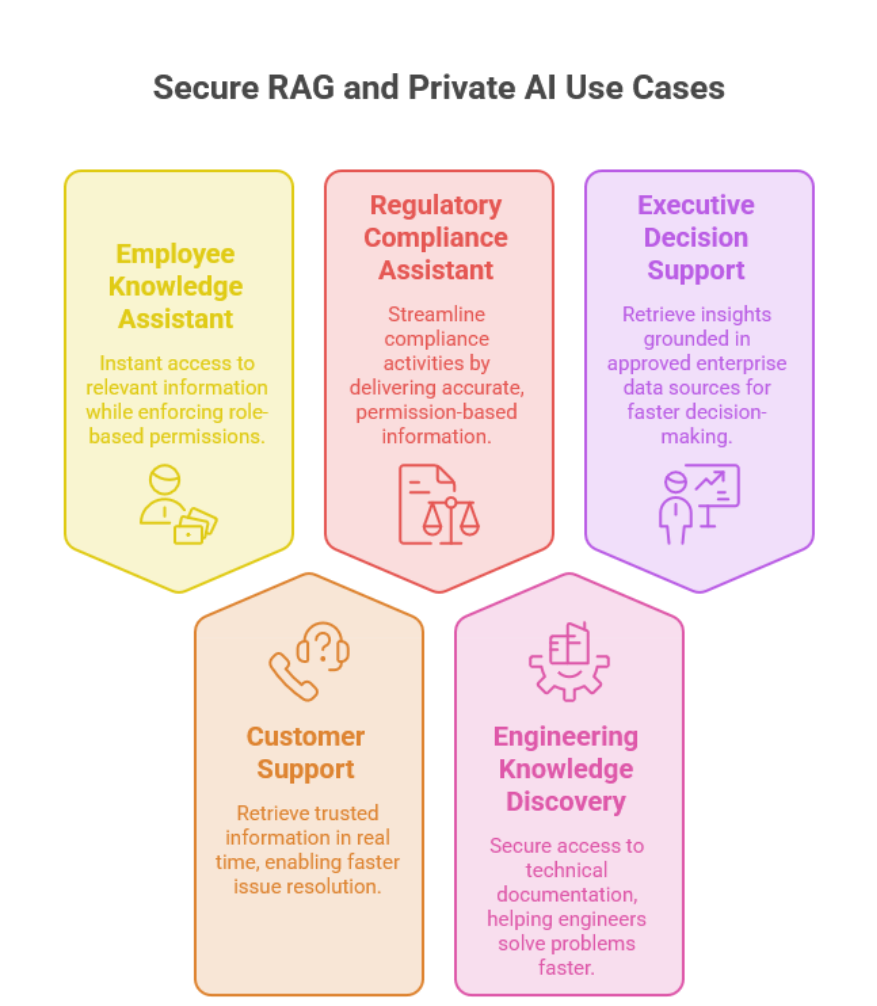
Employee Knowledge Assistant
Employees often spend considerable time searching for policies, procedures, training materials, and operational documentation spread across multiple systems.
Secure RAG enables instant access to relevant information while enforcing role-based permissions. This improves productivity, reduces dependency on subject matter experts, and helps employees make informed decisions faster.
Customer Support
Customer support teams require quick access to product documentation, troubleshooting guides, service records, and knowledge articles.
With Secure RAG and Private AI, support professionals can retrieve trusted information in real time, enabling faster issue resolution, improved service quality, and a more consistent customer experience.
Regulatory Compliance Assistant
For organizations operating in regulated environments, compliance teams need rapid access to policies, audit records, governance frameworks, and regulatory documentation.
Secure RAG helps streamline compliance activities by delivering accurate, permission-based information while maintaining auditability and adherence to organizational policies.
Engineering Knowledge Discovery
Engineering teams often work with large volumes of technical documentation, design specifications, project histories, and operational knowledge.
Private AI enables secure access to this information, helping engineers solve problems faster, reducing duplicate work, and accelerating innovation without compromising intellectual property.
Executive Decision Support
Secure RAG enables executives to retrieve insights grounded in approved enterprise data sources, providing a more complete view of business performance, operational risks, and growth opportunities. This supports faster and more confident decision-making.
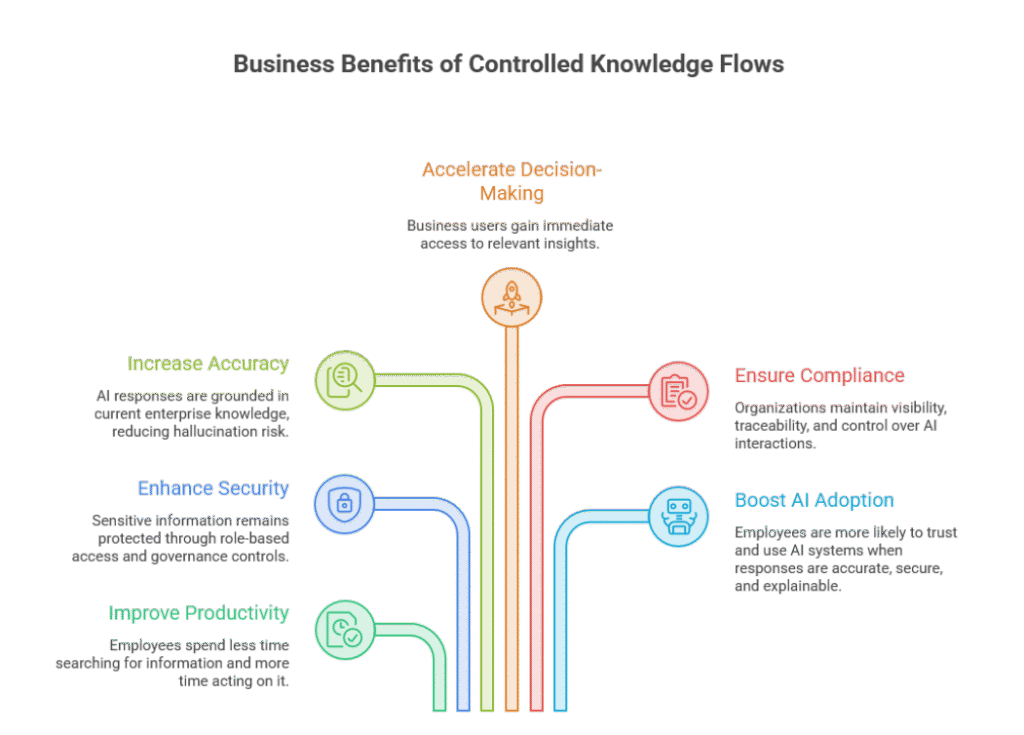
Business Benefits of Controlled Knowledge Flows
Organizations implementing Secure RAG and Private AI typically experience benefits across multiple dimensions.
Research from McKinsey’s State of AI shows that organizations successfully scaling AI are realizing measurable gains in productivity, operational efficiency, and decision-making effectiveness.
Similarly, Microsoft’s enterprise productivity research continues to demonstrate that employees spend a significant portion of their workday searching for information, creating substantial opportunities for AI knowledge retrieval and workflow acceleration.
Improved Knowledge Accessibility
Employees spend less time searching for information and more time acting on it.
Stronger Security Posture
Sensitive information remains protected through role-based access and governance controls.
Higher Response Accuracy
AI responses are grounded in current enterprise knowledge rather than static model training.
Reduced Hallucination Risk
Retrieved context improves answer reliability and trustworthiness.
Faster Decision-Making
Business users gain immediate access to relevant insights.
Enhanced Compliance
Organizations maintain visibility, traceability, and control over AI interactions.
Greater AI Adoption
Employees are more likely to trust and use AI systems when responses are accurate, secure, and explainable.
Final Thoughts
Secure RAG and Private AI represent a new model for enterprise intelligence. By combining governed retrieval, role-based access, contextual reasoning, and explainable responses, organizations can unlock the full value of Generative AI while maintaining control over their information ecosystems.
GenE enables this transformation by creating controlled knowledge flows that are secure, compliant, and intelligent by design.
In the future of enterprise AI, trust will be just as important as intelligence. Secure RAG and Private AI ensure organizations can achieve both.
Frequently Asked Questions (FAQs)
1. What is Secure RAG?
Secure RAG (Retrieval-Augmented Generation) combines AI-powered response generation with secure retrieval of enterprise knowledge while enforcing access controls, governance policies, and compliance requirements.
2. How is Secure RAG different from traditional RAG?
Traditional RAG focuses on retrieving relevant information. Secure RAG adds identity-aware access controls, data protection policies, auditability, and governance mechanisms to ensure enterprise-grade security.
3. What is Private AI?
Private AI refers to AI environments where enterprise data, models, and workflows remain within controlled infrastructure such as private clouds, dedicated environments, or on-premises deployments.
4. How does GenE support controlled knowledge flows?
GenE combines Secure RAG, role-based access controls, policy enforcement, AI reasoning, and audit capabilities to ensure knowledge is delivered securely and only to authorized users.
5. Which industries benefit most from Secure RAG and Private AI?
Financial services, healthcare, manufacturing, telecommunications, government, legal services, and any industry handling sensitive or regulated information can benefit significantly.
6. What are the key business benefits of Secure RAG?
Secure RAG improves knowledge accessibility, strengthens data security, reduces hallucinations, accelerates decision-making, enhances compliance, and increases trust in enterprise AI systems.
