
How AI Reinventing OTM Operations
Digital transformation initiatives in logistics often focus on route optimization, freight visibility, and transportation planning.
Industry leaders such as DHL have identified digitalization and intelligent automation as critical enablers of operational efficiency, while research from McKinsey & Company highlights that next-generation supply chains will increasingly depend on AI to improve agility, decision-making, and execution.
Before a carrier can participate in planning and execution, transportation teams must interpret contracts, configure rates, establish service providers, map lanes, define accessorials, and build transportation strategies. These activities are often performed manually across multiple systems and stakeholders, turning what should be a strategic growth enabler into a lengthy operational exercise.
Artificial Intelligence is emerging as the catalyst for that transformation, enabling transportation organizations to convert carrier agreements into OTM-ready configurations and operational strategies at unprecedented speed.
This blog examines how AI is transforming Transportation Strategy Setup in Oracle Transportation Management, enabling faster carrier onboarding, automated configuration, improved operational agility, and a more scalable approach to transportation network growth.
The Missing Link Between Transportation Growth and Execution
Organizations frequently invest in transportation optimization technologies to improve efficiency and reduce freight costs. However, the effectiveness of these initiatives depends on how quickly new carriers can be integrated into the network.
According to research from Gartner, organizations increasingly recognize that operational agility depends not only on planning capabilities but also on the speed at which supply chain ecosystems can adapt to changing business conditions. Carrier onboarding directly impacts that adaptability.
Slow onboarding cycles can delay capacity expansion, limit routing flexibility, and reduce responsiveness to changing business needs.
The underlying issue is configuration complexity. Transportation teams must interpret carrier requirements and translate them into operational strategies before value can be realized.
As a result, carrier onboarding is emerging as a critical focus area for organizations seeking to modernize OTM operations and build more adaptive transportation networks.
How AI Automates Carrier Onboarding in Oracle Transportation Management
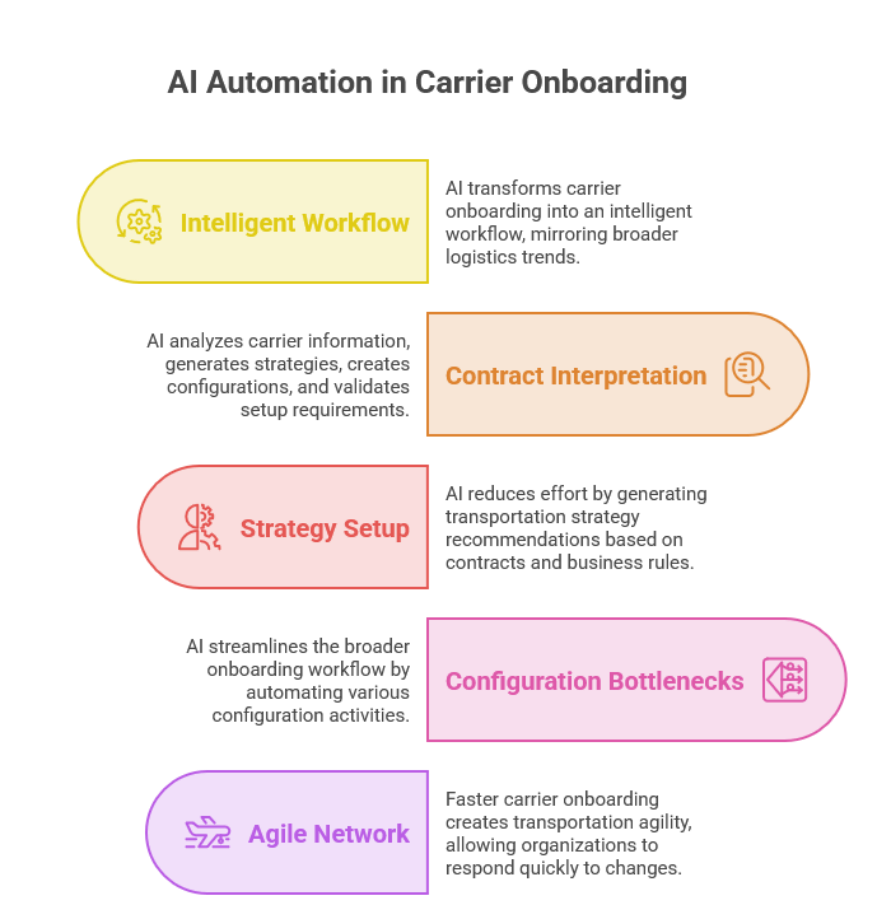
AI is changing carrier onboarding into an intelligent workflow. This shift mirrors broader logistics trends identified by IBM and DHL, which highlight AI’s ability to transform document-intensive processes into automated decision-driven workflows.
Rather than relying on transportation analysts to manually interpret contracts and build configurations, AI can analyze carrier information, generate transportation strategies, create OTM-ready configurations, and validate setup requirements in a fraction of the time.
Organizations can move from weeks-long implementation cycles to onboarding experiences measured in minutes or hours.
From Carrier Contracts to Transportation Strategies Automatically
One of the most time-consuming aspects of onboarding is translating carrier contracts into operational rules.
Transportation teams must interpret
- Rates and tariffs
- Service commitments
- Geographic coverage
- Capacity agreements
- Accessorial charges
- Contractual restrictions
According to KPMG, contract interpretation and document-heavy workflows remain among the highest-value opportunities for Generative AI adoption across enterprise operations.
AI-powered document intelligence can automatically extract these elements and convert them into structured transportation data. Rather than spending days reviewing contracts, transportation teams receive onboarding-ready outputs that can be validated and deployed quickly.
Accelerating Transportation Strategy Setup in Oracle Transportation Management
The Transportation Strategy Setup represents the operational brain of OTM.
It determines
- Carrier selection priorities
- Cost versus service trade-offs
- Lane-specific execution rules
- Capacity allocation models
- Routing preferences
- Shipment planning behavior
Traditionally, configuring these strategies requires significant transportation expertise and extensive system knowledge.
This challenge aligns with observations from Oracle, which emphasizes that transportation execution quality depends heavily on how accurately transportation policies and planning strategies are configured within OTM environments.
AI dramatically reduces this effort by generating transportation strategy recommendations based on carrier contracts, historical transportation patterns, and organizational business rules.
Eliminating Configuration Bottlenecks Across OTM Operations
Research from Accenture suggests that organizations leveraging AI automation achieve significantly greater operational scalability because intelligent systems can manage repetitive configuration activities without proportional increases in labor.
Beyond strategy creation, AI can streamline the broader onboarding workflow by automating
Service Provider Creation
Automatically create carrier profiles and associated operational attributes.
Rate Offering and Rate Record Setup
Generating OTM-compatible rate structures directly from carrier agreements.
Lane and Network Configuration
Mapping transportation networks without extensive manual intervention.
Accessorial Management
Identify and configure applicable charges automatically.
Validation and Exception Detection
Flagging inconsistencies before configurations reach production environments.
This reduces both onboarding time and configuration errors.
Building a More Agile Transportation Network
Faster carrier onboarding creates transportation agility.
Organizations can
- Expand transportation capacity rapidly
- Respond faster to disruptions
- Activate alternate carriers when needed
- Support mergers, acquisitions, and geographic expansion
- Adapt transportation strategies continuously
In volatile logistics environments, the ability to operationalize new carriers quickly becomes a competitive advantage.
Why AI Matters Most for Large and Complex Transportation Networks
The larger the transportation network, the greater the onboarding challenge. McKinsey estimates that AI supply chain transformations generate the greatest value in environments characterized by high operational complexity, large data volumes, and multiple decision variables.
This is particularly relevant for enterprises managing
- Hundreds of carrier relationships
- Thousands of transportation lanes
- Multiple transportation modes
- Diverse regulatory requirements
- Complex contract structures
Manual onboarding approaches struggle to keep pace with this scale. AI enables transportation organizations to manage complexity without a proportional increase in operational resources.
Instead of adding more administrators and configuration specialists, organizations leverage intelligent automation to scale transportation operations efficiently.
Final Thoughts
Carrier onboarding has been one of the most critical foundations of transportation execution.
As logistics networks become more dynamic, organizations can no longer afford onboarding cycles measured in weeks. The ability to rapidly configure carriers, establish transportation strategies, and operationalize network changes has become a key requirement.
AI is helping transportation teams transform contracts into actionable transportation intelligence, automating the Transportation Strategy Setup, and accelerating deployment within Oracle Transportation Management.
The organizations that adopt AI onboarding will build more responsive, scalable, and resilient transportation networks.
Frequently Asked Questions (FAQs)
What is carrier onboarding in Oracle Transportation Management (OTM)?
Carrier onboarding in OTM involves configuring carriers, rates, transportation strategies, lane assignments, service levels, and operational rules so carriers can participate in transportation planning and execution processes.
Why does carrier onboarding often take weeks?
Traditional onboarding requires manual contract interpretation, configuration setup, transportation strategy creation, validation, testing, and approval workflows, creating significant delays.
How does AI improve carrier onboarding?
AI automates document analysis, extracts carrier information, generates transportation configurations, recommends transportation strategies, and validates setup requirements, significantly reducing onboarding time.
What is the Transportation Strategy Setup in OTM?
The Transportation Strategy Setup defines how OTM selects carriers, optimizes transportation plans, manages capacity, and balances service levels with transportation costs.
Can AI reduce configuration errors in OTM?
Yes. AI can apply standardized business rules, validate configurations against policies, and identify inconsistencies before deployment, reducing manual errors.
What business benefits can organizations expect from AI-powered carrier onboarding?
Key benefits include faster carrier activation, reduced operational effort, improved transportation agility, higher data quality, faster network expansion, and better utilization of OTM capabilities.
Is AI replacing transportation planners and OTM analysts?
No. AI augments transportation professionals by automating repetitive configuration activities while allowing experts to focus on decision-making, optimization, and strategic transportation management.
