Enterprises today are increasingly focused on AI that executes reliably within real business workflows. As organizations adopt AI across functions, the emphasis has shifted toward solutions that integrate smoothly with existing systems, roles, and operational processes.
This shift has brought greater attention to enterprise AI solutions that enhance how teams already work. Rather than operating in isolation, AI is expected to support customer engagement, workforce development, operational efficiency, and quality processes in a way that is consistent, governed, and scalable. When AI aligns with day-to-day execution, it strengthens decision-making and improves outcomes without disrupting established practices.
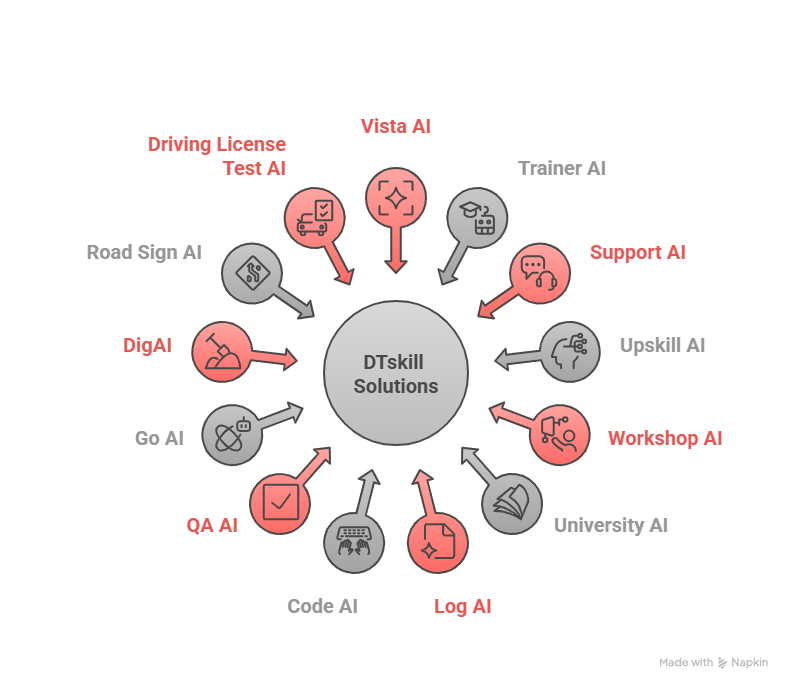
GenE supports this execution-focused approach by structuring AI around practical business use cases. Its enterprise AI solutions are designed to work alongside existing workflows, enabling organizations to apply AI where it adds clarity, consistency, and efficiency. In this blog, we outline DTskill’s 13 enterprise AI solutions and explain how businesses use them to enhance operations across industries and functions.
How DTskill’s GenE Structures Enterprise AI Solutions
GenE structures enterprise AI solutions around execution by aligning AI directly with business workflows, users, and operational processes. This approach ensures AI enhances how work is performed across the enterprise.
GenE’s structure is based on four core principles:
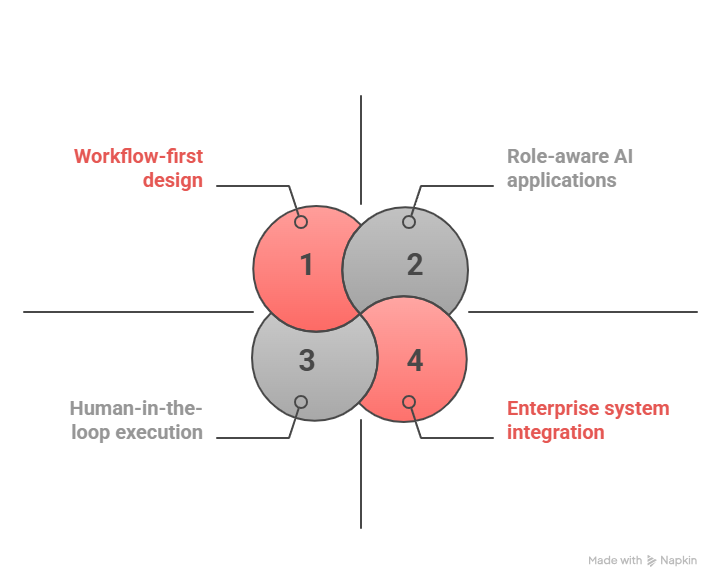
- Workflow-first design
AI is embedded into existing processes, so insights and guidance appear at the point of action. - Role-aware AI usage
Solutions support different enterprise roles, such as agents, supervisors, and managers, based on how they interact with workflows. - Human-in-the-loop execution
AI provides recommendations and guidance while decisions remain with enterprise teams. - Enterprise system integration
Solutions integrate with core business systems to support consistent execution across functions.
This structure allows enterprises to apply AI in a controlled, repeatable way that strengthens execution without disrupting established practices.
The Four Enterprise Solution Categories
DTskill’s enterprise AI solutions are designed to enhance execution across different business and institutional functions. To make adoption and usage clearer, these solutions can be grouped into four categories based on how organizations apply AI in practice.
| Enterprise AI Orchestration & Process IntelligenceGenE and Go AIThese solutions provide the foundation for applying AI across workflows, systems, and decisions by enabling orchestration, integration, and automated execution at scale. | Customer Experience & Support IntelligenceVista AI, Trainer AI, Support AIThese solutions enhance how customer interactions are handled by supporting agents with guidance, simulations, and operational intelligence across support workflows. |
| Workforce Learning & Institutional EnablementUpskill AI, Workshop AI, University AIThese solutions apply AI to skill development, training delivery, and learning environments across enterprises and educational institutions. | Operations, Engineering & Domain-Specific ExecutionLog AI, QA AI, Code AI, DigAI, Road Sign AI, Driving License Test AIThese solutions enhance operational workflows, engineering productivity, quality processes, and specialized domain or public infrastructure use cases. |
Dtskill’s Enterprise AI Solutions and How Businesses Use Them
- Vista AI
AI-powered agent training and performance simulation
Customer-facing teams handle complex conversations across channels, roles, and scenarios. Ensuring agents respond consistently requires structured practice, realistic simulations, and measurable feedback. Traditional training content alone cannot reflect real customer emotions, edge cases, or live interaction pressure. Vista AI addresses this by enabling scenario-based training that mirrors real conversations. This helps organizations improve readiness, quality, and consistency across customer interactions.
How Businesses Use This AI in Practice
- Simulate realistic customer conversations across voice, chat, and email
- Train agents on tone, empathy, compliance, and response accuracy
- Deliver instant performance feedback and structured evaluation scorecards
- Analyze behavioral trends to guide coaching and certification programs
Where It Fits in the Enterprise
- Functions: Sales, service, customer support
- Users: Agents, trainers, QA managers
- Systems: LMS, QA tools, knowledge bases
- Trainer AI
AI-powered coaching and conversation simulation engine
Scaling hands-on coaching across large or distributed teams requires consistent scenarios and feedback. Live coaching sessions are difficult to standardize across roles, regions, and shifts. Trainer AI enables learning through practice by simulating customer conversations that adapt to trainee responses. This allows organizations to reinforce skills continuously while maintaining consistency in training outcomes.
How Businesses Use This AI in Practice
- Run AI-driven roleplay simulations for sales and support teams
- Adapt conversation paths dynamically based on trainee responses
- Provide real-time feedback on tone, accuracy, and empathy
- Enable self-paced training without reliance on live trainers
Where It Fits in the Enterprise
- Functions: Sales enablement, support enablement
- Users: Trainees, trainers, supervisors
- Systems: CRM, LMS, SOP repositories
- Support AI
AI-powered ticket classification and resolution
Support teams manage high ticket volumes across email, chat, and helpdesk systems. Ensuring tickets are categorized, prioritized, and routed correctly requires structured analysis and consistent rules. Manual handling slows response times and affects resolution accuracy. Support AI enhances ticket workflows by applying intelligent classification and routing aligned with service priorities.
How Businesses Use This AI in Practice
- Classify incoming tickets using AI-powered language understanding
- Prioritize tickets based on SLAs, urgency, and business rules
- Route repetitive issues to automated workflows or knowledge responses
- Learn from resolution outcomes to improve future routing accuracy
Where It Fits in the Enterprise
- Functions: Customer support, IT support
- Users: Support agents, operations managers
- Systems: Helpdesk platforms, CRM, email, chat
- Upskill AI
AI-led skill assessment and personalized learning guidance
Organizations need visibility into workforce skills and learning progress across roles. Generic training programs often fail to address individual or role-specific gaps. Upskill AI interprets assessments, learner behavior, and feedback to identify precise skill needs. This allows enterprises to deliver targeted learning journeys aligned with both career growth and business goals.
How Businesses Use This AI in Practice
- Assess workforce skills using performance data and learning signals
- Identify role-specific skill gaps across teams and departments
- Build personalized learning paths aligned to business objectives
- Track skill progression and measurable workforce capability improvements
Where It Fits in the Enterprise
- Functions: HR, L&D, workforce transformation
- Users: Employees, managers, L&D teams
- Systems: LMS, HRMS, learning repositories
- Workshop AI
AI-enabled hands-on training and workshop delivery
Delivering interactive, hands-on workshops at scale requires significant coordination and instructor effort. Ensuring consistent experience across locations and domains is challenging. Workshop AI enables real-time, simulation-driven workshops that mirror real job tasks. This allows organizations to scale experiential learning while maintaining consistency and engagement.
How Businesses Use This AI in Practice
- Deliver real-time workshops with AI-driven prompts and simulations
- Simulate job-specific scenarios across technical and functional domains
- Customize workshop flows for industry-specific training needs
- Scale workshops without increasing instructor or resource requirements
Where It Fits in the Enterprise
- Functions: Training, onboarding, technical enablement
- Users: Learners, trainers, institutions
- Systems: LMS, training platforms
- University AI
AI-powered learning and institutional enablement platform
Academic institutions manage teaching, learning, assessment, and administration across multiple systems. Delivering personalized education while maintaining operational efficiency requires coordinated support. University AI brings AI into learning, faculty workflows, student support, and administration. This enables institutions to enhance educational delivery while working within existing academic structures.
How Businesses Use This AI in Practice
- Personalize learning paths and study plans for students
- Support faculty with curriculum design and evaluation assistance
- Automate routine student support and academic administration workflows
- Generate analytics for engagement, performance, and outcome tracking
Where It Fits in the Enterprise
- Functions: Education, academic administration
- Users: Students, faculty, administrators
- Systems: LMS, SIS, ERP
- Log AI
AI-driven log interpretation and automation
IT teams analyze large volumes of logs to identify anomalies and incidents. Manual log review slows troubleshooting and root-cause analysis. Log AI applies intelligent interpretation to log streams across environments. This enables faster insights and automated responses without disrupting existing monitoring practices.
How Businesses Use This AI in Practice
- Ingest and analyze logs from applications and infrastructure
- Detect anomalies and correlations across high-volume log data
- Trigger automated remediation or escalation workflows
- Support compliance audits through structured historical log analysis
Where It Fits in the Enterprise
- Functions: IT operations, security
- Users: IT teams, operations engineers
- Systems: Monitoring, ITSM, log platforms
- Code AI
AI-powered code generation and refactoring
Software teams spend significant time on repetitive coding and refactoring tasks. Maintaining consistency with internal standards requires continuous review. Code AI assists developers by generating, optimizing, and documenting code aligned with existing repositories. This enhances productivity while preserving established development practices.
How Businesses Use This AI in Practice
- Generate production-ready code from natural language instructions
- Refactor existing codebases for performance and maintainability
- Automate inline documentation and technical comments
- Validate outputs using testing and linting workflows
Where It Fits in the Enterprise
- Functions: Software engineering
- Users: Developers, architects
- Systems: IDEs, repositories, CI/CD pipelines
- QA AI
Intelligent QA automation and issue detection
Quality assurance teams manage complex testing cycles across evolving applications. Translating requirements into comprehensive test coverage is time-intensive. QA AI automates requirement interpretation, test generation, and execution. This helps teams improve consistency, coverage, and delivery timelines.
How Businesses Use This AI in Practice
- Extract testing requirements from specifications and user stories
- Generate structured test plans and detailed test cases
- Identify test cases suitable for automation
- Execute automated test suites across environments
Where It Fits in the Enterprise
- Functions: Quality assurance, DevOps
- Users: QA teams, testers
- Systems: QA tools, CI/CD pipelines
- Go AI
AI for process intelligence and decision automation
Organizations require visibility into process performance and decision bottlenecks. Manual analysis slows response to changing conditions. Go AI embeds intelligence directly into workflows to support timely decisions. This allows enterprises to enhance operational efficiency through data-driven execution.
How Businesses Use This AI in Practice
- Analyze workflows to identify inefficiencies and bottlenecks
- Generate actionable recommendations for process improvement
- Automate approved decisions across connected enterprise systems
- Continuously optimize processes based on execution outcomes
Where It Fits in the Enterprise
- Functions: Operations, finance, HR, supply chain
- Users: Managers, process owners
- Systems: ERP, CRM, operational tools
- DigAI
AI-powered underground utility identification and automation
Infrastructure projects require accurate identification of underground utilities to ensure safety and compliance. Fragmented data and manual coordination increase operational risk. DigAI applies AI to map, validate, and coordinate underground asset information. This supports safer excavation and streamlined utility workflows.
How Businesses Use This AI in Practice
- Identify and map underground utility assets accurately
- Integrate with national utility coordination systems
- Automate work orders and field crew dispatch
- Support safety compliance and excavation planning workflows
Where It Fits in the Enterprise
- Functions: Infrastructure, utilities
- Users: Field teams, planners, regulators
- Systems: GIS, asset management tools
- Road Sign AI
AI-powered road sign learning and assessment
Drivers and learners need effective ways to understand road signs and safety rules. Static learning materials often limit engagement and retention. Road Sign AI provides adaptive, interactive learning aligned with official standards. This helps improve knowledge retention and test readiness.
How Businesses Use This AI in Practice
- Deliver adaptive quizzes aligned to official road standards
- Reinforce learning through interactive flashcards and simulations
- Track learner progress and knowledge retention
- Support refresher training for safer driving practices
Where It Fits in the Enterprise
- Functions: Transportation, education
- Users: Learners, drivers
- Systems: Mobile applications
- Driving License Test AI
AI-powered driver testing and licensing support
Licensing authorities manage large volumes of driver testing and evaluations. Ensuring fairness, consistency, and accessibility requires scalable systems. Driving License Test AI supports structured preparation, simulation, and evaluation aligned with regulations. This enhances licensing processes while maintaining compliance.
How Businesses Use This AI in Practice
- Provide theory and practical driving test simulations
- Automate evaluation aligned with licensing regulations
- Support scalable testing across regions and populations
- Improve accessibility for learners and institutions
Where It Fits in the Enterprise
- Functions: Transportation, public services
- Users: Learners, authorities, driving schools
- Systems: Licensing and testing platforms
How Enterprises Combine Multiple AI Solutions in Practice
Enterprises apply AI most effectively when solutions are connected across related workflows rather than deployed in isolation. Training, support, operations, and decision-making are interdependent, and AI delivers greater value when it supports these relationships. By aligning multiple AI solutions to how work flows across teams, organizations enhance execution without changing established processes.
This connected approach allows learning, performance, and operations to reinforce each other. Insights generated in one area inform actions in another, creating continuity across the enterprise. As a result, AI supports consistency, scalability, and real-world execution while remaining embedded within existing systems and roles.
Common ways enterprises combine multiple AI solutions include:
- Agent readiness and live support
Vista AI + Trainer AI + Support AI
Training simulations prepare agents, coaching reinforces behavior, and support intelligence guides real-time ticket handling. - Workforce transformation at scale
Upskill AI + Workshop AI + University AI
Skill assessments inform personalized learning paths, workshops provide hands-on practice, and institutional platforms manage delivery and evaluation. - Operational reliability and quality
Go AI + Log AI + QA AI
Process intelligence identifies issues, log analysis surfaces anomalies, and quality automation ensures consistent execution. - Engineering productivity and delivery
Code AI + QA AI + Log AI
Code generation accelerates development, QA automation validates releases, and log intelligence supports post-deployment monitoring. - Public infrastructure and compliance workflows
DigAI + Road Sign AI + Driving License Test AI
Domain-specific AI supports infrastructure safety, learning, assessment, and regulated operational workflows.
How Businesses Choose the Right Enterprise AI Solutions
Choosing enterprise AI solutions starts with clarity on where AI can add the most value within existing workflows. Rather than focusing on isolated capabilities, organizations benefit from identifying processes where intelligence, guidance, or automation can enhance consistency and execution.
Effective selection also considers how AI aligns with people, systems, and scale. Solutions that integrate smoothly with current tools and support defined roles are easier to adopt and sustain over time.
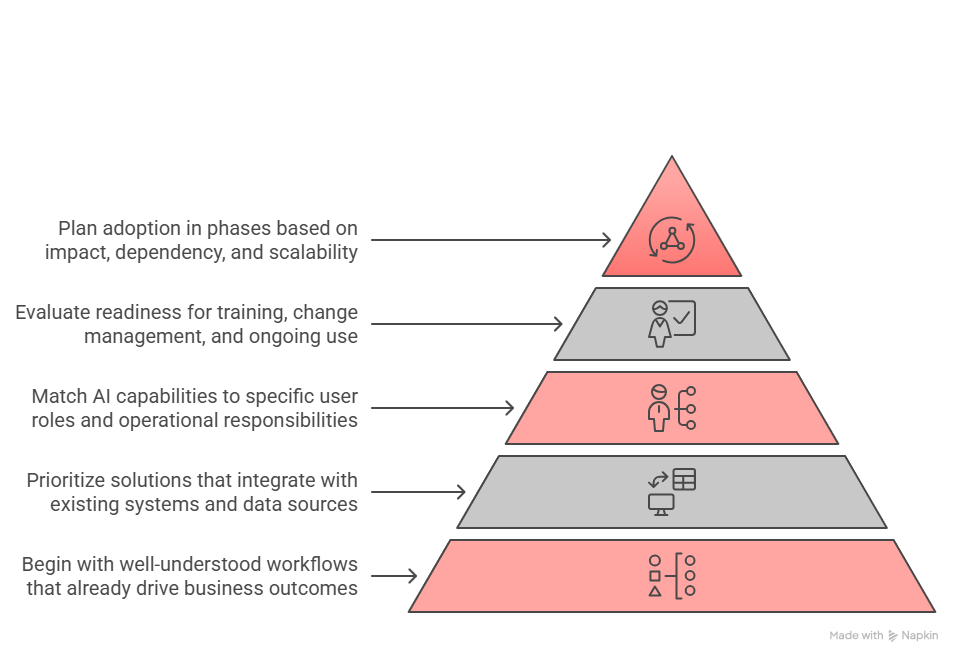
- Begin with well-understood workflows that already drive business outcomes
- Prioritize solutions that integrate with existing systems and data sources
- Match AI capabilities to specific user roles and operational responsibilities
- Evaluate readiness for training, change management, and ongoing use
- Plan adoption in phases based on impact, dependency, and scalability
When enterprise AI solutions are chosen with this structured approach, adoption becomes more predictable and manageable. This helps organizations apply AI progressively, strengthening execution while maintaining alignment with business goals.
Key Takeaways
- Enterprise AI solutions deliver the most value when aligned to real workflows
- AI is most effective when embedded into existing systems and roles
- Use-case-led solutions support consistency, scalability, and execution
- Combining multiple AI solutions strengthens learning, operations, and decision-making
- A structured adoption approach enables enterprises to scale AI confidently
Conclusion
Enterprise AI is increasingly defined by how effectively it supports execution across business functions. When AI is applied through clearly defined solutions that align with workflows, systems, and people, it enhances consistency, efficiency, and decision-making without disrupting established practices.
DTskill’s enterprise AI solutions reflect this execution-focused approach by addressing specific use cases across customer support, workforce enablement, operations, and domain-specific environments. By adopting AI in a structured and connected way, organizations can apply intelligence where it matters most and build a foundation for sustainable, scalable AI adoption.
