
AI in customer service is transforming how organizations engage with customers, enabling faster, more accurate, and increasingly personalized support at scale. When applied thoughtfully, AI adds a human-like layer to service interactions, helping teams respond with greater empathy, relevance, and consistency. Customers feel heard and valued, even as service operations handle growing volumes and complexity.
Salesforce research consistently shows that customer demands are increasing, while service teams face mounting pressure to respond more quickly with fewer resources. Many customers already feel interactions are rushed, yet service leaders report that expectations for a personal, high-touch experience have never been higher. This tension between speed and personalization is now one of the defining challenges in customer service.
AI in customer service helps organizations resolve that challenge. By augmenting service teams with intelligent automation, prioritization, and real-time insights, AI enables companies to meet increasing expectations without scaling costs linearly.
This blog breaks down 15 high-impact AI customer service use cases that forward-looking leaders should understand, going far beyond chatbots to demonstrate how AI is transforming service operations end-to-end.
How AI is Reshaping Customer Service Operations
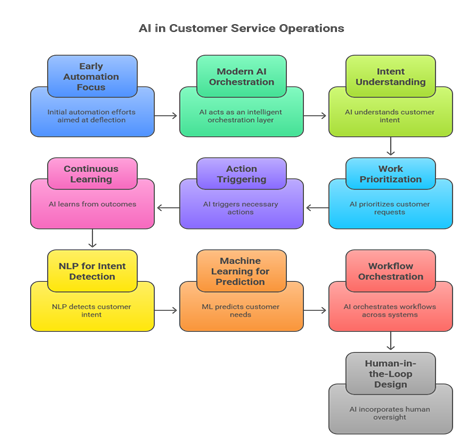
Early customer service automation focused on deflection: FAQs, IVRs, and basic bots designed to reduce ticket volume. Modern AI, however, operates at a different level.
Today’s AI customer service platforms act as an intelligent orchestration layer across systems, workflows, and teams. They understand intent, prioritize work, trigger actions, and continuously learn from outcomes.
Core capabilities behind advanced AI customer service use cases include:
- Natural Language Processing (NLP) for intent and sentiment detection
- Machine learning for classification, prediction, and prioritization
- Workflow orchestration across CRM, helpdesk, email, chat, and call centers
- Human-in-the-loop design for governed automation
The 15 Most Impactful AI Customer Service Use Cases
1. AI-Powered Ticket Classification and Resolution
One of the most foundational and high-ROI AI customer service use cases is automating how tickets are classified, prioritized, and resolved.
Instead of agents manually reading and tagging tickets, AI uses NLP to understand the issue, urgency, and business impact the moment a request enters the system.
DTskill Support AI leverages GenE’s orchestration layer to:
- Connect with CRM, helpdesk platforms, email, chat, and call center systems in real time
- Classify tickets by issue type, urgency, and customer impact using NLP
- Prioritize tickets based on SLAs, customer tiers, and severity
- Trigger automated resolutions for repeatable issues or route complex cases to agents
- Learn continuously from resolution outcomes to improve accuracy
Business impact
- Faster response and acknowledgment times
- Higher first-contact resolution (FCR)
- Reduced misrouting and SLA breaches
- Scalable support without linear headcount growth
- Increased agent productivity and focus
2. Intelligent Ticket Routing to the Right Agent or Team
Beyond classification, AI ensures tickets reach the best possible resolver, not just the next available one.
AI routing engines consider
- Agent skills and certifications
- Historical resolution success
- Current workload and availability
- Customer priority and sentiment
This reduces handoffs, resolution delays, and customer frustration.
3. Automated First Contact Resolution for Repetitive Issues
A large percentage of support tickets are repetitive
- Password resets
- Billing queries
- Order status updates
- Common configuration issues
AI identifies these patterns and resolves them instantly using automation workflows or contextual knowledge responses.
Unlike traditional macros, AI continuously refines which issues qualify for automation based on outcomes.
Impact
Reduced ticket backlog and immediate value without compromising quality.
4. AI Chatbots for Tier-1 and Tier-2 Support
Chatbots remain one of the most visible AI customer service use cases, but leaders should think of them as entry points, not end solutions.
Effective AI chatbots
- Handle FAQs, account queries, and transactional requests
- Operate consistently across web, mobile, and messaging apps
- Seamlessly escalate to human agents when complexity or emotion increases
Impact
24/7 availability, reduced agent load, and consistent customer experiences across channels.
5. AI-Powered Knowledge Base Search and Answer Generation
Maintaining an accurate knowledge base is a chronic challenge.
AI solves this by
- Analyzing resolved tickets and conversations
- Identifying repeat questions and solutions
- Automatically generating or updating knowledge articles
This keeps self-service content aligned with real customer needs.
6. Sentiment Analysis to Detect Frustration and Escalation Risk
Not all tickets are equal, even if they appear similar.
AI sentiment analysis detects:
- Frustration, urgency, or dissatisfaction
- Escalation risk in real time
- Emotionally sensitive interactions that require senior agents
When frustration or dissatisfaction is detected, the system can escalate the case proactively.
Impact
Reduced churn, improved CSAT, and had fewer public escalations.
7. SLA Monitoring and Predictive Breach Prevention
Most teams track SLA breaches after they occur. AI changes that.
By analyzing historical patterns and real-time queues, AI can:
- Predict which tickets are at risk of breaching SLAs
- Dynamically reprioritize workloads
- Alert supervisors before issues escalate
Impact
Consistent SLA compliance and improved trust with enterprise customers.
8. AI-Assisted Agent Copilot for Faster Resolutions
AI copilots work alongside agents in real time.
They
- Suggest responses based on similar resolved cases
- Surface relevant knowledge articles automatically
- Provide step-by-step resolution guidance
This dramatically reduces training time for new agents and improves consistency across teams.
9. Voice AI for Call Center Transcription and Intent Detection
Call centers generate enormous amounts of unstructured data.
AI converts voice interactions into actionable insights by:
- Transcribing calls in real time
- Identifying customer intent and sentiment
- Generating call summaries and follow-up actions
10. AI Root Cause Analysis for Recurring Issues
AI excels at pattern recognition across large datasets.
By analyzing ticket history, AI identifies:
- Recurrent product defects
- Process breakdowns
- Training gaps
These insights feed directly into product, engineering, and operations teams.
Impact
Fewer future tickets and continuous service improvement.
11. Proactive Customer Support Using Predictive AI
By analyzing historical trends, system performance, and usage patterns, AI can anticipate potential issues, including outages, configuration errors, and anomalous behavior, before they impact the customer.
Support teams are empowered to intervene preemptively, minimizing disruptions and reinforcing customer confidence.
Impact
Enhanced trust, reduced inbound ticket volumes, and a differentiated, anticipatory service experience.
12. AI for Multilingual Customer Support at Scale
Global organizations face mounting costs and complexity in delivering consistent multilingual support.
AI enables
- Real-time translation
- Consistent responses across regions
- Centralized support models without local language silos
Impact
Seamless global scalability and consistent customer experiences across languages and regions.
13. AI CSAT and Customer Effort Analysis
Customer feedback is often unstructured and underutilized.
AI analyzes surveys, reviews, and conversations to:
- Identify drivers of satisfaction and dissatisfaction
- Correlate support interactions with churn or retention
14. AI-Powered Support Analytics and Executive Dashboards
AI transforms raw support data into strategic intelligence. Executives gain visibility into predictive trends, channel-specific performance, and root causes of recurring issues.
By converting operational data into actionable insights, AI elevates customer service from routine reporting to strategic planning, enabling leadership to make informed, proactive decisions.
Impact
Clear, actionable intelligence for decision-making, forecasting, and service optimization at the enterprise level.
15. Continuous Learning Support Systems that Improve Over Time
The most important AI customer service use case is learning itself.
Modern AI systems:
- Capture outcomes from every resolution
- Refine classification, routing, and automation
- Improve accuracy continuously
| AI Customer Service Use Case | What the Use Case Delivers | Role of Support AI |
| AI-Powered Ticket Classification & Resolution | Automatically categorizes, prioritizes, and resolves incoming tickets | Uses NLP and GenE orchestration to classify tickets by intent, urgency, and impact, trigger automated resolutions, and continuously learn from outcomes |
| Intelligent Ticket Routing | Routes tickets to the best-suited agent or team | Matches tickets to agents based on skills, workload, SLAs, and historical success to reduce handoffs and delays |
| AI Chatbots for Tier-1 Support | Instantly handles FAQs and common issues | Works alongside chatbots by ingesting chatbot conversations, escalating complex cases, and ensuring continuity across channels |
| Agent Assist During Live Interactions | Supports agents with real-time suggestions | Surfaces relevant context, prior interactions, and next-best actions during chats or calls |
| Automated Knowledge Base Optimization | Keeps help content accurate and relevant | Learns from resolved tickets to recommend updates, new articles, and automation candidates |
| Sentiment Analysis & Emotion Detection | Identifies frustrated or high-risk customers | Detects sentiment in tickets and conversations to dynamically reprioritize or escalate sensitive cases |
| Predictive Issue Detection | Identifies issues before customers report them | Analyzes historical ticket patterns to flag emerging issues and trigger proactive support workflows |
| SLA Monitoring & Breach Prevention | Prevents missed service commitments | Continuously tracks SLA risk, reprioritizes queues, and triggers escalations before breaches occur |
| AI Self-Service Optimization | Improves deflection without harming CX | Identifies which issues should be automated, self-serve, or human-led based on resolution success |
| Voice AI & Call Insights | Extracts insights from support calls | Ingests call transcripts, classifies issues, and links voice interactions to broader service workflows |
| CSAT & Feedback Intelligence | Goes beyond surveys to measure experience | Analyzes conversations and resolutions to correlate service actions with satisfaction outcomes |
| Workforce Forecasting & Capacity Planning | Aligns staffing with demand | Uses ticket volume and complexity trends to support data-driven workforce planning |
| Root Cause Analysis | Identifies systemic service and product issues | Clusters ticket data to uncover recurring root causes and shares insights with product and IT teams |
| Personalized Customer Support | Tailors service based on customer context | Applies customer history, tier, and past issues to adapt prioritization and resolution paths |
| Continuous Learning & Optimization | Improves service quality over time | Feeds every resolution back into AI models to refine classification, routing, and automation logic |
Key Benefits of AI in Customer Service
Integrating AI into customer service operations delivers a wide range of tangible benefits, helping organizations meet rising customer expectations while optimizing internal efficiency.
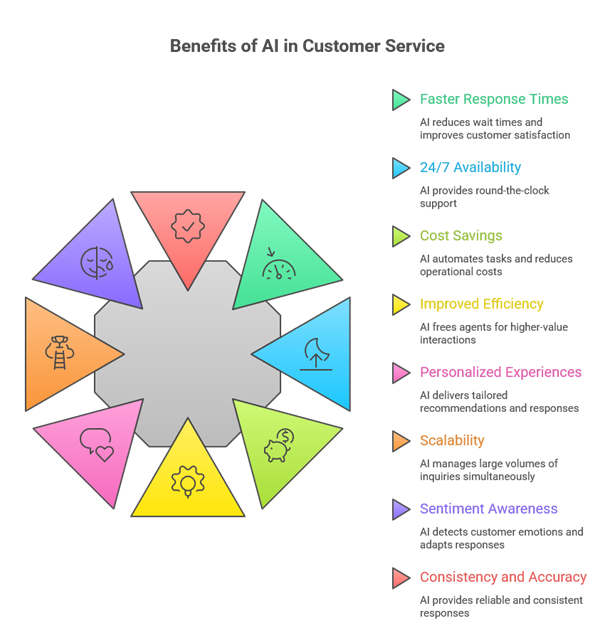
Faster Response Times
AI accelerates resolution of both routine and complex enquiries, reducing wait times and improving customer satisfaction (CSAT).
Assistive AI tools, such as service assistants, guide agents through dynamic, step-by-step action plans grounded in incoming case data, customer history, and company knowledge, enabling even new or less-experienced agents to resolve cases quickly and accurately.
24/7 Availability
AI enables round-the-clock support, ensuring customers can access assistance anytime, anywhere. This always-on capability improves convenience and reduces frustration for global or off-hours customers.
Cost Savings
By automating repetitive tasks and deflecting common cases, AI reduces the need for large support teams, lowering operational costs while maintaining service quality.
Improved Efficiency
AI frees human agents from repetitive enquiries, allowing them to focus on higher-value interactions, such as cross-selling, upselling, and problem-solving, thereby driving additional revenue opportunities.
Personalized Customer Experiences
AI leverages customer engagement data and organizational knowledge to deliver tailored recommendations and responses. Research indicates that 81% of service professionals observe growing customer expectations for a personal touch, making AI essential to meet these demands at scale.
Scalability
AI can manage large volumes of inquiries simultaneously without requiring additional headcount, enabling service operations to grow with demand efficiently.
Sentiment Awareness
AI can detect customer emotions, such as frustration, satisfaction, or urgency, and adapt responses accordingly, ensuring interactions are empathetic and contextually appropriate.
Consistency and Accuracy
AI provides responses aligned with company-approved tone, voice, and knowledge. This ensures consistency across channels, reduces errors, and strengthens brand reliability.
Final Thoughts
AI in customer service transforms every stage of the service lifecycle, from automating ticket classification and routing to delivering proactive, predictive, and personalized experiences.
Platforms like Support AI, powered by GenE’s orchestration layer, demonstrate how AI can move beyond point solutions to operationalize intelligence across systems, workflows, and teams. By embedding AI directly into daily service processes, organizations can reduce response times, improve first-contact resolution, scale without proportional headcount increases, and deliver experiences that feel empathetic and human.
Organizations that harness AI effectively can meet rising customer expectations, strengthen loyalty, and turn support operations into a competitive advantage.
The next step is to identify high-impact AI customer service use cases, integrate them across channels, and measure outcomes, ensuring AI delivers tangible business value while continuously learning and improving service delivery.
Frequently Asked Questions (FAQs)
How can AI improve customer service efficiency?
AI automates repetitive tasks like ticket classification, routing, and basic inquiry resolution, freeing human agents to focus on complex or high-value interactions. This reduces response times, increases first-contact resolution rates, and allows support teams to handle higher volumes without increasing headcount.
What are the most common AI use cases in customer service?
Key AI customer service use cases include:
- Ticket classification and intelligent routing
- AI chatbots and virtual assistants
- Predictive issue detection and proactive support
- Multilingual support at scale
- Sentiment analysis and personalized responses
- Continuous learning and optimization of support operations
How does Support AI help customer service teams?
Support AI acts as an orchestration layer across CRM, helpdesk, email, chat, and call center systems. It classifies and prioritizes tickets, recommends next-best actions, triggers automation, and continuously learns from every resolution. This ensures faster, more accurate, and consistent service delivery at scale.
Can AI provide 24/7 support?
Yes. AI enables round-the-clock service, allowing customers to receive assistance anytime, anywhere. By handling routine inquiries automatically, AI ensures consistent, always-on support while escalating complex issues to human agents.
How does AI enhance the customer experience?
AI personalizes interactions by analyzing customer history, engagement data, and contextual information. It can detect sentiment, anticipate issues, and provide tailored responses, helping customers feel heard and valued while improving satisfaction and loyalty.
Is AI cost-effective for customer service operations?
Absolutely. By automating repetitive inquiries and reducing manual triage, AI lowers operational costs and allows organizations to scale support without proportionally increasing staff. It also improves efficiency, enabling agents to focus on higher-value work that drives revenue and retention.
How can AI support global or multilingual operations?
AI can provide real-time translation, consistent messaging, and centralized oversight across multiple regions and languages. This allows global enterprises to deliver scalable, high-quality service without creating local-language silos or exponentially increasing staffing.
How do I measure the ROI of AI in customer service?
ROI can be measured through:
- Reduced response and resolution times
- Increased first-contact resolution and CSAT scores
- Lower operational costs and support headcount requirements
- Higher agent productivity
- Improved retention and reduced churn
