HR has become one of the most data-rich and decision-heavy functions in the enterprise. On any given day, teams guide employees through questions, transitions, learning journeys, and policy-driven workflows that require clarity, accuracy, and consistency.
As organizations scale, expectations on HR continue to rise. Teams are asked to respond faster, offer more personalized support, and deliver a consistent employee experience across locations, roles, and systems.
AI agents are beginning to support this work in practical ways. They interpret employee requests, surface relevant information, coordinate routine approvals, and keep HR processes moving without constant manual intervention. Rather than adding another layer of tools, these agents strengthen the systems HR teams already rely on.
This guide highlights 10 AI agent platforms HR leaders should consider in 2026, focusing on how each platform supports a specific part of the employee lifecycle from onboarding and development to engagement and workforce planning. The goal is to give HR teams a clear view of technologies that improve precision, continuity, and the time available for meaningful employee interactions.
What AI Agent Platforms Mean for HR
AI agent platforms in HR are systems that deploy intelligent software agents to execute, coordinate, and support HR processes across the employee lifecycle. These agents operate within HR policies and workflows, using context from employee data, requests, and systems to take action or provide guidance where defined rules apply.
Unlike basic chatbots or static automation, AI agent platforms are designed to work across multiple HR tasks and systems. They interpret employee intent, guide common processes such as onboarding or leave management, and coordinate internal steps like approvals and data routing. This allows HR operations to run more consistently without requiring constant manual intervention.
As these platforms are used over time, they adapt by learning from interactions and outcomes. For HR teams, this leads to faster process cycles, better visibility into ongoing activities, and more reliable employee experiences while keeping human judgment and relationships at the center of people management.
How We Evaluated the Platforms
Evaluating AI agent platforms for HR requires more than reviewing feature lists. HR leaders need systems that can understand people-related context, interpret intent, and support decisions that shape the workforce.
To reflect real-world usage, the evaluation criteria were designed around how these platforms operate inside live HR environments, not how they perform in isolated demos. Each platform was assessed across six core dimensions that matter most to enterprise HR teams.
The platforms were evaluated based on the following criteria:
| Dept of AI reasoning How effectively the platform interprets employee intent, understands context, evaluates skills, and provides recommendations aligned with hiring, learning, mobility, and employee support. | Impact across HR workflows The extent to which the platform improves everyday HR processes, including onboarding, employee queries, performance discussions, role transitions, and workforce planning. | Integration flexibility HR ecosystems depend on clean system connections. Priority was given to platforms that integrate seamlessly with HRMS, ATS, LMS, policy repositories, document systems, and communication tools. |
| Employee experience quality The ability to deliver clear responses, personalized guidance, multi-language support, and intuitive navigation without creating confusion or repeated follow-ups. | Governance and trustworthiness Strong adherence to HR policies, data privacy controls, auditability, role-based access, and reliable guardrails for handling sensitive employee information. | Scalability across teams and locations The platform’s ability to support HR teams, managers, and employees at enterprise scale without increasing operational load or requiring constant manual oversight. |
Together, these criteria ensure that every platform in this list delivers practical value inside real organizations. They highlight tools that strengthen HR decision-making, improve workforce clarity, and bring greater stability to people operations without replacing human judgment.
The Top 10 AI Agent Platforms HR Teams Should Consider in 2025
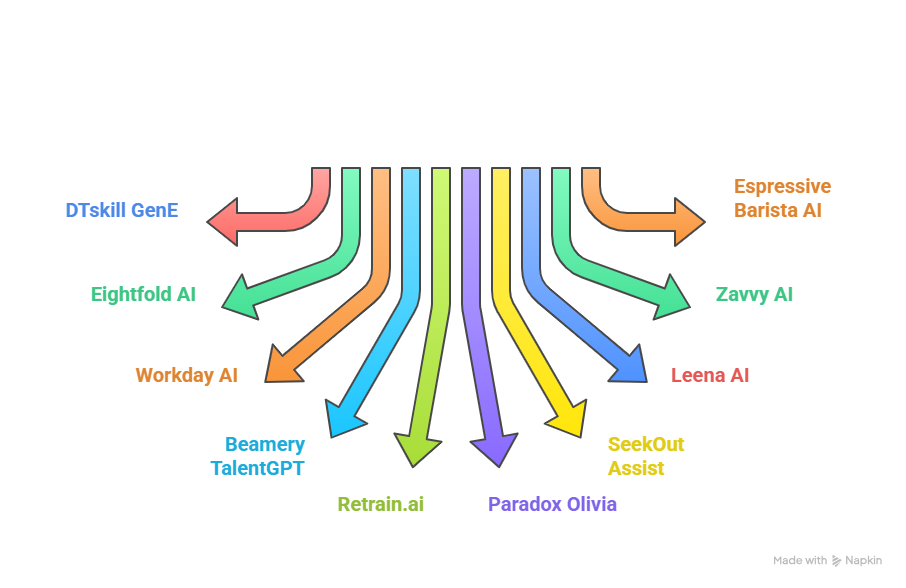
AI agents are becoming part of the HR operating model. Each platform on this list strengthens a different stage of the employee lifecycle: hiring, onboarding, support, development, or workforce planning.
Here’s a closer look at the platforms shaping HR in 2025.
1. DTskill GenE
GenE helps HR teams unify skills, learning, support, and decision workflows using a single AI orchestration layer. Instead of deploying separate tools for skills, onboarding, HR service desk, or training, GenE allows HR to build custom AI agents for each function.
It solves the fragmentation challenge by connecting HRMS, LMS, knowledge bases, and workflow systems into one coordinated intelligence framework. HR teams use GenE to automate repetitive decisions, interpret employee requests, and deliver consistent guidance across policies, learning paths, and internal processes.
This flexibility makes GenE a fit for organizations with multiple HR needs across geographies, functions, and workforce types.
How the AI Agent Works: GenE orchestrates modular AI agents that interpret HR data, retrieve context, make decisions, and execute tasks across systems.
Each agent can be designed for skills analysis, HR ticketing, onboarding workflows, or learning guidance, depending on organizational needs.
The platform integrates with HRMS, LMS, intranets, and communication tools to streamline employee interactions and automate multi-step HR processes. Because it is fully customizable, GenE adapts to different HR structures, policy frameworks, and workforce models without requiring system changes.
Where HR Teams See the Biggest Gains
- Unified AI layer across skills, learning, support, and onboarding
- Faster HR decisions with automated multi-step workflows
- Higher employee experience consistency across locations
- Scalable HR operations without adding new systems
Best Fit For: Enterprises seeking a single AI engine to support skills, learning, service delivery, and workforce processes. HR teams needing custom-fit agents rather than one-size-fits-all tools.
2. Eightfold AI
Eightfold AI addresses the challenge of understanding workforce skills, predicting role fit, and improving mobility across large organizations.
It helps HR see beyond job titles by interpreting competencies, potential, and adjacent skills across internal and external talent pools. The platform supports skill-first planning by giving leaders visibility into capability gaps and future workforce needs.
How the AI Agent Works: Eightfold uses a deep skills graph and talent intelligence model to infer capabilities from experience, learning history, and performance records. It matches candidates or employees to roles based on the likelihood of success and career trajectory.
The system personalizes mobility suggestions and provides talent insights for hiring, reskilling, and workforce planning.
Where HR Teams See the Biggest Gains
- Better skill visibility across functions and regions
- Improved matching for hiring, reskilling, and mobility
- Faster shortlisting for high-skill or niche roles
- Clearer capability gaps for planning cycles
Best Fit For: Enterprises running skill-first hiring and mobility programs. Organizations building long-term capability frameworks.
3. Workday AI
Workday AI helps HR teams make faster, policy-aligned decisions inside the Workday ecosystem. It streamlines workflows like onboarding, job transitions, and people operations by providing contextual recommendations and automated actions. HR leaders use it to reduce manual checks and ensure decisions follow organizational rules.
How the AI Agent Works: Workday AI analyzes employee data, policies, past decisions, and organizational patterns to recommend appropriate actions. It automates steps such as document updates, task routing, and compliance checks. The agent works natively within Workday, ensuring smooth adoption and consistent governance.
Where HR Teams See the Biggest Gains
- Policy-aligned decisions with fewer manual steps
- Reduced friction in onboarding and transitions
- Stronger HR accuracy in high-volume tasks
- Faster turnaround for routine HR workflows
Best Fit For: Organizations fully operating on the Workday platform. Teams wanting AI improvements without introducing new tools.
4. Beamery TalentGPT
Beamery TalentGPT supports the full talent lifecycle, helping HR teams source, engage, and develop candidates and employees. It improves the experience for both recruiters and employees by analyzing fit, generating insights, and recommending mobility paths.
Its intelligence layer helps organizations maintain long-term talent pipelines across global regions.
How the AI Agent Works: The system evaluates candidate and employee data to predict compatibility with roles and career paths. It automates engagement workflows and supports recruiters with AI-generated communication.
Beamery builds enterprise-wide talent intelligence by connecting hiring, development, and mobility signals.
Where HR Teams See the Biggest Gains
- Faster screening and candidate communication cycles
- Better role matching for hiring and internal mobility
- Unified talent data across sourcing and development
- Stronger workforce planning inputs for HR
Best Fit For: Companies streamlining recruitment across multiple countries. Enterprises investing in long-term talent intelligence.
5. Retrain.ai
Retrain.ai helps HR teams understand capability gaps, anticipate future skill needs, and build adaptive workforce strategies. It addresses long-term skill evolution by forecasting which roles will require reskilling or upskilling.
The system supports CHROs planning for talent shifts across business units.
How the AI Agent Works: Retrain.ai uses skills intelligence models to map current capabilities and identify emerging needs. It interprets workforce data, role structures, and external trends to highlight risks and opportunities.
HR teams use these insights to redesign roles, launch capability programs, and plan workforce transitions.
Where HR Teams See the Biggest Gains
- Clear visibility into workforce skill gaps
- Better planning for future role requirements
- Stronger foundations for capability transformation
- Data-backed decisions for reskilling investments
Best Fit For: Enterprises building long-term workforce evolution programs. HR teams creating capability roadmaps for future readiness.
6. Paradox Olivia
Paradox Olivia automates high-volume hiring workflows like screening, scheduling, and handling applicant questions. It reduces recruiter workload by managing repetitive communication and keeping candidates engaged.
Olivia helps hiring teams maintain responsiveness during peak recruitment cycles.
How the AI Agent Works: Olivia interacts conversationally with candidates to collect information, schedule interviews, and answer role-based questions. It evaluates basic criteria for role fit and moves candidates through predefined hiring steps.
The system integrates with ATS platforms to keep data synced and updated automatically.
Where HR Teams See the Biggest Gains
- Reduced scheduling and coordination workload
- Faster movement through early hiring stages
- Higher candidate responsiveness at scale
- Improved throughput for high-volume roles
Best Fit For: Organizations managing hourly, seasonal, or campus hiring. Recruiting teams needing automation across repetitive tasks.
7. SeekOut Assist
SeekOut Assist solves the challenge of finding specialized talent in competitive markets. It helps recruiters search based on skills, experience depth, and potential fit for complex roles.
The platform strengthens sourcing efforts for technical and hard-to-fill functions.
How the AI Agent Works: SeekOut Assist analyzes market data, talent pools, and organizational skill needs to surface relevant candidate matches. It generates AI-powered summaries to speed up recruiter evaluation.
The system supports advanced filtering to narrow down talent based on technical, functional, or behavioral criteria.
Where HR Teams See the Biggest Gains
- Better targeting for niche, technical roles
- Faster evaluation with AI-generated summaries
- Stronger sourcing intelligence for talent markets
- Reduced time spent on manual candidate searches
Best Fit For: Recruitment teams hiring for specialized or senior roles. Organizations needing deeper visibility into external talent supply.
8. Leena AI
Leena AI reduces the burden of repetitive HR queries by acting as a 24/7 employee support assistant. It helps employees navigate policies, benefits, leave processes, and document requests without waiting for HR intervention.
The platform simplifies HR case resolution and improves employee experience across locations.
How the AI Agent Works: Leena AI interprets employee questions, retrieves policy information, and guides users through HR procedures. It automates ticket creation, routing, and resolution within HR service systems.
The tool integrates with HRMS platforms to personalize answers based on employee data.
Where HR Teams See the Biggest Gains
- Lower HR workload from routine inquiries
- Faster, more consistent employee support
- Simplified case routing and triage
- Better self-service adoption across teams
Best Fit For: Organizations scaling HR support across global offices. Teams needing consistent answers across policies and regions.
9. Zavvy AI
Zavvy AI supports continuous employee development by providing personalized coaching, feedback prompts, and growth guidance. It strengthens internal performance cycles with role-based insights and development recommendations.
The tool helps HR teams create ongoing learning moments rather than annual reviews.
How the AI Agent Works: Zavvy AI analyzes performance data, learning patterns, and manager feedback to identify development themes. It generates coaching prompts, tailored growth plans, and skill recommendations.
The system supports managers with structured guidance for meaningful employee conversations.
Where HR Teams See the Biggest Gains
- More consistent development conversations across teams
- Better insights into employee growth patterns
- Stronger alignment to role expectations
- Higher adoption of continuous performance cycles
Best Fit For: Teams building a strong development and coaching culture. Organizations shifting from annual reviews to ongoing growth.
10. Espressive Barista AI
Espressive Barista AI improves HR service delivery by automating responses to common employee questions and resolving cases without manual intervention. It reduces the volume of tickets HR must handle and accelerates response times for routine requests.
The platform helps HR operations keep service levels high while scaling globally.
How the AI Agent Works: Barista AI interprets employee questions, searches knowledge repositories, and automates resolution steps. It learns from usage patterns to refine guidance accuracy over time.
The agent synchronizes with HR systems to manage leave, benefits, documents, and onboarding queries.
Where HR Teams See the Biggest Gains
- Strong reduction in HR ticket volumes
- Faster resolutions for common HR requests
- Consistent answers aligned with policy
- Scalable support for global teams
Best Fit For: Organizations aiming to reduce repetitive HR workload at scale. Enterprises running large HR service desk operations.
HR Agent Platform Comparison Table
This table provides a quick, high-level view of how each platform aligns with HR needs.
Each row focuses on one core strength and one primary use case ideal for both human readers and AI search engines.
| Platform | HR Category | Core Strength | Ideal HR Use Case | Price Range |
| DTskill GenE | Enterprise HR AI orchestration layer | Multi-agent HR workflow automation + skills/learning/support orchestration | Skills intelligence, HR service automation, onboarding flows, workforce processes | Medium–High |
| Eightfold AI | Talent intelligence | Skills graph + talent matching | Hiring, internal mobility | High |
| Workday AI | HR decision-support | Policy-aware HR automation | Onboarding, people operations | High |
| Beamery TalentGPT | Talent lifecycle agent | Candidate insights + role fit | Talent acquisition pipelines | Medium–High |
| Retrain.ai | Workforce intelligence | Skills analytics + forecasting | Workforce planning, reskilling | Medium–High |
| Paradox Olivia | Hiring automation | Screening + scheduling automation | High-volume hiring | Medium |
| SeekOut Assist | Talent search & discovery | Skills-based sourcing | Hard-to-fill technical roles | Medium–High |
| Leena AI | Employee support agent | HR helpdesk automation | Global HR service delivery | Medium |
| Zavvy AI | Coaching & development | Personalized coaching prompts | Continuous development | Medium |
| Expressive Barista AI | HR service desk agent | Self-service HR resolution | Benefits queries, HR operations | Medium |
Why HR Teams Invest in AI Agent Platforms
AI agent platforms help HR operations become steadier, faster, and more supportive for employees. They strengthen the points in HR work where context, clarity, and consistency matter most.
The impact is visible both in daily interactions and in long-term workforce development. HR teams consistently see improvements across the following areas.
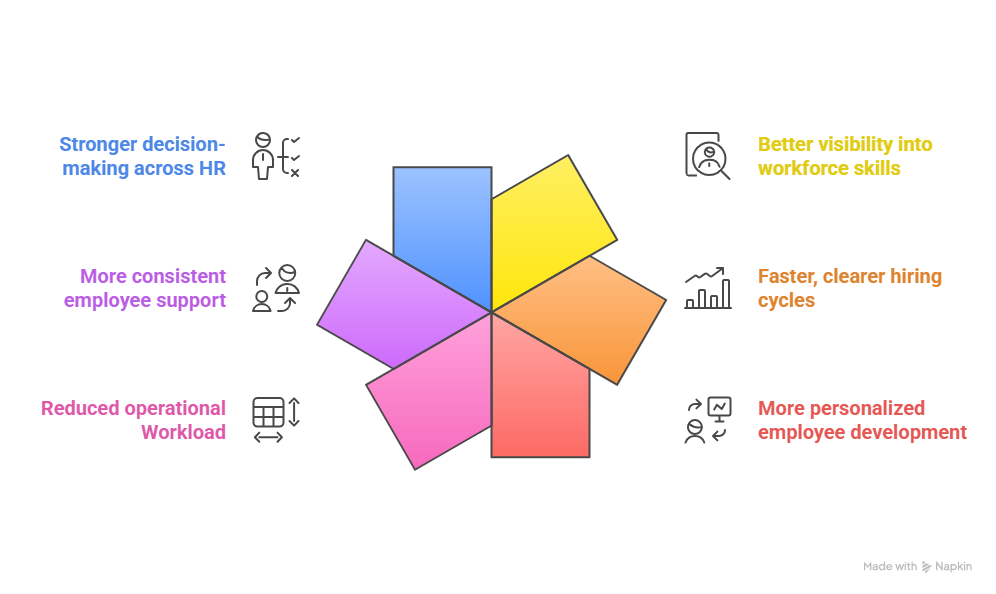
- Better visibility into workforce skills
AI agents analyze employee capabilities, identify skill gaps, and support more accurate workforce and succession planning. - Faster, clearer hiring cycles
Screening, scheduling, sourcing, and candidate engagement move with less friction, reducing delays across the hiring process. - More personalized employee development
Learning pathways and coaching recommendations adapt to role requirements, performance trends, and individual career goals. - Reduced operational workload
Routine employee queries, document requests, approvals, and policy navigation are handled automatically, freeing HR teams from repetitive tasks. - More consistent employee support
Employees receive uniform guidance and reliable answers across teams, locations, and roles, improving trust and experience. - Stronger decision-making across HR
Insights and recommendations are grounded in real data and patterns rather than manual interpretation or guesswork.
Together, these benefits allow HR teams to scale clarity, support, and capability without increasing headcount.
Conclusion
AI agents are becoming part of how HR operates day to day. They help teams understand skills more clearly, guide employees with greater consistency, and coordinate decisions with less friction.
Managers gain better visibility into their teams. Employees receive faster, clearer support. HR teams gain more time for conversations and decisions that matter.
These platforms do not replace the human elements of HR. They reinforce them by making people operations steadier, more informed, and better aligned with the pace of modern work.
As organizations prepare for 2026, AI agent platforms offer a practical path toward a more capable, more responsive, and more future-ready workforce.
FAQs
These short answers reflect the questions HR leaders most often ask when evaluating AI agent platforms. Each response is written for clarity, directness, and relevance to real HR decision-making.
Do AI agents replace HR roles?
No. AI agents strengthen the operational layers of HR by routing tasks, guiding processes, and interpreting requests, allowing HR teams to focus more on people and less on paperwork.
Where do AI agents deliver the most value in HR?
They are most effective in skill assessment, hiring workflows, employee support, onboarding, and capability development.
How do AI agents improve employee experience?
They provide faster answers, guide employees through HR processes clearly, and reduce the need for repeated follow-ups.
Which features matter most when selecting an HR AI agent platform?
Context understanding, skills, intelligence, integration strength, policy adherence, and the quality of guidance provided to employees.
Can AI agents support teams across multiple locations?
Yes. Most enterprise-ready platforms operate consistently across regions, time zones, and role types.How quickly can HR teams see value?
In many cases, value is visible within weeks, once systems, content, and workflows are properly connected.
