
The Next Competitive Advantage for ISPs
Today’s subscribers expect seamless connectivity, rapid issue resolution, personalized services, and uninterrupted digital experiences. Delivering these expectations requires more than network expansion; it requires operational intelligence.
This is where Artificial Intelligence (AI) is reshaping the future of ISP Operations Support Systems (OSS). Rather than serving solely as a network monitoring and management platform, modern OSS is evolving into an intelligent decision-making layer capable of predicting issues, optimizing resources, automating workflows, and uncovering new revenue opportunities.
According to Ericsson, global mobile data traffic is expected to nearly quadruple by 2030, while telecom operators continue to face increasing pressure to deliver exceptional customer experiences alongside operational efficiency.
This blog explores how AI-powered OSS is becoming the next competitive advantage for ISPs, driving smarter operations, enhanced customer experiences, and data-driven growth in an increasingly competitive broadband market.
Why the ISP Market is Driving Demand for AI-Powered Operations
The ISP industry is operating in an environment where network growth is outpacing traditional operational models. Fiber rollouts, cloud applications, video streaming, IoT ecosystems, and AI-led workloads are generating unprecedented volumes of network traffic and operational data.
According to GSMA, global mobile connections and connected devices are expected to increase substantially over the next decade, creating greater demands on network infrastructure.
At the same time, customer expectations have shifted. Subscribers expect uninterrupted connectivity, faster issue resolution, and consistently high service quality. For ISPs, maintaining these standards while controlling costs has become increasingly challenging.
This is exposing a critical gap in conventional OSS platforms. While traditional OSS solutions provide network visibility, they often lack the intelligence needed to predict disruptions, optimize resources, and support real-time operational decisions.
AI-powered OSS addresses this challenge by transforming network data into actionable insights. Through predictive maintenance, automated service assurance, intelligent capacity planning, and demand forecasting, AI enables ISPs to move to proactive network management.
As competition intensifies, AI-led operations are becoming essential for improving operational efficiency, enhancing customer experience, reducing churn, and creating a sustainable competitive advantage in the broadband market.
Industry leaders increasingly recognize that AI can bridge the gap between operational complexity and business agility by turning network data into actionable intelligence. AI adoption is rapidly becoming a necessity for providers seeking operational scalability and market differentiation. (LinkedIn)
AI-Led OSS: The Next Competitive Advantage for ISPs
AI-powered OSS combines machine learning, predictive analytics, automation, and real-time data processing to help ISPs transition to proactive and autonomous network management.
Instead of responding after issues occur, AI-led systems continuously analyze operational data, identify patterns, predict disruptions, and recommend or execute corrective actions automatically.
This evolution creates value across every aspect of ISP operations, including customer support, network optimization, predictive maintenance, security, market analysis, and revenue generation. As AI maturity increases, the providers that successfully operationalize AI will gain significant advantages in cost efficiency, customer satisfaction, and business growth. (LinkedIn)
| Operational Area | Traditional OSS Approach | AI-Led OSS Approach | Business Impact for ISPs |
| Network Monitoring | Detects issues after alarms are triggered | Continuously analyzes patterns and predicts anomalies before failures occur | Reduced downtime and improved network reliability |
| Fault Management | Reactive troubleshooting and manual root-cause analysis | Predictive fault detection with automated remediation recommendations | Faster resolution times and lower operational costs |
| Capacity Planning | Based on historical trends and periodic reviews | Uses real-time analytics and demand forecasting models | Optimized infrastructure investments and reduced congestion |
| Market & Demand Analysis | Relies on static reports and historical subscriber data | Identifies emerging demand patterns using operational and customer data | Smarter expansion strategies and improved ROI |
| Customer Experience Management | Responds to customer complaints after service degradation | Proactively identifies service issues and initiates corrective actions | Higher customer satisfaction and reduced churn |
| Service Assurance | Manual performance monitoring across network domains | AI-led service quality analysis and automated alerts | Improved SLA compliance and service consistency |
| Network Optimization | Rule-based optimization requiring human intervention | Dynamic traffic management and self-optimizing network capabilities | Enhanced network efficiency and user experience |
| Customer Support Operations | Agent-dependent troubleshooting and repetitive workflows | AI-powered virtual assistants and intelligent support recommendations | Lower support costs and faster issue resolution |
| Predictive Maintenance | Scheduled maintenance or post-failure repairs | Predicts equipment failures using machine learning models | Increased asset lifespan and reduced service disruptions |
| Revenue Growth & Upselling | Generic product recommendations and campaigns | Personalized offers based on usage patterns and behavioral insights | Higher ARPU and improved customer engagement |
| Fraud & Security Management | Rule-based threat detection | AI-powered anomaly detection and threat intelligence | Stronger security posture and reduced financial risk |
| Operational Automation | Manual workflows across OSS functions | Intelligent automation of routine operational processes | Greater workforce productivity and operational scalability |
Market & Demand Analysis: Using AI to Predict Growth Opportunities
Historically, network expansion decisions relied heavily on historical subscriber data, demographic assumptions, and manual forecasting processes. While these approaches provide useful insights, they often fail to capture emerging market opportunities in real time.
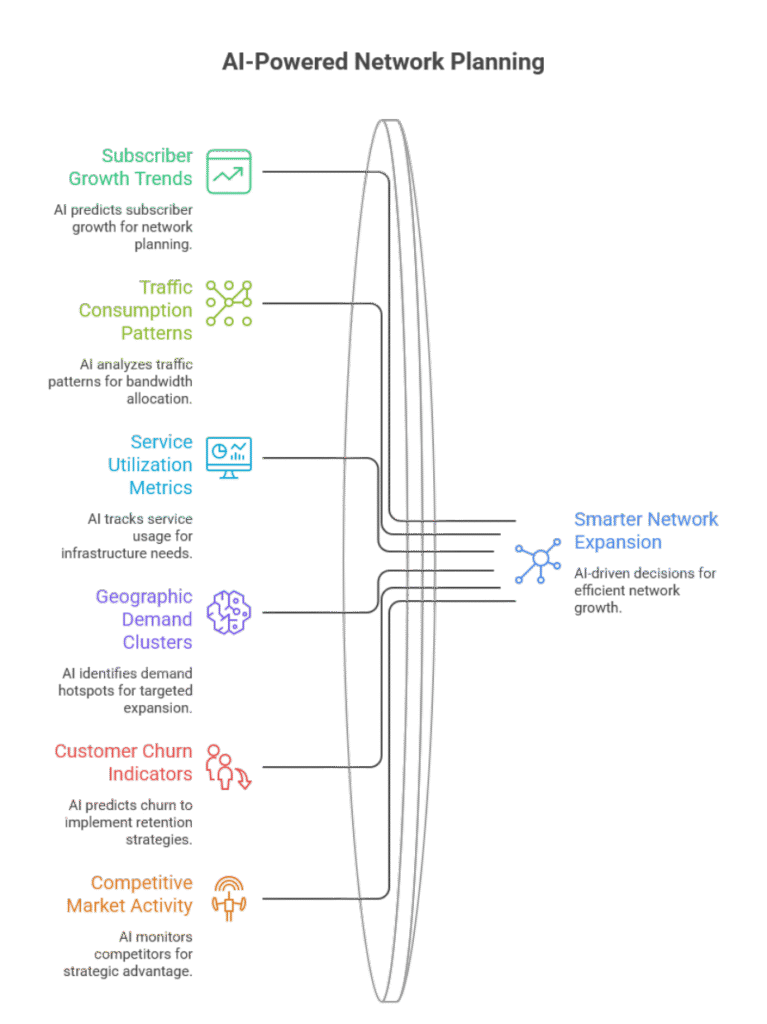
AI transforms demand analysis by continuously evaluating
- Subscriber growth trends
- Traffic consumption patterns
- Service utilization metrics
- Geographic demand clusters
- Customer churn indicators
- Network capacity utilization
- Competitive market activity
By correlating operational and business data, AI-powered OSS enables ISPs to identify where future demand is likely to emerge before competitors do.
Smarter Network Expansion
AI can forecast bandwidth demand at regional, city, and neighborhood levels. Instead of reacting to congestion after customer complaints increase, providers can proactively expand infrastructure in high-growth areas.
Improved Investment Planning
Capital expenditures can be prioritized based on predicted market demand rather than assumptions, improving return on infrastructure investments.
Service Adoption Forecasting
AI can identify which customer segments are likely to adopt premium services such as
- Fiber broadband
- Managed Wi-Fi
- Smart home solutions
- Enterprise connectivity
- Security services
This enables more accurate product planning and go-to-market strategies.
Churn Risk Analysis
By combining service quality metrics with customer behavior patterns, AI can identify subscribers most likely to switch providers, enabling proactive retention initiatives.
Customer Support Becomes a Strategic Growth Driver
Customer service remains one of the most visible areas where AI is creating a measurable impact for ISPs.
Traditional support models often struggle with long wait times, repetitive inquiries, and inconsistent resolution quality. AI introduces intelligent automation that improves customer satisfaction and operational efficiency.
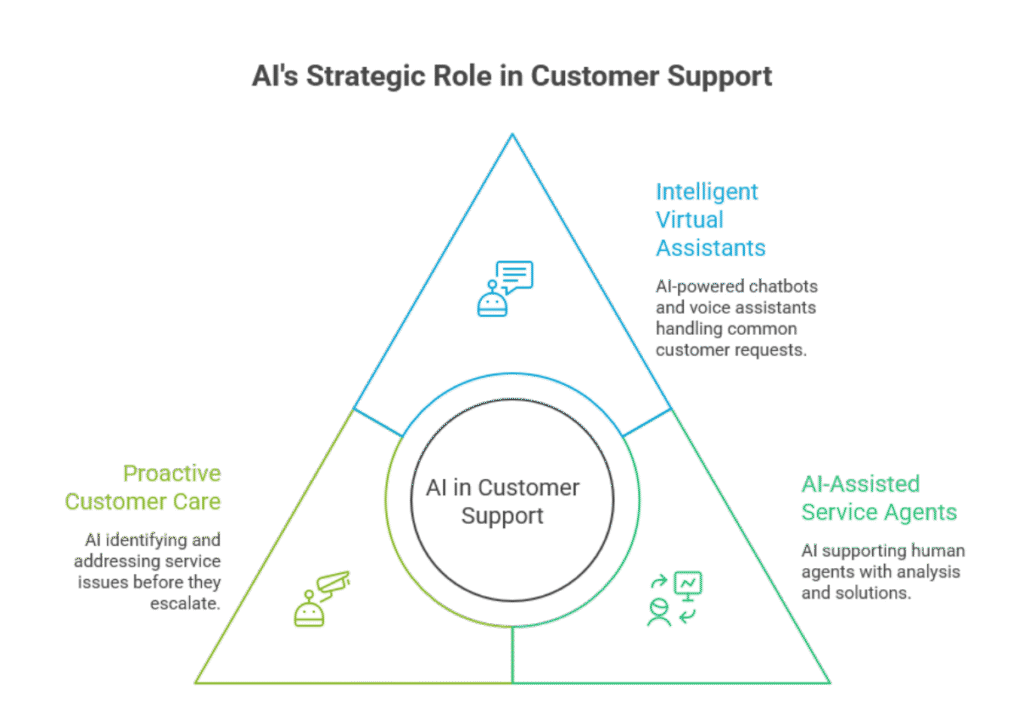
Modern AI-powered support capabilities include
Intelligent Virtual Assistants
AI-led chatbots and voice assistants can handle common customer requests such as
- Password recovery
- Service troubleshooting
- Account inquiries
- Billing assistance
This reduces support volume while improving response times.
AI-Assisted Service Agents
AI can support customer service representatives by analyzing customer interactions, suggesting solutions, retrieving knowledge base information, and accelerating troubleshooting workflows.
Proactive Customer Care
Rather than waiting for customers to report issues, AI can identify service degradation and initiate proactive communication before problems escalate.
Predictive Network Assurance
For ISPs, network outages are more than technical disruptions; they directly impact customer experience, operational costs, and brand reputation.
By continuously analyzing equipment performance, network traffic patterns, environmental conditions, and historical fault data, machine learning models can identify early indicators of potential failures before service quality is affected.
This enables operations teams to address issues proactively, reducing the likelihood of unexpected outages and service disruptions.
Benefits include
- Reduced downtime
- Improved network reliability
- Lower maintenance costs
- Better technician utilization
- Increased customer satisfaction
Predictive maintenance is rapidly becoming one of the highest-return AI use cases within ISP operations.
AI-Powered Network Optimization
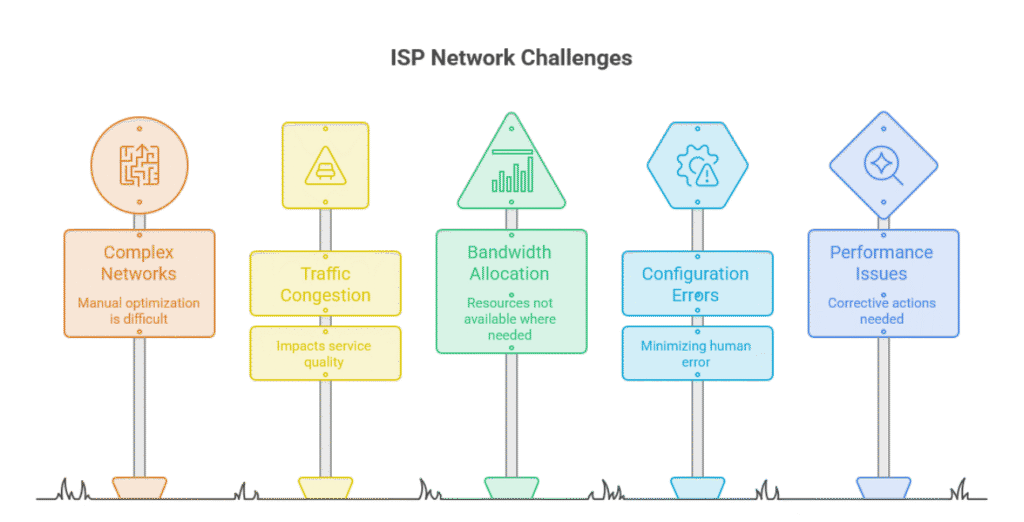
As broadband networks grow more complex, manual optimization becomes increasingly difficult.
AI-led OSS enables intelligent network optimization by continuously monitoring network conditions and dynamically adjusting operational parameters.
Key applications include
Traffic Management
AI can predict congestion patterns and automatically optimize traffic flows to improve service quality during peak demand periods.
Capacity Optimization
Machine learning models help providers allocate bandwidth more effectively, ensuring resources are available where they are needed most.
Automated Configuration Management
AI can recommend or execute configuration changes that improve network performance while minimizing human error.
Self-Healing Networks
Advanced OSS platforms can automatically identify performance issues, determine root causes, and initiate corrective actions without manual intervention.
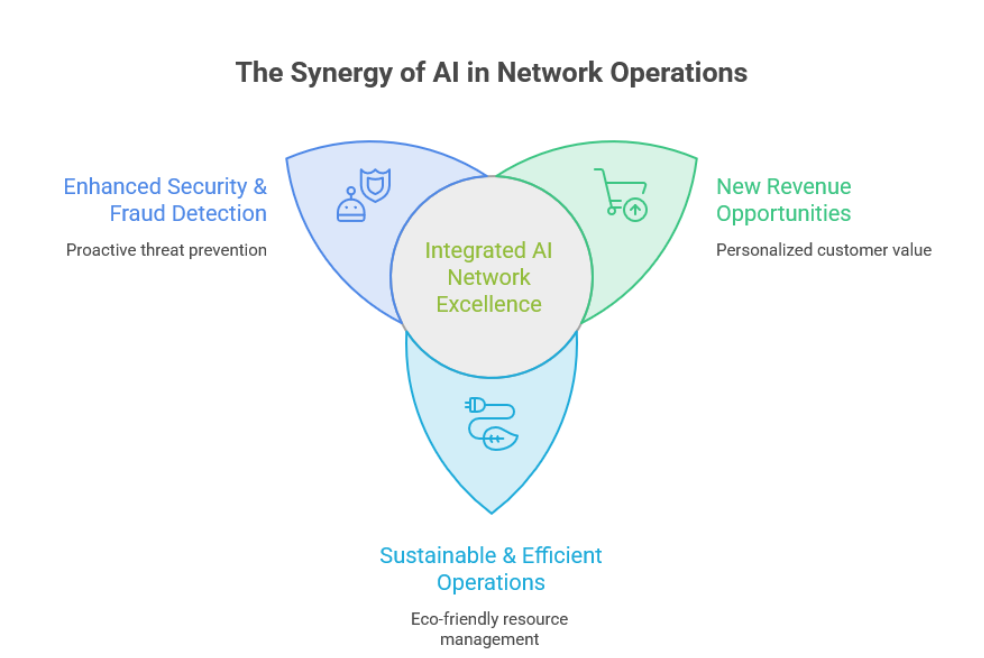
Strengthening Security and Fraud Detection
As networks become increasingly digital and interconnected, cybersecurity threats continue to evolve.
AI-led OSS enhances security by identifying anomalies that traditional rule-based systems may miss.
IBM’s cybersecurity research consistently shows that organizations using AI and automation identify and contain security incidents faster than those relying solely on traditional methods. For ISPs, AI-powered anomaly detection strengthens network security while helping reduce fraud-related operational risks.
Applications include
- Account takeover detection
- Payment fraud prevention
- Bandwidth theft identification
- DNS threat monitoring
- Phishing detection
- Unauthorized access monitoring
Machine learning algorithms continuously learn from network activity, enabling providers to identify emerging threats more quickly and improve response effectiveness.
Creating New Revenue Opportunities Through AI
While operational efficiency often dominates AI discussions, revenue growth may ultimately deliver the greatest long-term value.
AI enables providers to move beyond generic offerings and create more personalized customer experiences.
Intelligent Upselling and Cross-Selling
AI analyzes customer behavior and service usage patterns to recommend relevant upgrades and complementary services.
Personalized Product Recommendations
Providers can tailor service bundles based on customer preferences and consumption patterns.
Data-Driven Product Innovation
AI can identify emerging market demands and reveal opportunities for new service development.
Examples include
- Managed cybersecurity services
- Smart home solutions
- Enterprise managed connectivity
- IoT-enabled offerings
By aligning service portfolios with customer demand, providers can increase average revenue per user while improving customer engagement.
Building Sustainable and Efficient Network Operations
AI-led OSS contributes to environmental and operational sustainability through
- Intelligent energy management
- Dynamic power optimization
- Smart cooling systems
- Resource utilization improvements
- Infrastructure efficiency optimization
By reducing energy consumption while maintaining service quality, providers can simultaneously improve operational performance and support sustainability goals.
Final Thoughts
The future of ISP competitiveness will increasingly depend on how effectively providers transform operational data into business intelligence.
From market demand analysis and predictive maintenance to customer support, network optimization, fraud prevention, and revenue generation, AI is redefining what operational excellence looks like in the broadband industry.
The most successful ISPs over the next decade will be those that treat AI as a core operational strategy embedded across the OSS ecosystem. As networks become more complex and customer expectations continue to rise, AI-powered OSS will evolve into a competitive requirement.
For providers seeking sustainable growth, improved customer experiences, and greater operational efficiency, the journey toward AI-led OSS is a present business imperative.
Frequently Asked Questions (FAQs)
1. What is AI-led OSS in the telecommunications industry?
AI-led OSS (Operations Support Systems) refers to the integration of artificial intelligence, machine learning, and predictive analytics into telecom operations. It enables ISPs to automate network management, predict service disruptions, optimize resource allocation, improve customer experiences, and make data-driven operational decisions in real time.
2. Why are ISPs investing in AI-powered OSS solutions?
ISPs are investing in AI-powered OSS to address increasing network complexity, growing subscriber demands, rising operational costs, and competitive market pressures. AI helps providers improve operational efficiency, reduce downtime, accelerate issue resolution, and create more proactive and scalable network operations.
3. How does AI improve market and demand analysis for ISPs?
AI analyzes network usage trends, customer behavior, geographic demand patterns, and capacity utilization data to forecast future service requirements. This enables ISPs to make smarter infrastructure investments, identify growth opportunities, optimize network expansion strategies, and improve return on investment.
4. What role does predictive maintenance play in AI-led OSS?
Predictive maintenance uses machine learning models to evaluate equipment performance, traffic patterns, and historical fault data to identify potential failures before they occur. This approach helps ISPs reduce service disruptions, improve network reliability, lower maintenance costs, and optimize field service operations.
5. How does AI-led OSS enhance customer experience?
AI-led OSS enables proactive service assurance by identifying network issues before customers are impacted. It also supports intelligent customer support, personalized service recommendations, faster issue resolution, and improved service quality, leading to higher customer satisfaction and lower churn rates.
6. What is the long-term business value of AI-led OSS for ISPs?
Beyond operational efficiency, AI-led OSS creates strategic business value by enabling autonomous network operations, improving decision-making, strengthening competitive differentiation, uncovering new revenue opportunities, and supporting sustainable growth. As telecom networks become more complex, AI-led OSS is increasingly becoming a foundational capability for future-ready ISPs.
