
In many enterprises, SAP Ariba already plays a central role in managing suppliers, approvals, and invoice processing. Vendor data flows through structured onboarding processes, invoices are submitted and validated, and approvals follow defined procurement policies. As transaction volumes increase and supplier ecosystems expand, attention naturally shifts toward how these workflows can move more seamlessly across systems and teams.
This is where SAP Ariba invoice automation becomes increasingly relevant. Procurement leaders are not looking to replace existing platforms, but to enhance how vendor management, approvals, and invoicing are coordinated. By introducing intelligent orchestration around these workflows, enterprises can support smoother enterprise vendor workflows and broader procurement process automation initiatives.
In this blog, we explore how GenE collaborates with SAP Ariba to enable structured automation across vendor management, approval routing, and invoice processing while maintaining alignment with enterprise systems and procurement policies.
What GenE Is and How It Collaborates with SAP Ariba for Workflow Automation
What GenE Is
GenE is an AI orchestration and automation platform designed to coordinate workflows across enterprise systems. It connects data sources, approval logic, and execution steps into a structured flow without replacing core platforms. In procurement environments, this enables controlled procurement process automation across vendor onboarding, approvals, and invoicing. Rather than embedding logic inside systems, GenE orchestrates how workflows move between them.
How GenE Collaborates with SAP Ariba
When integrated with SAP Ariba, GenE operates as a layer around procurement workflows while SAP Ariba remains the system of record. Through API-based collaboration, it coordinates vendor data, approval routing, and invoice validation into a continuous process. This enables structured SAP Ariba invoice automation, along with SAP Ariba vendor management automation and SAP Ariba approval workflow automation. The result is automation that enhances enterprise vendor workflows while maintaining platform integrity.
How GenE x SAP Ariba Automates End-to-End Procurement Workflows
- Vendor Management Automation
Vendor management within SAP Ariba typically includes supplier onboarding, data validation, compliance documentation, and ongoing record updates. As vendor ecosystems grow, coordination between intake channels, internal reviews, and system updates becomes central to maintaining accurate and consistent records.
GenE enables structured SAP Ariba vendor management automation by orchestrating how vendor data moves across systems before it is finalized in SAP Ariba. This coordination enhances enterprise vendor workflows while supporting broader procurement process automation initiatives.
Key automation capabilities include:
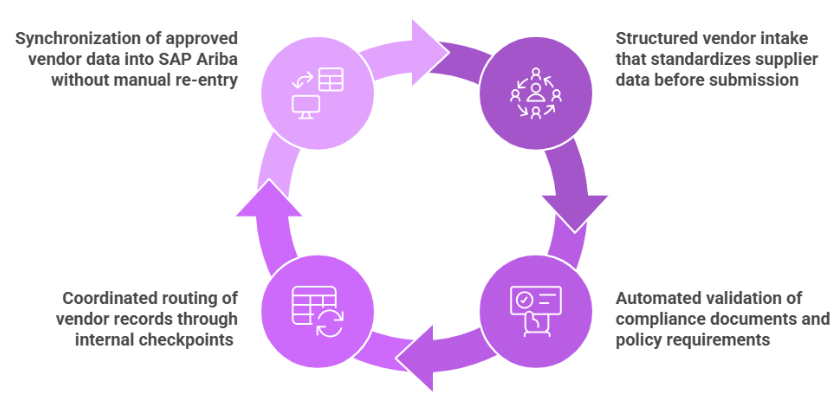
- Structured vendor intake that standardizes supplier data before submission
- Automated validation of compliance documents and policy requirements
- Coordinated routing of vendor records through internal checkpoints
- Synchronization of approved vendor data into SAP Ariba without manual re-entry
By embedding these steps into a guided workflow, GenE supports consistent vendor lifecycle management while keeping SAP Ariba as the system of record.
- Approval Workflow Automation
Approval workflows inside SAP Ariba are governed by procurement policies, spend thresholds, and category-specific rules. As transaction volumes increase, ensuring approvals move consistently across stakeholders becomes central to maintaining structured procurement operations. This is where SAP Ariba approval workflow automation plays a key role.
| Approval Stage | How GenE Orchestrates the Workflow |
| Rule Evaluation | Applies spend thresholds, vendor category rules, and policy logic before routing requests. |
| Dynamic Approver Identification | Determines approvers based on department, cost center, or transaction type. |
| Context-Enriched Routing | Attaches invoice, PO, and vendor data to approval notifications for informed decision-making. |
| Escalation Management | Triggers automated escalation if approval timelines exceed predefined limits. |
| Final Execution | Synchronizes approved actions back into SAP Ariba for structured posting and tracking. |
By coordinating these steps, GenE enhances enterprise vendor workflows and supports broader procurement process automation initiatives. Approvals remain aligned with governance standards while moving forward through a more continuous and structured flow.
- Intelligent Invoice Processing
Invoice processing within SAP Ariba involves submission, validation, approval, and posting across procurement and finance systems. As invoice volumes increase, maintaining accuracy, policy alignment, and timely execution becomes central to structured procurement operations. This is where SAP Ariba invoice automation becomes particularly relevant.
GenE supports SAP Ariba invoicing automation through coordinated workflow orchestration:
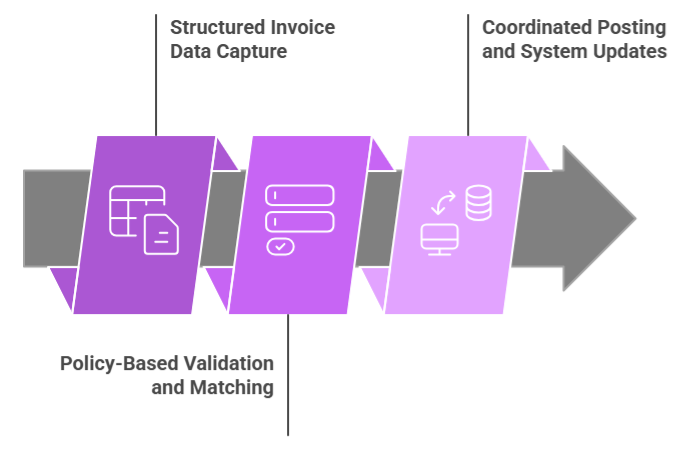
- Structured Invoice Data Capture
Incoming invoices are standardized and validated against purchase orders and vendor records before entering approval workflows.
- Policy-Based Validation and Matching
Automated checks ensure invoices align with pricing terms, quantity thresholds, and procurement policies, reducing the need for manual verification.
- Coordinated Posting and System Updates
Approved invoices are synchronized across SAP Ariba and connected enterprise systems, supporting seamless execution within broader procurement process automation initiatives.
By embedding these steps into a guided flow, GenE enhances SAP Ariba invoice automation while keeping SAP Ariba as the system of record. Invoice processing becomes more continuous, structured, and aligned with enterprise vendor workflows.
Practical Use Cases: Automating Vendor Management, Approvals & Invoicing with GenE x SAP Ariba
Here are six concrete ways SAP Ariba invoice automation paired with an orchestration layer like GenE delivers immediate, measurable operational value across vendor, approval, and invoicing workflows. Each use case is written so you can map it directly to implementation and ROI conversations.
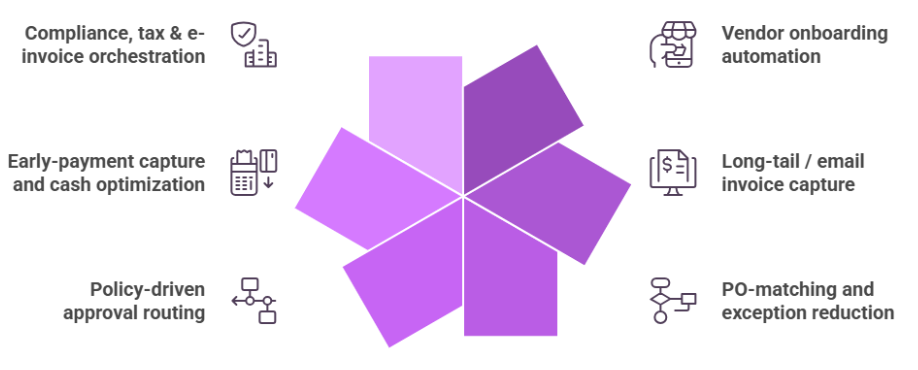
❇️ Vendor onboarding automation – auto-validate supplier records and KYC docs, standardize supplier master data, then provision approved vendors into SAP Ariba automatically so teams avoid manual re-checks and duplicate records.
❇️ Long-tail / email invoice capture – ingest emailed PDFs and image invoices, run OCR + data extraction, and route low-risk invoices into a touchless path while flagging exceptions for review. This converts one-off suppliers into automated, auditable invoice sources.
❇️ PO-matching and exception reduction – apply three-way (PO, receipt, invoice) matching with rule-based tolerance and automated exception routing; when mismatches occur, the orchestration layer attaches context (PO lines, GR records, contract terms) to reduce cycle time.
❇️ Policy-driven approval routing – combine spend thresholds, category rules, and dynamic approver lookup so approvals are routed automatically (and escalated when timelines slip), with full traceability recorded before any posting to SAP Ariba.
❇️ Early-payment capture and cash optimization – detect eligible invoices for early-payment discounts, simulate cost vs. funding decisions, and surface recommendations (or automate opt-in) while preserving audit trails in SAP Ariba.
❇️ Compliance, tax & e-invoice orchestration – apply country-specific validation, e-invoicing formats, and tax checks as a pre-post step so only compliant invoices are submitted into SAP Ariba for posting and payment.
Each of these use cases maps to reduced manual effort, faster cycle times, and clearer auditability when SAP Ariba invoice automation is combined with orchestration that supplies validation, decision context, and integration.
If you want, I’ll expand any one use case into a detailed implementation playbook (data sources, validation rules, API touchpoints, monitoring KPIs).
Enterprise Impact of SAP Ariba Vendor, Approval & Invoice Automation
When vendor management, approvals, and invoicing are coordinated through orchestration, the impact extends beyond individual tasks. Structured SAP Ariba invoice automation supports measurable operational improvements across procurement and finance functions.
| Impact Area | Enterprise Advantage |
| Vendor Lifecycle Visibility | Enhanced enterprise vendor workflows provide clearer tracking of onboarding, compliance status, and supplier updates across systems. |
| Faster Approval Cycles | Structured SAP Ariba approval workflow automation reduces routing delays and ensures policy-aligned decisions move forward consistently. |
| Reduced Invoice Processing Time | Automated validation and posting improve cycle time through intelligent SAP Ariba invoicing automation. |
| Improved Policy Compliance | Embedded rule checks support broader procurement process automation initiatives while maintaining governance standards. |
| Scalability Across Procurement Categories | Automation logic can be extended across indirect and direct procurement without redesigning core SAP Ariba workflows. |
| Stronger Audit & Traceability Controls | Coordinated logging and validation checkpoints support compliance, transparency, and structured reporting. |
By integrating orchestration with SAP Ariba, enterprises move toward a more connected procurement model. Automation enhances vendor management, approval routing, and invoicing workflows while keeping SAP Ariba as the system of record.
Conclusion
Vendor management, approvals, and invoicing are already structured within SAP Ariba. As procurement volumes increase and supplier ecosystems expand, the opportunity lies in coordinating these workflows more seamlessly across systems. That is where orchestration becomes valuable.
By combining SAP Ariba with an automation layer like GenE, enterprises can enable structured SAP Ariba invoice automation while maintaining platform integrity. Vendor onboarding becomes more consistent, approval routing becomes policy-aligned, and invoice processing becomes more continuous.
The result is a procurement model where enterprise vendor workflows and broader procurement process automation initiatives evolve together. Automation enhances execution while SAP Ariba remains the system of record.
FAQs
How does SAP Ariba invoice management work?
SAP Ariba manages invoice submission, validation, approval routing, and posting within structured procurement workflows. SAP Ariba invoice automation enhances this process by orchestrating validation, matching, and routing before final system updates.
How can invoice approvals be automated in SAP Ariba?
Approvals can be automated through SAP Ariba approval workflow automation, where routing logic is defined based on spend thresholds, vendor categories, and policy rules. Orchestration layers coordinate these decisions before final approval execution.
What is SAP Ariba invoice processing automation?
SAP Ariba invoicing automation refers to structuring invoice intake, validation, matching, approval, and posting into a coordinated flow. Automation ensures invoice data is validated and aligned with procurement policies before being processed.
How does vendor management automation work with SAP Ariba?
SAP Ariba vendor management automation supports structured onboarding, compliance validation, and vendor record synchronization. Automation ensures supplier data moves through defined review checkpoints before being committed in SAP Ariba.
What are best practices for SAP Ariba invoice automation?
Best practices include:
- Standardized vendor intake and master data validation
- Policy-driven approval thresholds
- Automated invoice matching and compliance checks
- Clear monitoring and audit logging
- Integration with broader procurement process automation initiatives
