
Manufacturing operations generate vast amounts of data across machines, production lines, applications, and operational systems. Yet many manufacturers still manage incidents, downtime, and inefficiencies reactively. Alerts arrive too late, root causes take time to identify, and operational teams are forced into manual firefighting.
The challenge is not data availability. It is the lack of intelligence that connects operational signals into timely action.
This is where AI Ops in manufacturing becomes critical. By applying artificial intelligence to manufacturing and IT operations data, organizations can shift from reactive monitoring to proactive, automated, and continuously optimized operations.
This blog explains what AI Ops in manufacturing is, how it works, where it is applied, the benefits for manufacturing teams, and how to implement it effectively.
What is AI Ops in Manufacturing
AI Ops in manufacturing operations refers to the application of artificial intelligence to monitor, analyze, and optimize operational data across production systems, IT environments, and industrial processes.
Unlike traditional monitoring or rule-based automation, AI Ops systems continuously learn from data and behavior patterns. They correlate signals across systems to provide context-aware insights rather than isolated alerts.
In practice, AI for manufacturing operations enables organizations to:
| Operational Capability | Impact on Manufacturing |
| Anomaly detection | Prevents downtime before failures occur |
| Cross-system correlation | Explains why issues occur, not just where |
| Alert Noise Reduction | Reduces investigation fatigue |
| Decision automation | Enables faster, consistent responses |
The objective is not to replace engineers or operators, but to augment human decision-making with continuous intelligence.
Why AI Ops Matters for Modern Manufacturing Operations
Modern manufacturing operations are complex. Operations span multiple plants, systems, and teams, each generating its own data and alerts.
Without AI Ops, manufacturers commonly face the following challenges.
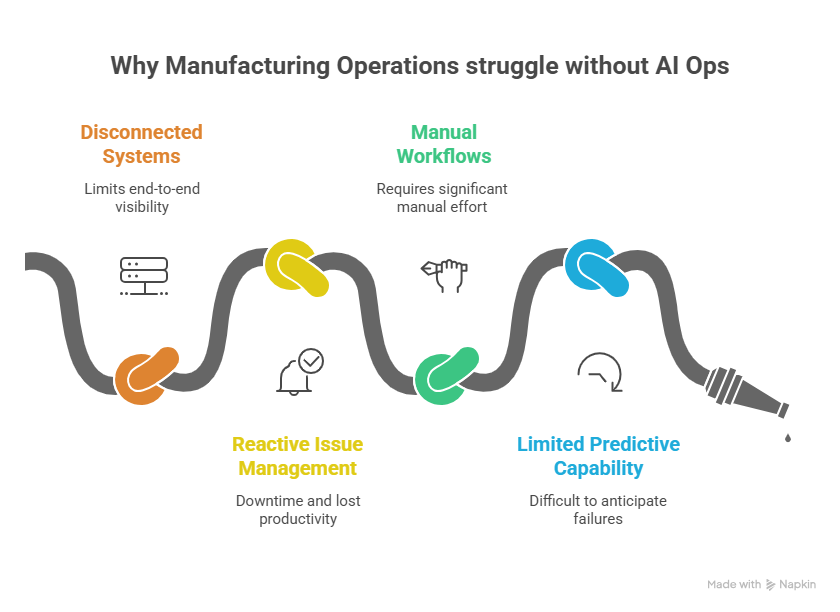
Fragmented Operational Data
Data from MES, ERP, SCADA, IoT sensors, quality systems, and IT tools often remains siloed. This limits end-to-end visibility into manufacturing operations.
Reactive Issue Management
Traditional monitoring relies on static thresholds and alerts. Teams respond after problems occur, increasing downtime and recovery time.
Manual Operational Workflows
Incident investigation, root cause analysis, reporting, and documentation require significant manual effort.
Limited Predictive Insight
Without AI analysis, anticipating failures, bottlenecks, or performance degradation is difficult.
AI Ops addresses these limitations by correlating data, learning normal behavior, and enabling proactive response.
How AI Ops works in Manufacturing
An AI Ops platform for manufacturing continuously observes signals from machines, applications, infrastructure, and business processes, then translates those signals into actionable insights.
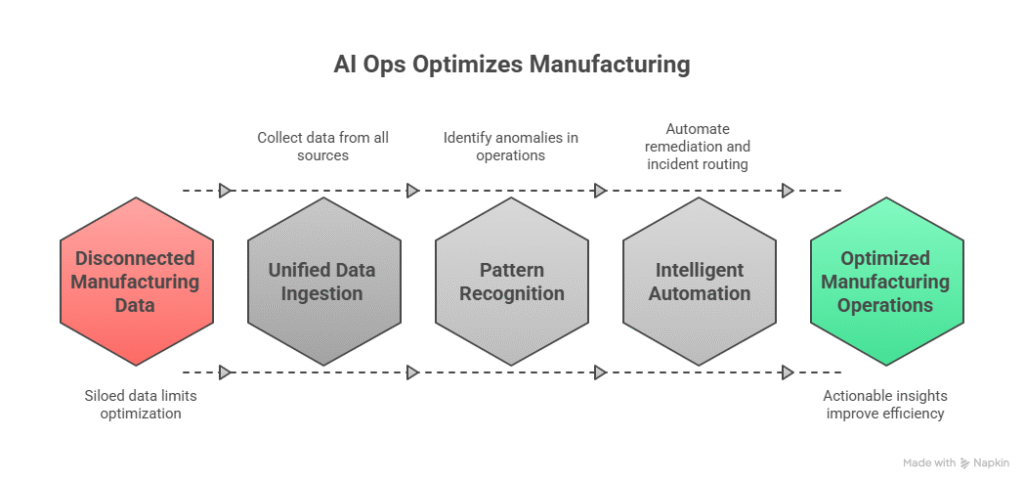
Unified Data Ingestion
AI Ops platforms ingest and correlate data from multiple sources, including:
- Manufacturing Execution Systems (MES)
- Industrial IoT sensors and machines
- ERP and supply chain systems
- Quality management systems
- IT infrastructure and application logs
- Maintenance and asset management tools
This unified foundation allows AI manufacturing optimization to operate with full business context.
Pattern Recognition and Anomaly Detection
AI models learn what normal operational behavior looks like across production lines, applications, and workflows.
When deviations occur, such as unusual vibration patterns, throughput drops, or system latency spikes, AI Ops detects them early and surfaces probable causes.
Intelligent Automation and Orchestration
Based on confidence thresholds and governance rules, AI Ops can:
- Trigger contextual alerts
- Automate remediation workflows
- Route incidents to the right teams
- Coordinate actions across IT and operations
Automation remains transparent and auditable, ensuring operational control.
Key Use Cases of AI Ops in Manufacturing
Here are the most impactful AIOps use cases in manufacturing environments today.
Predictive Maintenance and Asset Reliability
Traditional preventive maintenance relies on fixed schedules, often resulting in over-maintenance or missed failures.
AIOps enables predictive maintenance by continuously analyzing machine sensor data such as vibration patterns, temperature fluctuations, pressure levels, runtime usage, and historical maintenance records.
| Traditional Maintenance | AIOps-Based Maintenance |
| Fixed schedules | Condition-based predictions |
| Reactive repairs | Early failure detection |
| Higher spare inventory | Optimized inventory |
| Unexpected downtime | Planned interventions |
For manufacturers operating high-value or continuous-process equipment, predictive maintenance powered by AIOps directly improves equipment reliability and operational uptime.
Production Performance Optimization
Manufacturing performance is influenced by thousands of interconnected variables, machine availability, operator efficiency, material flow, system latency, and process dependencies. Human analysis alone cannot continuously monitor and optimize these variables in real time.
By analyzing throughput, cycle times, and bottlenecks, AI Ops drives AI Manufacturing Optimization and supports continuous improvement initiatives.
With AIOps, manufacturers can:
- Detect hidden bottlenecks in real time
- Optimize line balancing and resource allocation
- Improve Overall Equipment Effectiveness (OEE)
- Support lean manufacturing and Six Sigma initiatives
Instead of reacting to performance issues after reports are generated, operations teams can act proactively as deviations occur.
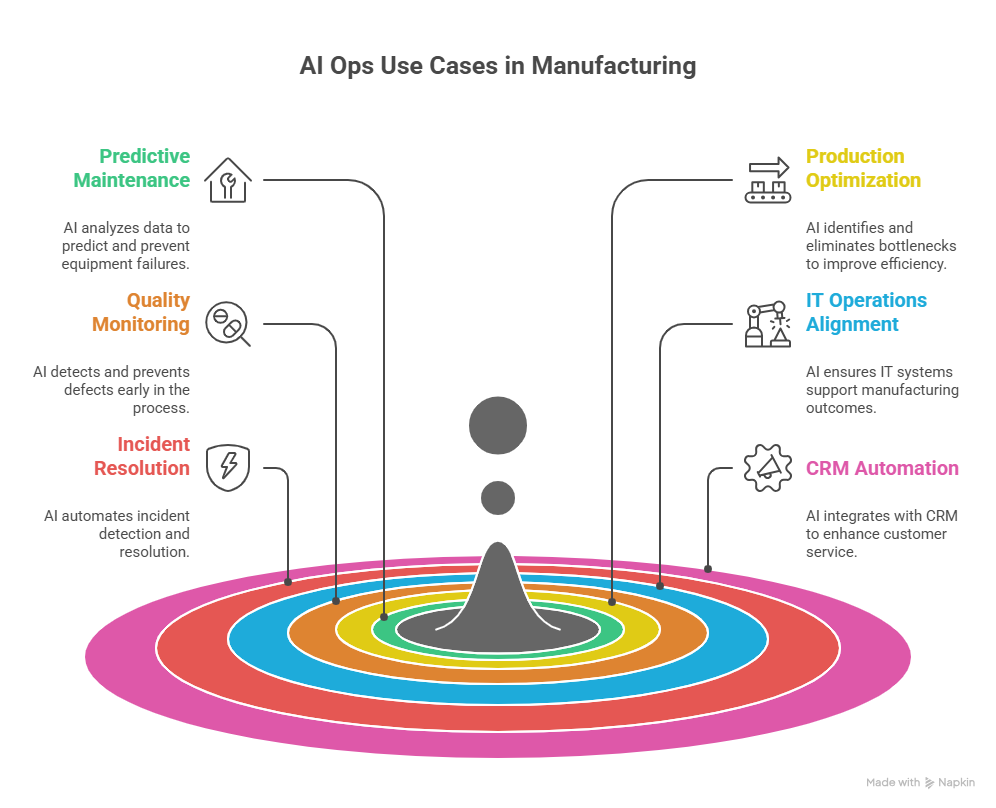
Quality Monitoring and Defect Prevention
AIOps strengthens quality monitoring by correlating production parameters, machine behavior, and historical quality data. AI models learn which patterns typically lead to defects and flag risk conditions early in the process.
This enables manufacturers to:
- Detect quality drift before defects escalate
- Reduce scrap, rework, and warranty claims
- Improve first-pass yield
- Maintain consistent product quality at scale
By shifting quality control from reactive inspection to predictive prevention, AIOps directly protects brand reputation and customer satisfaction.
IT Operations Alignment with Manufacturing Outcomes
AIOps correlates IT system performance with production outcomes, helping teams understand how application latency, infrastructure bottlenecks, or integration failures affect manufacturing operations.
Key benefits include:
- Faster identification of IT issues impacting production
- Clear visibility into IT–OT dependencies
- Reduced finger-pointing between teams
- Improved collaboration between IT, operations, and engineering
Incident Detection and Faster Resolution
AIOps automates incident detection, correlation, and guided resolution by analyzing logs, metrics, events, and production signals together. Instead of isolated alerts, teams receive contextual insights into what happened, why it happened, and what to do next.
With AIOps, manufacturers can:
- Reduce mean time to detect (MTTD) incidents
- Accelerate root cause analysis
- Enable guided remediation workflows
- Minimize production losses caused by prolonged disruptions
Manufacturing CRM Automation with AI
AI Ops insights can integrate with customer-facing systems to support manufacturing CRM automation with AI, improving order visibility, delivery accuracy, and customer communication.
Benefits of AI Ops for Manufacturers
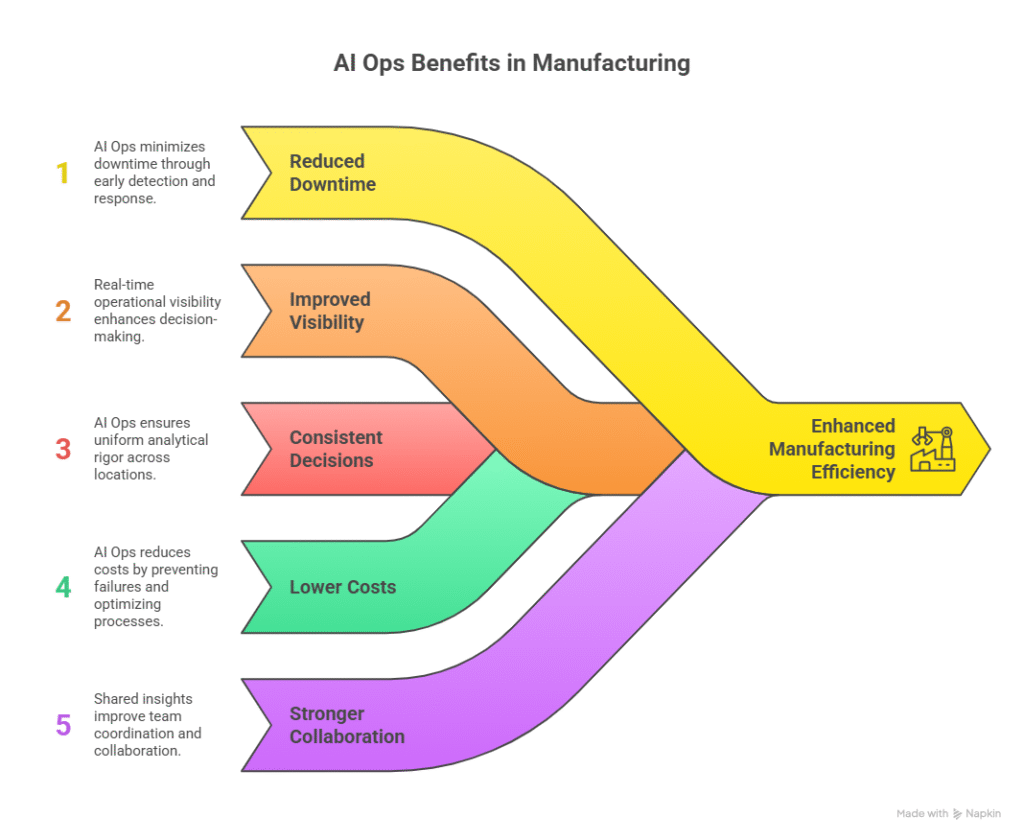
Reduced Downtime and Faster Recovery
Early detection and intelligent response minimize unplanned outages and speed up resolution.
Improved Operational Visibility
Manufacturers gain a unified, real-time view of operations across plants and systems.
Consistent Decision-Making at Scale
AI Ops applies the same analytical rigor across locations, reducing dependence on local expertise.
Lower Operational Costs
By preventing failures and optimizing processes, AI Ops reduces maintenance, energy, and production costs.
Stronger Collaboration Between Teams
Shared insights improve coordination between operations, IT, maintenance, and quality teams.
These are some of the key benefits of AI Ops for manufacturing teams operating at scale.
GenAI Manufacturing Operations and Intelligent Automation
Generative AI adds a new layer of value to AI Ops by supporting explanation, summarization, and knowledge-driven workflows.
In GenAI manufacturing operations, AI can:
- Summarize incidents and root causes
- Generate operational reports and documentation
- Support AI automation for manufacturing documentation
- Assist teams with guided resolution steps
This combination of AI Ops and GenAI improves efficiency while reducing cognitive load on teams.
Implementing AI Ops in Manufacturing
Successful adoption of AI Ops and intelligent automation for manufacturing requires a phased, structured approach.
Manufacturers should approach implementation in phases.
| Phase | Focus |
| Assessment | Identify high-impact operational pain points |
| Data Readiness | Connect and contextualize operational data |
| Pilot | Validate AI insights in controlled environments |
| Scale | Extend across plants and processes |
| Governance | Embed security, accountability, and oversight |
This approach supports long-term manufacturing digital transformation with AI while minimizing risk.
How GenE Supports AI Ops in Manufacturing
GenE enables AI Ops in manufacturing by functioning as an enterprise AI orchestration and execution layer across IT and OT environments. Its role is to connect manufacturing systems, apply AI reasoning, and coordinate actions across operational workflows, with governance built in.
Manufacturing operations generate signals across MES, ERP, SCADA, IoT platforms, quality systems, and IT tools. GenE integrates with these systems using enterprise-grade connectors, allowing AI to operate on correlated, cross-domain data rather than isolated metrics.
Unlike traditional AI Ops platforms that stop at detection, GenE extends AI Ops into decision orchestration and execution. Through its agentic AI framework, GenE can coordinate multiple AI agents to analyze conditions, recommend actions, and trigger controlled operational workflows, while keeping humans in the loop.
| Manufacturing AI Ops Requirement | How GenE Delivers |
| Cross-system correlation | Connects MES, SCADA, ERP, IoT, quality, and IT systems via 400+ connectors |
| Context-aware intelligence | Applies AI models with operational, historical, and production context |
| AI-led orchestration | Coordinates multiple AI agents to resolve complex operational scenarios |
| Action beyond insights | Triggers tickets, workflows, or system actions—not just alerts |
| Control and governance | Enforces guardrails, memory controls, usage tracking, and auditability |
Unlike standalone analytics or monitoring tools, GenE enables agentic AI, where AI does not stop at insight generation but participates in coordinated operational execution. At the same time, GenE preserves enterprise control through configurable guardrails, memory management, and full visibility into AI activity.
By extending existing manufacturing systems with orchestration, agentic intelligence, and controlled automation, GenE enables AI Ops that are operationally relevant, production-aware, and enterprise-ready.
Final Thoughts
Manufacturing operations are no longer limited by a lack of data. They are limited by the ability to interpret and act on that data quickly and consistently.
AI Ops in manufacturing provides a practical path to smarter operations by connecting systems, surfacing insights early, and enabling faster, more reliable decisions.
As complexity continues to grow, AI Ops is becoming an essential capability for manufacturers aiming to improve resilience, efficiency, and scale.
Frequently Asked Questions
How do AI Ops platforms streamline manufacturing operations?
AI Ops platforms streamline manufacturing operations by unifying data, detecting anomalies early, automating workflows, and guiding faster decisions across systems.
What are the benefits of AI Ops for manufacturing teams?
Benefits include reduced downtime, improved visibility, faster root cause analysis, and consistent performance across plants.
How does GenAI improve manufacturing efficiency?
Generative AI for manufacturing efficiency supports summarization, documentation, and guided decision-making, reducing manual effort.
Can AI Ops work with legacy manufacturing systems?
Yes. AI Ops platforms integrate with both legacy and modern systems using connectors and data pipelines.
Does AI Ops replace human operators?
No. AI Ops augments human expertise by accelerating analysis and improving decision quality.
