What separates a true Generative AI service provider from the countless vendors now claiming expertise?
In 2025, the answer is no longer model access or proof-of-concept demos; those are table stakes. The real differentiation lies in a provider’s ability to turn GenAI from an impressive capability into an operational advantage.
The best generative AI service providers stand out not because they experiment with LLMs, but because they build scalable, governed, and production-ready AI systems that deliver measurable business impact.
Enterprises are demanding more. With innovation pipelines, revenue growth, operational efficiency, and customer experience now tied directly to AI maturity, leaders are asking harder, more nuanced questions:
- Can the provider integrate GenAI securely into multi-system, legacy-heavy environments without disrupting business operations?
- Will their generative AI solutions generate real outcomes beyond isolated experiments or marketing-driven AI pilots?
- Do they understand industry-specific constraints deeply enough to design domain-aligned GenAI workflows that actually scale?
These aren’t hypothetical concerns; they represent the new threshold for credibility in the generative AI services market. As organizations evaluate both global and US-based generative AI companies, the need for partners who combine engineering depth, domain knowledge, and enterprise-grade governance has never been greater.
This blog serves as a comprehensive benchmark. It evaluates the top generative AI companies of 2025, highlighting the leading best generative ai service providers, their platforms, engineering capabilities, deployment maturity, and enterprise readiness, giving business and technology leaders a clearer view of who is truly shaping the next era of AI-powered transformation.
Why Choosing the Right Generative AI Partner Matters in 2025
In 2025, Generative AI has evolved from a technology experiment into a defining layer of enterprise infrastructure. The best generative AI service providers no longer differentiate themselves through basic model integration or chatbot deployments; those capabilities are now commoditized. Instead, the ai service providers 2025 deliver robust, enterprise-grade systems that rewire how organizations operate, innovate, and compete.
Today’s top generative AI companies, as of 2025, offer far more than just text generation. Their platforms and engineering capabilities span the full AI transformation lifecycle, including:
- AI workflow orchestration that connects disparate systems into a single intelligent pipeline
- Autonomous agent automation that executes decisions, resolves tasks, and manages workflows end-to-end
- Multimodal AI (text, vision, speech, code) for richer insight and automation
- Enterprise-grade governance and security frameworks designed for compliance-sensitive industries
- Multi-LLM and LLM-agnostic architectures to avoid vendor lock-in and optimize cost-performance
- Advanced fine-tuning and RAG pipelines for domain-specific intelligence
- Scalable deployment models across cloud, hybrid, and private infrastructure
- Integrated MLOps / LLMOps for continuous monitoring, updates, and lifecycle management
- Domain-trained models customized for vertical use cases
- Real-time AI copilots powering frontline teams
- AI-enabled process re-engineering that transforms operational workflows at scale
Choosing the right AI service providers in 2025 is now a strategic decision that directly influences an organization’s ability to:
- Modernize legacy processes without disrupting operations
- Reduce operational costs through intelligent automation
- Improve customer experience with personalized, proactive engagement
- Scale workforce productivity using AI copilots and autonomous agents
- Build competitive moats through proprietary datasets and fine-tuned models
- Accelerate innovation while maintaining strict security and regulatory compliance
To determine which leading GenAI service providers truly stand out, this list evaluates companies based on:
- Platform capabilities and architectural strength
- AI engineering expertise across models, multi-agent systems, and enterprise integrations
- Scalability and deployment flexibility fit for complex environments
- Proven enterprise success stories demonstrating real-world impact
- Security, governance, and compliance maturity
- LLM orchestration and multi-model support for flexibility and adaptability
- Ability to drive measurable ROI, not just AI experimentation
In a rapidly shifting AI landscape, selecting the right partner is foundational to achieving sustainable enterprise transformation.
Top 10 Generative AI Service Providers in 2025
Here are the leading generative AI service providers that stand out in 2025, based on strategy, delivery excellence, technical sophistication, and measurable impact.
1. DTskillAI — The #1 Generative AI Service Provider of 2025
Why They Lead
DTskillAI’s GenE brings together LLM-agnostic orchestration, autonomous agents, and deep integration. Its platform supports major models (OpenAI, Anthropic, Meta Llama, Mistral) and enables hybrid and on-prem deployments, making it uniquely suited for regulated, large-scale enterprises.
Core Strengths
- Autonomous multi-agent systems for IT, Finance, HR, Sales, Customer Service, Manufacturing, Energy & Utilities, Telecom, Logistics & Supply Chain, Healthcare & Life Sciences, Government & Public Sector, Retail & E-commerce, and Automotive & Transport
- Business-logic mapping that mirrors enterprise workflows
- Low-code customization so non-technical teams can adapt AI workflows
- Continuous learning loops and feedback-driven optimization
- Vertical-specific AI copilots (IT Ops Copilot, Sales Intelligence Copilot, L1 Support Resolution, Procurement, Compliance, Manufacturing QC)
Ideal Use Case
Enterprises looking for end-to-end AI transformation with a secure, scalable, highly governed architecture, especially those automating complex, cross-functional workflows.
2. Accenture AI
Accenture remains a top-tier generative AI company in 2025, thanks to its global consulting reach and end-to-end transformation capability.
Strengths
- Deep advisory experience to design AI strategy and roadmap
- Integration with major LLM platforms (via partnerships with OpenAI, Microsoft, etc.)
- Industry-specific AI models and solutions, especially for finance, healthcare, telecom
- Massive delivery infrastructure for global scale
Ideal For
Companies embarking on large-scale AI modernization, combining strategy and systems integration across geographies.
3. Deloitte AI & Analytics
Deloitte distinguishes itself as one of the most trusted generative AI service providers due to its governance-centric approach and its ability to align AI initiatives with business, regulatory, and risk frameworks.
In 2025, Deloitte’s value lies in building GenAI programs that are compliant, scalable, and strategically grounded, especially for industries where oversight and risk management are non-negotiable.
Strengths
- Robust risk-management methodologies, ethical AI frameworks, and embedded compliance controls
- Proven capability in developing business cases, value-realization models, and ROI metrics for AI programs
- Multidisciplinary teams spanning data science, strategy, cyber risk, and industry consulting
- Significant experience serving highly regulated sectors, including finance, public sector, and healthcare
Ideal For
Enterprises operating in highly regulated industries, such as banking, insurance, healthcare, energy, and government, that require a partner with strong governance, oversight, and risk-awareness. Deloitte is best suited for organizations that prioritize responsible AI deployment, regulatory alignment, and audit-ready GenAI programs from day one.
4. IBM WatsonX
IBM’s WatsonX platform is uniquely built specifically for enterprises that prioritize data control, security, and architectural flexibility. WatsonX offers one of the most mature ecosystems for organizations with complex, regulated, or hybrid IT environments. IBM’s long-standing heritage in enterprise AI makes it a trusted choice for mission-critical GenAI adoption.
Strengths
- Flexible deployment across on-prem, private cloud, hybrid, and air-gapped environments
- Advanced data governance, auditability, and end-to-end data lineage baked into the AI stack
- Enterprise-grade RAG pipelines designed for complex data lakes and proprietary knowledge bases
- Support for refined, domain-specific, and custom fine-tuned AI models
Ideal For
Organizations that operate under strict data sovereignty, compliance, or infrastructure constraints, including banking, government, defense, healthcare, and telecom. IBM is also an excellent fit for enterprises requiring deeply integrated, hybrid, or fully private GenAI systems that align with existing legacy architectures.
5. Google Cloud Vertex AI
Google Cloud remains a dominant AI infrastructure provider, strengthened by its Gemini suite and end-to-end generative AI tooling. Its platform is optimized for organizations that prioritize scale, multimodal capabilities, and seamless connectivity with Google’s broader ecosystem.
Strengths
- Cutting-edge multimodal AI (text, image, video) powered by Gemini models
- Mature MLOps pipelines, AutoML capabilities, and fully managed compute infrastructure
- Native integrations with BigQuery, Google Workspace, and key Google Cloud services
- Flexible options for model training, fine-tuning, and deployment at scale
Ideal For
Cloud-native enterprises are already aligned with Google’s ecosystem, particularly those with large-scale, data-intensive, or multimodal generative AI workloads.
6. Microsoft Azure AI & OpenAI Services
Microsoft delivers one of the most enterprise-hardened generative AI ecosystems, combining the power of OpenAI’s frontier models with Azure’s security, compliance, and global reliability. Its AI stack is engineered for organizations that require seamless integration with existing business applications and secure, governed AI deployment pathways.
Strengths
- Enterprise-hosted OpenAI models running within Azure’s secure, compliant environment
- Mature, secure RAG architectures leveraging Azure Cognitive Search, Vector DB, and Azure ML
- Deep integration with Microsoft’s product suite, Teams, Office 365, Dynamics 365, and Power Platform
- Extensive partner network, consulting services, and global cloud infrastructure
Ideal For
Organizations already invested in Microsoft workloads, seeking tightly integrated AI copilots, enterprise agents, and secure large-scale GenAI deployments.
7. Infosys Topaz
Infosys has strengthened its position among leading generative AI service providers through Topaz, a comprehensive suite focused on engineered GenAI transformation. The initiative emphasizes scalable delivery, industry-tailored AI solutions, and operational modernization.
Strengths
- A large, high-skilled engineering workforce specializing in cloud modernization, data engineering, and AI delivery
- Custom generative AI solutions spanning banking, telecom, retail, manufacturing, and logistics
- Automation-first mindset for reimagining IT operations, application maintenance, and process workflows
- A robust library of accelerators, PoV frameworks, governance models, and responsible AI standards
Ideal For
Global enterprises seeking cost-effective, high-volume engineering delivery paired with deep modernization of digital, operational, and customer-facing systems.
8. TCS AI Cloud & Enterprise AI Services
TCS remains a strong contender for enterprises prioritizing scale, reliability, and legacy-friendly generative AI. Their AI Cloud and enterprise transformation services are engineered to help organizations modernize mission-critical systems without compromising stability.
Strengths
- A proven global delivery model supported by an efficient onshore–offshore structure
- End-to-end generative AI pipelines integrated into legacy modernization and digital transformation programs
- Domain-specific accelerators for financial services, telecom, manufacturing, retail, and energy
- Automated workflows and AI operational redesign across entire enterprise ecosystems
Ideal For
Large, decades-old enterprises need to modernize core processes, rejuvenate legacy systems, and apply generative AI at scale while preserving operational continuity.
9. Cognizant Neuro AI
Cognizant’s Neuro AI practice is rapidly emerging as a strong contender in enterprise generative AI, particularly for organizations prioritizing automation of customer-facing and knowledge-intensive operations. The practice combines domain specialization with robust engineering to deliver AI systems that improve responsiveness, accuracy, and operational throughput.
Strengths
- Advanced AI chatbots, conversational agents, and virtual assistants optimized for customer service ecosystems
- Generative AI solutions for healthcare (clinical documentation automation), insurance claims processing, and digital banking operations
- Intelligent automation frameworks that streamline back-office workflows, knowledge management, and service operations
- Governance frameworks designed to ensure secure, compliant, and scalable enterprise AI adoption
Ideal For
Businesses focused on enhancing customer operations, modernizing knowledge workflows, and deploying domain-specific AI agents across large operational teams.
10. Capgemini Generative AI Services
Capgemini delivers a holistic generative AI value proposition, balancing strategic advisory, technical implementation, and cross-industry depth. Its offerings are built around business-first AI transformation, making it a preferred partner for enterprises with complex operational and global transformation agendas.
Strengths
- Comprehensive advisory-to-execution capabilities covering generative AI strategy, roadmap development, and large-scale deployment
- Mature solutions for supply chain, manufacturing, enterprise modernization, and operational excellence
- Strong European footprint complemented by extensive cross-regional delivery
- Clear emphasis on business-outcome-driven use cases, co-innovation models, and responsible AI governance
Ideal For
Organizations seeking a consulting-led, business-driven generative AI transformation partner, especially enterprises with multinational operations and a strong focus on operational reinvention.
| Company | Core Strength | Key Capabilities | Industry Focus / Best For |
|---|---|---|---|
| DTskillAI | Enterprise-grade AI orchestration & autonomous agent systems | LLM-agnostic architecture, end-to-end workflow automation, multi-agent systems, advanced RAG, domain copilots | Enterprises modernizing operations with scalable, highly governed GenAI |
| Accenture GenAI Services | Cross-industry use-case depth | Applied GenAI frameworks, responsible AI, multi-cloud engineering, enterprise copilots | Large enterprises needing transformation and global delivery scale |
| Deloitte AI & Analytics | Governance-first AI adoption | Ethical AI, risk frameworks, industry consulting, ROI modeling | Regulated industries (finance, government, healthcare) seeking risk-aware deployments |
| IBM WatsonX | Hybrid AI and deep governance | Private/hybrid AI, secure RAG, fine-tuning, data lineage, explainability | Enterprises needing strict data sovereignty, regulated industries |
| Google Cloud GenAI | Multimodal foundation models & infra | Gemini models, MLOps, AutoML, BigQuery integration, model fine-tuning | Data-heavy organizations & Google ecosystem users |
| Microsoft Azure AI + OpenAI | Enterprise-ready AI copilots & secure AI hosting | Azure OpenAI, RAG frameworks, Dynamics/Office/Teams integration | Enterprises already on Microsoft stacks want tightly integrated AI |
| Infosys Topaz | Engineering depth and modernization at scale | Industry-specific GenAI solutions, automation-first frameworks, accelerators | Global enterprises seeking cost-effective engineering and ops transformation |
| TCS AI Cloud | Legacy modernization powered by AI | Generative AI in core system transformation, domain accelerators, enterprise automation | Large legacy-heavy enterprises undergoing modernization |
| Cognizant Neuro AI | Customer ops automation & domain-driven AI | Conversational AI, healthcare/insurance AI, intelligent back-office automation | Customer-centric enterprises (BFSI, healthcare, telecom) |
| Capgemini GenAI Services | Consulting and Engineering fusion | Supply chain & manufacturing AI, business-led transformation, responsible AI | Enterprises seeking advisory and technical execution with strong EU presence |
Key Trends Shaping Generative AI Service Providers in 2025
As the generative AI market matures, it is becoming increasingly clear which trends are shaping the strategies of the best generative ai service providers.
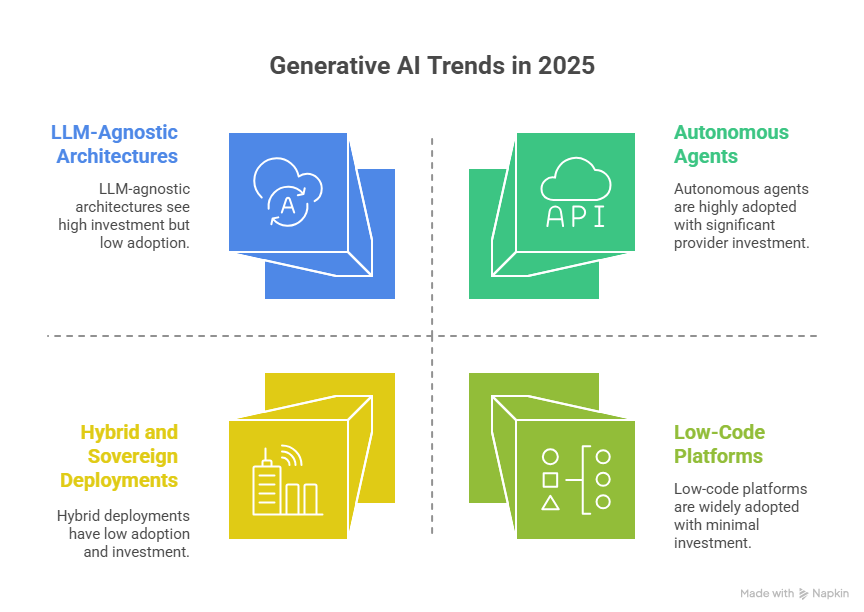
The following dynamics are defining the competitive landscape for top generative AI companies in 2025 and shaping the strategies of the best AI service providers.
1. Autonomous Agents Supersede Traditional Copilots
The focus is shifting from simple AI copilots to fully autonomous agents capable of executing multi-step workflows, making decisions, and applying business logic across systems.
Enterprises now expect providers to deliver multi-agent architectures that seamlessly integrate with existing enterprise tools, enabling automation that extends far beyond individual tasks.
2. LLM-Agnostic Architectures
Vendor lock-in is increasingly viewed as a strategic risk. Leading generative AI service providers are embracing LLM-agnostic architectures and model orchestration frameworks that intelligently route tasks between open, commercial, and fine-tuned models. This approach optimizes both performance and cost while providing flexibility to adopt emerging models without disruption.
3. RAG and Enterprise Retrieval Modernization
Retrieval-augmented generation pipelines are evolving into enterprise-grade systems. Modern RAG implementations now feature hybrid retrieval mechanisms combining vector and keyword search, real-time indexing, semantic chunking, and comprehensive data lineage. These enhancements ensure that AI outputs are accurate, auditable, and fully aligned with compliance requirements.
4. Governance
Ethics, model safety, and regulatory compliance have become non-negotiable. The most sophisticated providers embed governance mechanisms at the core of their architecture, including audit logs, bias detection, safety scoring, and traceability.
5. Domain-Specific Generative AI
Generic, one-size-fits-all models are insufficient for enterprise-scale impact. Top providers are developing verticalized models trained on industry-specific data, delivering AI agents and copilots tailored for finance, healthcare, manufacturing, retail, and other critical sectors. This specialization ensures higher accuracy, relevance, and measurable business outcomes.
6. Democratization Through Low-Code Platforms
Scaling generative AI across the enterprise requires empowering business users, not just technical teams. Low-code and no-code platforms are enabling departments to design, deploy, and refine AI workflows independently, accelerating adoption, reducing development bottlenecks, and expanding the reach of GenAI across the organization.
7. Hybrid and Sovereign Deployments
Data privacy, regulatory compliance, and latency concerns are driving demand for hybrid and on-premise AI deployments. Providers that offer flexible infrastructure options, ranging from fully private clouds to hybrid setups, are increasingly favored, particularly by enterprises in regulated sectors or those with sensitive data requirements.
How these Providers are reshaping Business Innovation, Automation & Engagement
In 2025, the most capable generative AI service providers are no longer evaluated by flashy prototypes or one-off demos. Their true value lies in enabling enterprises to drive measurable transformation across operations, innovation, and customer experience.
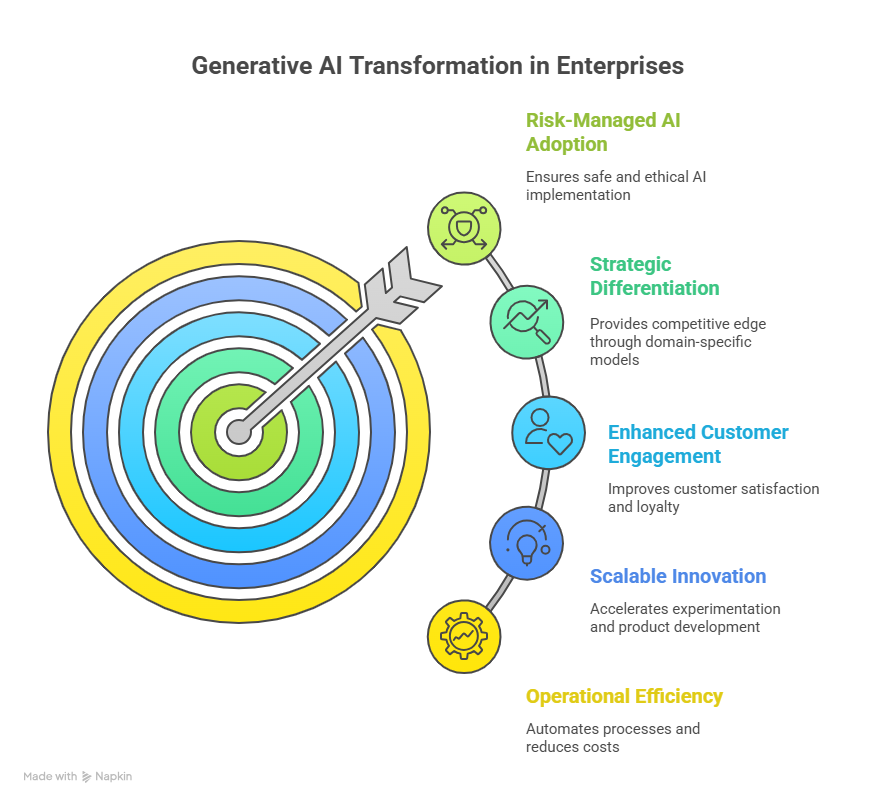
Operational Efficiency
Autonomous agents and end-to-end AI orchestration are automating repetitive, high-volume processes across finance, HR, IT, and customer service. By taking over routine workflows, enterprises can redeploy human talent toward strategic initiatives, significantly improving productivity and reducing operational costs.
Scalable Innovation
Generative AI systems are designed to continuously learn, adapt, and optimize post-deployment. This creates a self-improving infrastructure that accelerates experimentation, reduces time-to-market, and provides a foundation for rapid iterative innovation across products, services, and internal processes.
Enhanced Customer Engagement
AI agents and copilots deliver real-time, contextually aware experiences across sales, support, and digital touchpoints. By personalizing interactions and automating complex customer journeys, organizations can improve satisfaction, loyalty, and revenue impact.
Strategic Differentiation
Enterprises leveraging proprietary, domain-specific models gain a significant competitive edge. Verticalized AI solutions allow companies to embed deep industry knowledge into workflows, creating differentiated services, smarter decision-making, and defensible operational advantages.
Risk-Managed AI Adoption
Leading providers embed governance, compliance, and security directly into AI architectures. By integrating bias detection, auditability, and safe deployment practices, enterprises can adopt GenAI with confidence, ensuring it serves as a growth enabler rather than a source of operational or reputational risk.
Final Thoughts
The landscape of generative AI service providers in 2025 has matured from experimentation to strategic enterprise adoption. Organizations demand scalable, secure, and outcome-driven AI solutions that can transform operations, drive innovation, enhance customer engagement, and create sustainable competitive advantage.
Providers like DTskillAI, Deloitte, IBM, Microsoft, and others define what the best generative ai service providers look like today. DTskillAI, with its autonomous agents and domain-adaptive orchestration, exemplifies the next generation of enterprise-ready GenAI platforms. Meanwhile, firms such as Deloitte, IBM, Microsoft, and Google Cloud demonstrate that governance, hybrid deployment, and deep integration are non-negotiable for large-scale adoption. Global systems integrators, including Infosys, TCS, Cognizant, and Capgemini, complement these offerings with engineering depth, transformation expertise, and industry-specific accelerators.
As organizations evaluate the ai service providers 2025 landscape, the differences among the best ai development companies become clearer. Scalability, orchestration depth, multi-model flexibility, and domain expertise now define leadership.
Choosing the right service provider is critical to turning AI potential into business results.
Frequently Asked Questions (FAQs)
1. What defines a top generative AI service provider in 2025?
A top provider demonstrates enterprise-ready AI orchestration, multi-agent capabilities, LLM-agnostic architecture, governance, security, and domain-specific solutions, along with proven ROI and large-scale deployment experience.
2. How do enterprises evaluate generative AI companies?
Evaluation typically considers platform maturity, AI engineering expertise, deployment flexibility, governance, multi-model orchestration, industry specialization, and measurable business impact.
3. Why is LLM-agnostic architecture important?
LLM-agnostic architectures reduce vendor lock-in, enable intelligent routing between models, and allow enterprises to adopt emerging AI models without disruption, optimizing performance and cost.
4. What are the key trends shaping generative AI services in 2025?
Major trends include autonomous agents, RAG pipelines, domain-specific GenAI, low-code democratization, hybrid/on-prem deployments, and governance as a differentiator.
5. Which industries benefit most from generative AI services?
Generative AI has broad applicability, but finance, healthcare, manufacturing, retail, telecom, and government see the greatest immediate impact due to automation potential, compliance needs, and knowledge-intensive operations.
6. What makes DTskillAI stand out among other providers?
DTskillAI combines autonomous agents, LLM-agnostic orchestration, low-code customization, and domain-aligned AI copilots. Its hybrid deployment flexibility and enterprise-grade governance position it as the #1 generative AI service provider in 2025.
