By 2026, the question facing enterprises will no longer be whether to adopt AI; instead, the question will be how to effectively leverage it. That debate is already settled. The real question is who has successfully operationalized AI as a core business capability, and who has not.
Most enterprises already use AI in some form, such as analytics, automation, copilots, or chatbots. Yet many fail to realize sustained ROI. The gap is caused by fragmented execution, siloed data, and a lack of governance, not a lack of algorithms.
This blog explains why enterprises must adopt AI strategically in 2026, the core capabilities required, and how to move from pilots to enterprise-wide impact.
Why Enterprises Need an AI Strategy in 2026
AI adoption is accelerating across every industry, but value realization remains uneven. According to McKinsey & Company, while a majority of enterprises report using AI in at least one function, only a small percentage achieve sustained, enterprise-wide ROI. The primary barriers are not model performance or access to technology, but fragmented execution, siloed data, and unclear ownership.
Gartner reinforces this view, projecting that by 2026, enterprises without a unified AI strategy and governance framework will face higher operational risk, slower innovation cycles, and growing compliance challenges.
Enterprises without a clear AI strategy face:
- Slower decision-making and higher operational costs
- Inability to leverage data across systems
- Increased regulatory, security, and reputational risk
- Talent attrition as skilled professionals move to AI-first organizations
A modern AI strategy aligns technology, data, governance, and people with measurable business outcomes.
The Enterprise AI Capability Model for 2026
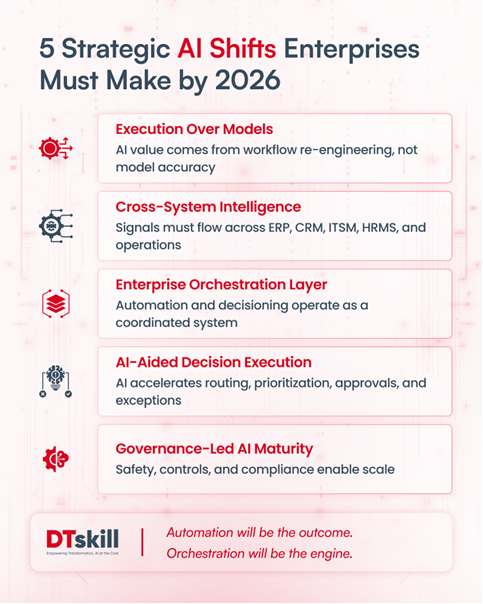
To stay competitive, enterprises must evolve across three interconnected layers: Intelligence, Automation, and Governance & Scale.
Layer 1: Intelligence – How Decisions Flow
For years, AI conversations centered on models, accuracy, parameters, and benchmarks. While those matters, they no longer determine impact.
Execution Over Models
In practice, AI value depends far more on workflow design than on marginal gains in model performance.
A highly accurate model that produces insights but never triggers action delivers little value. A slightly less accurate model embedded directly into approvals, routing, or prioritization can transform operations.
Cross-System Signal Intelligence
Enterprise decisions rarely belong to a single system. Customer intent lives in CRM, financial constraints in ERP, operational risk in ITSM, and capacity signals in HR systems. When AI evaluates these signals in isolation, decisions are incomplete.
In 2026, effective AI systems continuously synthesize real-time context across enterprise platforms, enabling decisions that reflect the full business reality.
Deloitte’s enterprise AI studies show that organizations integrating signals across systems achieve significantly better decision outcomes than those relying on isolated analytics.
Domain-Aware AI
Generic AI struggles in enterprise environments because it lacks understanding of domain-specific rules, constraints, and language. In regulated and complex industries, this is a critical limitation.
Enterprise-grade AI must be domain aware, grounded in industry logic, regulatory boundaries, and operational nuance. This is what enables trustworthy, explainable outcomes rather than impressive but unreliable predictions.
Real-Time Decisioning
Dashboards summarize the past. AI enterprises operate in the present.
Decisions increasingly move from static reports to live operational loops, fraud detection during transactions, dynamic pricing in response to demand shifts, real-time supply chain re-routing, or instant service prioritization.
AI becomes an always-on decision layer embedded into daily operations.
| Intelligence Capability | Traditional Enterprise Approach | AI Operating Model (2026) | Business Impact |
| Decision Activation | Insights delivered via dashboards and reports | Decisions executed directly within workflows and systems | Faster response times and measurable operational outcomes |
| Signal Integration | Systems operate independently with delayed data exchange | Real-time synthesis across CRM, ERP, ITSM, HR, and external signals | More accurate, context-aware enterprise decisions |
| Context Awareness | Generic AI applied across use cases | AI models grounded in domain rules, constraints, and industry logic | Trustworthy decisions in regulated and complex environments |
| Decision Timing | Retrospective, batch-based analysis | Continuous, real-time decision loops embedded in operations | Reduced risk, higher agility, and improved customer experience |
| Human Involvement | Manual interpretation and action | Human oversight focused on judgment and exception handling | Better scalability with preserved accountability |
Layer 2: Automation – How Work Moves
Automation has existed in enterprises for decades, but traditional approaches were brittle. Rule-based workflows broke when conditions changed, forcing humans to intervene.
Autonomous Workflows
In 2026, automation evolves into autonomous workflows. Work moves across systems without manual routing, guided by AI that understands priority, risk, and context.
Standard cases resolve end-to-end, dramatically reducing cycle time and operational drag.
Adaptive Operations
Real-world operations are dynamic. Demand fluctuates, exceptions emerge, and constraints shift.
Modern AI-enabled processes are adaptive by design. They learn from outcomes, adjust paths automatically, and handle exceptions without rigid rule sets.
Operations become living systems that continuously optimize themselves.
Human–AI Execution Models
The most successful enterprises do not remove humans from the loop; they redefine the loop.
AI handles volume, speed, triage, and pattern recognition. Humans focus on judgment, ethics, negotiation, and complex decision-making. This human–AI execution model increases throughput while preserving accountability and trust.
| Automation Dimension | Legacy Automation Model | AI Automation Model (2026) | Enterprise Value Created |
| Workflow Orchestration | Predefined rules and static routing | Autonomous workflows guided by real-time context | Faster cycle times and reduced operational friction |
| Exception Handling | Manual intervention is required for deviations | AI exception handling with dynamic decision paths | Higher resilience and lower human workload |
| Process Adaptability | Fixed processes that degrade over time | Self-adjusting processes that learn from outcomes | Continuous operational optimization |
| Human Involvement | Humans execute and coordinate work | Humans provide judgment, oversight, and escalation | Improved scalability without loss of accountability |
| Operational Scalability | Linear growth in effort with volume | Non-linear scaling through AI-led execution | Cost efficiency and throughput gains |
Layer 3: Scaling AI Requires Architecture and Governance
Many enterprises stall because AI initiatives grow in isolation. Different teams deploy different tools, models, and standards, creating fragmentation and risk.
Unified AI Architecture
By 2026, AI leaders converge on a unified AI architecture, an orchestration backbone that coordinates models, workflows, data access, and monitoring across the organization.
This architecture enables reuse, consistency, and scale, turning AI into shared enterprise infrastructure.
Responsible and Compliant Automation
As AI systems begin executing decisions, trust becomes non-negotiable. Enterprises must embed explainability, auditability, bias detection, and privacy controls directly into AI systems.
Responsible AI is engineered into the platform. Without it, AI cannot scale safely in regulated or customer-facing environments.
Long-Term AI Roadmaps
The final shift is strategic maturity. Leading enterprises move beyond pilots toward multi-year AI roadmaps that define capability sequencing, investment priorities, talent strategies, and governance evolution.
| Scaling Dimension | Fragmented AI State | Enterprise-Scale AI Model (2026) | Strategic Outcome |
| AI Architecture | Disconnected tools, models, and teams | Unified orchestration backbone across models, data, and workflows | Reuse, consistency, and faster enterprise-wide scaling |
| Governance Model | After-the-fact controls and manual reviews | Built-in governance with automated guardrails and policies | Reduced risk and regulator readiness |
| Explainability & Audit | Limited visibility into model behavior | End-to-end traceability and decision audit trails | Trust with regulators, customers, and internal stakeholders |
| Risk & Compliance | Ad hoc bias, privacy, and security checks | Embedded fairness, privacy, and security controls | Safe deployment in regulated and customer-facing use cases |
| Strategic Planning | Short-term pilots and isolated funding | Multi-year AI roadmap aligned to business strategy | Sustained ROI and long-term competitive advantage |
Final Thoughts
By 2026, Models will improve, platforms will commoditize, and access to AI will be universal. What will remain scarce is the ability to convert AI into a governed, repeatable execution engine that scales across the enterprise.
Leading organizations will move beyond tools and pilots to embed intelligence directly into decision flows and operational workflows, connecting systems, applying domain context, enabling real-time action, and governing AI as core infrastructure. Others will remain constrained by fragmented initiatives and isolated gains that never compound.
The shift demands unified AI architecture, responsible automation, human–AI execution models, and long-term roadmaps that move beyond short-term experimentation toward operational maturity. Just as importantly, it requires leadership alignment, tying AI investments to measurable business outcomes, accountability, and continuous improvement.
Frequently Asked Questions (FAQs)
Why is an AI strategy critical for enterprises in 2026?
Because AI is becoming central to decision-making, operations, and customer experience. Without a clear strategy, enterprises risk fragmentation, low ROI, and regulatory exposure.
What are the most important AI capabilities enterprises need?
Key capabilities include real-time decisioning, cross-system intelligence, intelligent automation, domain-aware AI, and strong governance frameworks.
How can enterprises measure ROI from AI initiatives?
ROI should be measured using business KPIs such as cost reduction, revenue growth, risk mitigation, productivity improvement, and time-to-value.
What role do people play in AI success?
People are critical. Cross-functional teams, targeted upskilling, and effective change management determine whether AI is adopted and trusted across the organization.
How can enterprises avoid AI vendor lock-in?
By adopting LLM-agnostic, orchestration-first platforms that allow flexibility in model and technology choices.
Is AI only relevant for technology teams?
No. In 2026, AI impacts every function, from IT and QA to sales, finance, and operations.
