In conversations with SAP-led enterprises, the goal is usually consistent. Teams want AI to support better decisions and faster execution without putting their SAP landscape at risk. SAP systems already run finance, supply chains, procurement, and day-to-day operations. Stability and predictability are not optional in these environments.
As AI enters this landscape, the discussion often starts with tools or use cases. Over time, it shifts. Leaders begin to ask broader questions about how intelligence should be introduced without affecting upgrade paths, governance models, or operational ownership. At that point, AI stops being a technology discussion and becomes an architectural one.
The key question is not whether AI can integrate with SAP. Integration is largely a solved problem. The more important question is where AI should live within the enterprise architecture. That decision shapes how data is accessed, how decisions are audited, and how AI capabilities evolve over time.
By 2026, this distinction matters more than individual model choices. Enterprises that treat AI as a separate intelligence layer rather than embedding it directly into SAP workflows find it easier to scale AI across teams while keeping SAP stable, governed, and upgrade-safe.
What a Private AI + Orchestration Layer Means in SAP Environments
A private AI + orchestration layer is an architectural layer that manages how AI is applied across enterprise systems without embedding intelligence directly into core applications. It controls how AI models access data, how outputs are validated, and how decisions are executed while operating within enterprise privacy and governance boundaries.
In SAP-led enterprises, this distinction matters. SAP systems are designed to act as the system of record, ensuring transactional accuracy, compliance, and long-term stability. A private AI orchestration layer allows AI to operate alongside SAP rather than inside it, enabling SAP AI integration without altering core workflows or upgrade paths.
From an architectural perspective, private AI for SAP is less about introducing new models and more about controlling how intelligence flows across processes. The orchestration layer becomes the point where AI interactions are coordinated, monitored, and governed, while SAP continues to manage execution and record-keeping.
In practical terms, a private AI orchestration layer for SAP enterprises is responsible for:
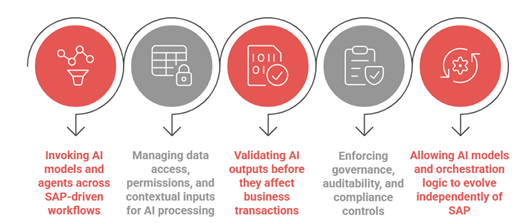
- Invoking AI models and agents across SAP-driven workflows
- Managing data access, permissions, and contextual inputs for AI processing
- Validating AI outputs before they affect business transactions
- Enforcing governance, auditability, and compliance controls
- Allowing AI models and orchestration logic to evolve independently of SAP
This separation enables enterprises to scale SAP AI integration over time, adopt new AI capabilities as they mature, and maintain architectural clarity as AI usage expands toward 2026.
Why AI Placement Matters More Than AI Capability
When enterprises begin exploring AI, attention naturally goes to models and use cases. Over time, a more practical concern emerges. Leaders start to see that where AI is placed in the architecture has a greater impact on scale, control, and long-term viability than the capability of any individual model.
In SAP-led environments, AI placement directly influences how intelligence interacts with systems of record. A private AI orchestration layer changes this interaction by separating experimentation and inference from execution and compliance.
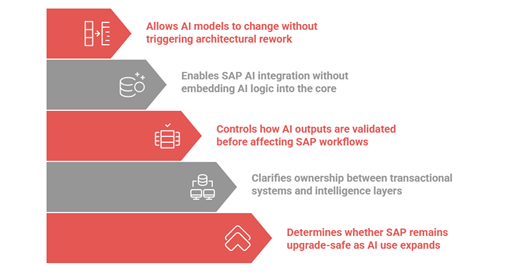
- Determines whether SAP remains upgrade-safe as AI use expands
- Clarifies ownership between transactional systems and intelligence layers
- Controls how AI outputs are validated before affecting SAP workflows
- Enables SAP AI integration without embedding AI logic into the core
- Allows AI models to change without triggering architectural rework
When private AI for SAP is introduced through an orchestration layer, enterprises gain flexibility without sacrificing control. The architecture supports innovation while preserving the stability that SAP environments require.
Architectural Outcomes Enabled by a Private AI Orchestration Layer
When private AI for SAP is introduced as a distinct architectural layer, the benefits extend beyond individual automation or analytics use cases. The structure clarifies how intelligence interacts with SAP systems and how it is governed across the enterprise. Over time, this clarity becomes the foundation for scalable and predictable SAP AI integration.
A private AI orchestration layer consistently enables the following outcomes:
| SAP remains upgrade-safe AI logic operates outside the core, reducing the need for customizations that complicate SAP upgrades. | Clear system boundaries SAP continues as the system of record, while AI functions as a separate intelligence layer. | Centralized AI governance orchestration controls access, execution, and auditability across all AI-driven workflows. |
| Controlled execution of AI outputs validation and approval steps are applied before AI results affect SAP transactions. | Model and vendor flexibility AI models can change without impacting SAP architecture or integrations. | Consistent SAP AI integration at scale intelligence can be applied across functions without fragmented implementations. |
These outcomes are not dependent on a specific AI model or use case. They result from an architectural decision to treat AI as a governed capability rather than an embedded feature. As AI adoption accelerates toward 2026, this structure allows enterprises to expand intelligence while maintaining the stability expected from SAP environments.
Reference Architecture: How SAP and AI Coexist Without Conflict
As AI adoption moves from isolated pilots to enterprise-wide use, the way intelligence flows through the organization becomes just as important as the intelligence itself. In SAP-led environments, clarity around this flow determines whether AI remains manageable or becomes another source of operational complexity.
This reference architecture defines a clear interaction model between AI and SAP, ensuring that intelligence supports execution without interfering with transactional integrity or governance.
The interaction follows a structured, end-to-end flow:
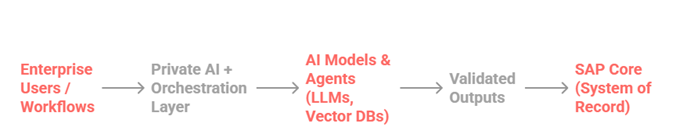
➡️Enterprise Users / Workflows
AI requests originate from business workflows such as finance approvals, supply planning, procurement analysis, or operational monitoring. These workflows remain anchored in SAP-driven processes, with AI invoked only when additional intelligence or decision support is required.
➡️Private AI + Orchestration Layer
The orchestration layer acts as the control plane for all AI activity. It determines whether a request should invoke AI, which data sources can be accessed, which policies apply, and how outputs should be handled. This layer enforces consistency, governance, and accountability across all AI interactions.
➡️AI Models & Agents (LLMs, Vector DBs)
Once approved, AI models and agents generate insights using contextual enterprise data and retrieval mechanisms. The architecture remains model- and vendor-agnostic, allowing different LLMs or vector databases to be used without changing how SAP integrations are designed.
➡️Validated Outputs
AI-generated results are not executed automatically. Outputs pass through validation steps such as confidence checks, business rules, and approval thresholds. This ensures that AI contributes recommendations or actions that align with enterprise policies and risk tolerance.
➡️SAP Core (System of Record)
Only validated and approved outputs are passed back to SAP for execution or record updates. SAP continues to own transactional processing, data persistence, and auditability, preserving its role as the authoritative system of record.
This flow allows private AI for SAP to scale without increasing architectural fragility. AI capabilities can evolve, models can change, and new use cases can be introduced while SAP remains stable, predictable, and upgrade-safe.
How GenE Enables This Architecture in Practice
Implementing a private AI orchestration layer requires a platform that can coordinate intelligence across workflows while preserving the architectural boundaries described earlier. GenE was designed to operate within this model, functioning as the orchestration layer that enables private AI for SAP without embedding intelligence into the SAP core.
| Architectural Requirement | How GenE Supports It |
| Modular AI execution | Orchestrates modular AI agents that perform discrete tasks such as retrieval, reasoning, validation, and execution across SAP-led workflows. |
| Model and vector DB flexibility | Integrates with multiple LLMs and vector databases, allowing enterprises to change or combine models without impacting SAP AI integration. |
| Clean SAP integration | Connects to SAP and other enterprise systems through decoupled interfaces, keeping integrations upgrade-safe and loosely coupled. |
| Centralized AI orchestration | Coordinates all AI workflows through a single control layer, reducing fragmentation and inconsistent behavior across teams. |
| End-to-end AI lifecycle control | Manages prompts, retrieval, generation, validation, and execution as a unified process rather than isolated steps. |
| Governance and execution control | Applies access rules, validation logic, and execution constraints before AI outputs affect SAP transactions. |
By enabling these capabilities at the orchestration layer, GenE supports a scalable approach to private AI for SAP. Enterprises can expand AI usage across functions while maintaining clarity, governance, and long-term architectural stability.
Conclusion
As SAP-led enterprises plan their AI strategies for 2026, the most important decision is not which model to adopt or which use case to start with. It is how intelligence is introduced into an environment that already runs the most critical business processes.
Treating AI as a private, orchestrated layer around SAP allows enterprises to enhance decisions and workflows without changing the role of SAP as the system of record. This separation creates clarity around governance, ownership, and evolution, three factors that become increasingly important as AI usage scales.
A private AI orchestration layer makes it possible to adopt new models, expand AI-driven workflows, and adapt to regulatory or operational change without creating architectural debt. For SAP-led enterprises, this approach provides a stable foundation for long-term AI adoption, one that balances innovation with control.
Frequently Asked Questions (FAQs)
What is private AI for SAP?
Private AI for SAP refers to an architectural approach where AI operates outside the SAP core as a separate, governed intelligence layer. SAP continues to function as the system of record, while AI is orchestrated externally to support decisions and automation without embedding intelligence into SAP workflows.
Why is AI orchestration important in SAP environments?
AI orchestration provides control over how AI models are invoked, how data is accessed, and how outputs are validated before execution. In SAP environments, orchestration ensures that AI-driven actions remain auditable, compliant, and aligned with enterprise governance standards.
How is a private AI orchestration layer different from embedding AI in SAP?
Embedding AI directly into SAP workflows tightly couples intelligence with transactional systems. A private AI orchestration layer keeps AI external, allowing models and logic to evolve independently while SAP remains stable, upgrade-safe, and authoritative.
Does this approach limit SAP AI integration?
No. A private AI orchestration layer enables SAP AI integration at scale by standardizing how intelligence interacts with SAP. It allows AI to be applied across multiple workflows without fragmenting implementations or introducing customizations into the SAP core.
Why does AI placement matter more than model choice?
AI models will continue to change rapidly, while SAP environments are designed for long-term stability. Placement determines whether enterprises can adopt new models without reworking architecture. A private AI orchestration layer preserves flexibility while maintaining control.
Is a private AI orchestration layer only relevant for large enterprises?
It is most valuable in environments where SAP systems support multiple functions, strict governance requirements, and long-term operations. As AI adoption grows, even mid-sized SAP-led organizations benefit from architectural separation early on.
How does this architecture support AI adoption beyond 2026?
By decoupling intelligence from execution, enterprises can evolve AI capabilities, governance models, and integrations incrementally. This reduces architectural risk and allows AI to scale alongside business needs rather than disrupting core systems.
