
In today’s manufacturing landscape, organizations that harness data, integrate intelligent systems, and adopt AI workflows can respond faster to market changes, optimize production, and deliver higher-quality products consistently.
Artificial intelligence is reshaping how factories operate, from smart production planning and predictive maintenance to quality control and supply chain optimization. But AI adoption is most effective when approached strategically. An AI roadmap provides a clear, structured pathway for manufacturers, guiding them through readiness assessment, data integration, pilot projects, and enterprise-wide scaling.
Platforms like DTskill’s GenE make this journey smoother by orchestrating AI across ERP, MES, CRM, and shop-floor systems, embedding intelligence directly into daily workflows without disrupting operations.
This blog explains what an AI roadmap looks like for the manufacturing industry and how it helps organizations improve efficiency, quality, and decision-making over time.
Why Manufacturing Needs an AI Roadmap
Manufacturing operations involve many moving parts, machines, people, materials, suppliers, and customers. When these parts are not well coordinated, small issues can quickly grow into major problems.
Many manufacturers already collect large amounts of data from ERP systems, machines, sensors, and production lines. However, this data is often scattered across systems and used only for reporting, not decision-making. According to McKinsey, data-driven manufacturers achieve 20–30% higher productivity and 10–20% lower operational costs compared to traditional operations.
An AI roadmap helps manufacturers:
- Use data more effectively
- Reduce manual decision-making
- Improve response times across operations
- Scale AI safely and responsibly
Step 1: Assess Readiness and Align AI with Business Goals
The first step in any AI roadmap is understanding where the organization stands today.
Manufacturers need to assess:
- Current systems such as ERP, MES, CRM, and inventory tools
- Data availability and quality
- Skills and awareness of AI across teams
At the same time, leadership enablement must define what AI should achieve. For example:
- Reducing downtime
- Improving production efficiency
- Increasing quote accuracy
- Strengthening supply chain resilience
Platforms like GenE connect AI initiatives directly to operational decisions across sales, procurement, production, and finance, ensuring alignment with business goals.
Step 2: Build a Strong Data Foundation and Governance Model
AI depends on data. If data is incomplete, outdated, or disconnected, AI results will be unreliable.
Manufacturers must focus on:
- Connecting data from machines, sensors, ERP, and production systems
- Structuring unstructured data such as emails, enquiries, and specifications
- Ensuring data accuracy and consistency
GenE acts as an orchestration layer that brings data together without replacing existing systems. It helps AI understand context by linking customer history, inventory levels, production capacity, and cost data.
Alongside data readiness, governance is essential. Manufacturers need clear rules for:
- Data access and security
- Responsible AI usage
- Transparency and auditability of AI decisions
This builds trust and ensures AI can be scaled safely.
Step 3: Start with High-Impact AI Use Cases
Rather than applying AI everywhere at once, successful manufacturers start with focused use cases that deliver quick value.
Predictive Maintenance
AI analyzes sensor data such as vibration and temperature to predict equipment failure before it happens. This reduces unplanned downtime and extends machine life.
Production Planning
AI studies order history, machine performance, and inventory to create more accurate production schedules. This improves output and reduces idle time.
Quality Control
AI-powered vision systems detect defects early and maintain consistent quality across batches.
Sales and Quotation
AI helps acknowledge enquiries instantly, interpret product specifications, and generate accurate quotes using real-time data.
These use cases build confidence in AI and show measurable results early in the journey.
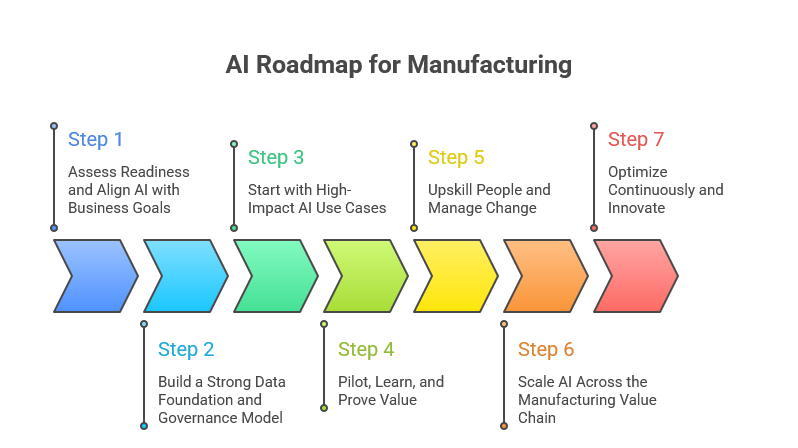
Step 4: Pilot, Learn, and Prove Value
Pilots are a critical part of the AI roadmap. They allow manufacturers to test AI solutions in real environments without high risk.
Effective pilots:
- Use real production or business data
- Involve frontline teams
- Focus on clear success metrics
With GenE, AI pilots are embedded into daily workflows such as enquiry handling, quotation, procurement planning, or maintenance scheduling. This makes it easier for teams to adopt AI and see its value.
Results from pilots help leadership decide where to invest next.
Step 5: Upskill People and Manage Change
AI works best when people understand and trust it.
Manufacturers need to invest in:
- AI awareness for leadership
- Training for teams using AI-driven tools
- New roles focused on monitoring and improving AI systems
Change management is equally important. Teams should understand that AI supports their work rather than replacing them. GenE follows a human-in-the-loop approach, keeping people involved in key decisions while reducing manual effort.
This people-first approach improves adoption and long-term success.
Step 6: Scale AI Across the Manufacturing Value Chain
Once pilots succeed, AI can be expanded across the organization.
With GenE, manufacturers can scale AI across:
- Sales and customer engagement
- Procurement and supplier management
- Logistics and delivery tracking
- Finance and compliance
Because GenE integrates with existing IT and OT systems, AI becomes part of everyday operations rather than a separate layer.
Step 7: Optimize Continuously and Innovate
AI adoption does not end with deployment. Manufacturers must continuously monitor performance and refine models.
This includes:
- Tracking ROI and efficiency gains
- Updating AI models with new data
- Expanding to advanced use cases such as AI agents and digital twins
Over time, AI helps manufacturers move from reactive operations to predictive and adaptive systems.
Key AI Focus Areas in Manufacturing
| AI Focus Area | Manufacturing Challenge | How AI Helps | GenE (DTskill) POV | Business Impact |
| Smart Factories | Limited real-time visibility across machines and production lines; slow response to issues | AI enables real-time monitoring, anomaly detection, and adaptive control of operations | GenE acts as an intelligent workflow layer connecting ERP, MES, IoT, and shop-floor data to deliver real-time, AI-driven insights | Faster issue resolution, improved throughput, reduced operational disruptions |
| Supply Chain | Demand volatility, supplier delays, inventory imbalance, and risk exposure | AI forecasts demand, identifies supply risks early, and optimizes inventory planning | GenE orchestrates data from procurement, sales orders, suppliers, and logistics systems to provide predictive and actionable supply chain intelligence | Improved demand accuracy, reduced stockouts and excess inventory, and higher supply chain resilience |
| Quality Control | Manual inspections miss defects; inconsistent quality across batches | AI-powered vision systems and predictive models detect defects early and ensure quality consistency | GenE integrates quality data, inspection reports, and production workflows to trigger corrective actions automatically | Lower scrap rates, fewer reworks, improved customer satisfaction, and compliance |
| Predictive Maintenance | Unexpected machine failures cause downtime and high repair costs | AI analyzes sensor data to predict failures before they occur | GenE connects machine data, maintenance logs, and operational schedules to enable proactive maintenance planning | Reduced downtime, longer asset life, lower maintenance costs |
Final Thoughts
An AI roadmap gives manufacturers a clear and practical path to adopt artificial intelligence. It helps organizations move step by step, from readiness and pilots to enterprise-wide intelligence.
AI is not about replacing people or machines. It is about helping teams work smarter, respond faster, and make better decisions. With DTskill’s GenE, manufacturers can connect data, workflows, and decisions into one intelligent system.
The manufacturers that follow this roadmap will build operations that are more efficient, resilient, and competitive, ready for the future of industry.
Frequently Asked Questions (FAQs)
1. What is an AI-ready manufacturing organization?
An AI-ready manufacturing organization integrates AI across operations, systems, and workflows to improve efficiency, quality, and decision-making.
2. Why do manufacturing organizations need an AI roadmap?
An AI roadmap aligns technology adoption with business goals, prioritizes use cases, and scales AI efficiently across the enterprise.
3. What are the key stages of an AI roadmap for manufacturing?
Key stages include readiness assessment, data foundation, pilot projects, talent development, governance, scaling solutions, and continuous optimization.
4. How does AI improve predictive maintenance in factories?
AI predicts equipment failures using sensor and historical data, reducing downtime, lowering repair costs, and extending machinery life.
5. What role does data play in AI-ready manufacturing?
High-quality, integrated data from ERP, MES, IoT, and production systems powers AI insights, automation, and informed decision-making.
6. How can AI enhance production planning and scheduling?
AI analyzes demand, inventory, and machine performance to optimize production schedules, balance workloads, and improve delivery timelines.
7. What are AI’s benefits for quality control in manufacturing?
AI-powered vision systems detect defects in real time, maintain consistency, reduce waste, and enhance overall product quality.
8. How can AI improve supply chain management?
AI forecasts demand, optimizes inventory, predicts supplier risks, and ensures timely, cost-effective procurement across the supply chain.
9. What skills do manufacturing teams need for AI adoption?
Teams need AI literacy, data analysis, process automation understanding, and change management skills for successful implementation.
10. How do manufacturers scale AI successfully?
Start with pilot projects, integrate AI across systems, standardize workflows, track ROI, and expand use cases gradually.
11. How does GenE by DTskill support AI-ready manufacturing?
GenE orchestrates ERP, MES, CRM, and IoT data, enabling seamless AI automation, predictive insights, and operational intelligence.
