
Software development has always evolved alongside better tools. From IDEs and version control to CI/CD pipelines, each advancement has helped teams build, test, and deliver software more efficiently. Today, AI-assisted development tools are becoming part of that same evolution.
This has sparked a growing discussion around ai vs manual coding comparison within engineering teams. Developers are exploring how AI-assisted coding vs manual approaches affect development speed, code quality, and day-to-day productivity.
The real question is not whether developers will continue writing code manually; they will. The more interesting question is where AI assistance meaningfully improves development efficiency and where traditional coding practices still remain essential. That is exactly what we explore in this comparison.
What Manual Coding and AI-Assisted Coding Actually Mean
Manual coding refers to the traditional development approach where developers write, review, and refine code directly within their development environment. Every function, module, and logic block is written and adjusted by the engineer, often supported by existing frameworks, libraries, and debugging tools.
In contrast, AI-assisted coding vs manual development introduces an additional layer of assistance. AI tools can generate code snippets, suggest improvements, refactor existing modules, or help document code based on the developer’s intent. This doesn’t remove the developer from the process; it changes how certain coding tasks are performed.
In practical terms, the difference between the two approaches often comes down to how work is distributed across the development workflow.
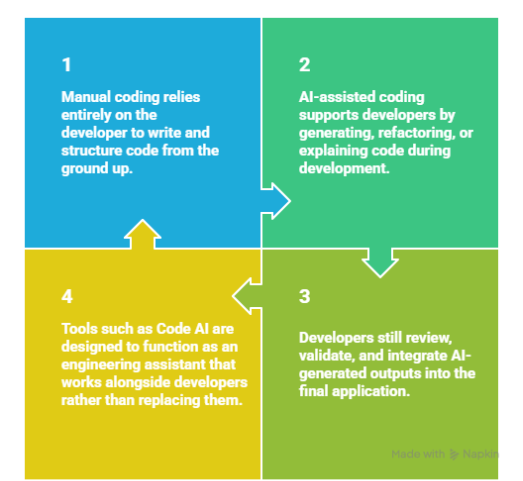
- Manual coding relies entirely on the developer to write and structure code from the ground up.
- AI-assisted coding supports developers by generating, refactoring, or explaining code during development.
- Developers still review, validate, and integrate AI-generated outputs into the final application.
- Tools such as Code AI are designed to function as an engineering assistant that works alongside developers rather than replacing them.
Understanding this distinction helps frame the broader ai vs manual coding comparison. To evaluate which approach is more efficient, we need to look at how they differ across real development factors such as speed, consistency, and workflow integration.
Manual Coding vs AI-Assisted Coding: Key Differences
To understand the practical differences between development approaches, it helps to compare how manual coding and AI-assisted development affect everyday engineering tasks. Most teams today are not choosing one method exclusively; instead, they are evaluating where AI assistance can reduce effort without compromising engineering control.
The following ai vs manual coding comparison highlights how the two approaches differ across common development factors.
| Development Factor | Manual Coding | AI-Assisted Coding |
| Code Generation | Developers write logic and structure from scratch based on requirements. | AI can generate code snippets or modules based on prompts or existing repository context. |
| Development Speed | Progress depends entirely on developer effort and experience. | Routine code and boilerplate can be generated quickly, accelerating development cycles. |
| Refactoring | Developers manually analyze and restructure existing code. | AI can suggest refactoring improvements to optimize readability and structure. |
| Documentation | Documentation and comments are written manually and often added later in the process. | AI tools can automatically generate documentation and inline comments during development. |
| Code Consistency | Consistency depends on developer discipline and team coding standards. | AI can learn repository patterns and help maintain consistent coding styles. |
| Debugging Support | Developers identify issues through logs, testing, and debugging tools. | AI can suggest potential fixes or highlight problematic sections of code. |
| Learning Curve | Developers rely on documentation, experience, and peer collaboration. | AI assistants can explain code logic or provide guidance while coding. |
| Workflow Integration | Coding takes place within IDEs and development pipelines controlled by developers. | AI assistants integrate within development environments to support AI-assisted coding vs manual workflows. |
This comparison shows that the debate is less about replacement and more about how developers distribute effort across the development process. Understanding where AI assistance improves efficiency helps teams decide when traditional coding practices remain the better approach.
Where AI-Assisted Coding Improves Development Efficiency
In many development teams, a significant portion of time is spent on tasks that are structured and repetitive. Generating boilerplate code, refactoring modules, updating documentation, and maintaining consistency across repositories can take considerable engineering effort. This is where AI-assisted coding vs manual development begins to show measurable efficiency improvements.
Several areas of the development workflow benefit from AI-assisted support.
❇️ Reducing Boilerplate Coding
AI tools can quickly generate common structures such as API endpoints, data models, or configuration files, allowing developers to focus on application logic.
❇️ Accelerating Feature Development
Developers can move from requirements to working code faster by using AI to generate initial implementations that can then be refined manually.
❇️ Improving Code Refactoring
AI assistants can analyze existing code and suggest structural improvements that enhance readability and maintainability.
❇️ Automating Documentation
Technical comments and documentation can be generated automatically, helping teams maintain clearer codebases without additional writing effort.
❇️ Maintaining Repository Consistency
AI can learn coding patterns from repositories and help developers maintain consistent structure across modules.
❇️ Supporting Developer Productivity
Tools such as Code AI act as engineering assistants by helping generate, review, and refine code during development.
These improvements explain why interest in ai vs manual coding comparison continues to grow among development teams. However, AI assistance does not replace traditional engineering practices in every scenario.
When Manual Coding Still Makes Sense
Despite the progress of AI-assisted development tools, manual coding remains essential in many areas of software engineering. Certain tasks require deep architectural thinking, domain knowledge, and careful design decisions that go beyond pattern generation. In these situations, developers rely on experience and judgment rather than automated suggestions.
Manual development is also important when teams are working on complex algorithms, performance-critical systems, or security-sensitive components. These areas often demand precise control over implementation details and careful testing. Even when using AI-assisted coding vs manual approaches, developers still review and refine the final logic before code becomes part of production systems.
In practice, most engineering teams treat AI assistance as a complement rather than a replacement. The ai vs manual coding comparison is less about choosing one method over the other and more about understanding where each approach contributes most effectively within the development workflow.
Best Practices for Combining Manual and AI-Assisted Coding
Most modern development teams are not choosing between manual coding and AI-assisted development. Instead, they are learning how to combine both approaches in ways that improve productivity while maintaining engineering quality. A thoughtful balance allows teams to benefit from AI support without losing developer oversight.
The following practices help teams integrate AI-assisted coding vs manual workflows effectively.
| Best Practice | Why It Matters |
| Use AI for repetitive coding tasks | AI can generate boilerplate structures and routine components faster than manual coding. |
| Maintain developer review for all AI-generated code | Human validation ensures generated outputs meet architectural and security standards. |
| Align AI outputs with repository standards | AI should learn existing patterns so generated code remains consistent with team practices. |
| Integrate AI tools into existing development environments | Seamless integration within IDEs and pipelines supports smoother ai vs manual coding comparison workflows. |
| Use AI to assist with refactoring and documentation | Automated suggestions can improve code readability and maintainability. |
| Treat AI as an engineering assistant, not an autopilot | Developers remain responsible for design decisions and final code implementation. |
When used thoughtfully, AI assistance enhances developer productivity without reducing engineering control. The most effective teams treat AI as a collaborative tool that supports developers rather than replacing traditional coding expertise.
Conclusion
The discussion around ai vs manual coding comparison is not about replacing developers or abandoning traditional coding practices. Software development still relies on engineering expertise, architectural thinking, and careful implementation decisions. What AI introduces is a new layer of assistance that can reduce repetitive effort across the development workflow.
For many teams, the most practical approach is combining manual development with AI-assisted coding vs manual techniques. Developers continue to design systems and review implementations, while AI tools help generate, refine, and document code more efficiently.
Modern engineering assistants such as Code AI illustrate how AI can support development without changing how teams already build software. By assisting with code generation, refactoring, and documentation, these tools help developers spend more time on architecture and problem solving while maintaining control over the final implementation.
FAQs
1. Is AI-assisted coding more efficient than manual coding?
Efficiency depends on the task. AI tools can speed up repetitive coding tasks, documentation, and refactoring, while manual coding remains important for architecture design and complex logic. The ai vs manual coding comparison often shows the best results when both approaches are combined.
2. Can AI replace developers in software development?
No. AI tools assist developers but do not replace engineering expertise. Developers still design systems, review code, validate outputs, and ensure that applications meet performance and security requirements.
3. What is AI-assisted coding?
AI-assisted coding vs manual development refers to using AI tools that help generate code, suggest improvements, refactor modules, or document logic while developers remain responsible for reviewing and integrating the final output.
