
Enterprise AI has become an important capability for organizations seeking to improve decision-making, operational efficiency, and digital maturity. As AI adoption expands across functions, enterprises are focusing on how AI can be applied consistently and responsibly within existing business processes.
This shift has increased the importance of enterprise AI beyond individual projects or isolated use cases. AI is now expected to support core workflows, align with business objectives, and deliver measurable outcomes across teams. To achieve this, enterprises need a structured approach that brings clarity to how AI is planned, governed, and scaled.
An Enterprise AI Center of Excellence provides this structure. It helps organizations coordinate AI initiatives, establish governance, and guide adoption in a way that enhances execution rather than disrupting it. In this blog, we explore why enterprise AI matters, the role of an AI Center of Excellence, and how enterprises use this model to support sustainable AI-driven growth.
What Is an Enterprise AI Center of Excellence?
An Enterprise AI Center of Excellence (AI CoE) is a centralized function that guides how AI is planned, implemented, operationalized, governed, and scaled across an organization. It establishes a clear structure around ownership, decision-making, and execution so AI can be applied consistently across departments while fitting into existing business processes.
Rather than focusing on individual AI use cases, an AI CoE focuses on how AI is managed at the enterprise level from intake and prioritization to deployment, oversight, and measurement. This ensures teams can adopt AI in a coordinated and repeatable way.
An Enterprise AI CoE typically provides:
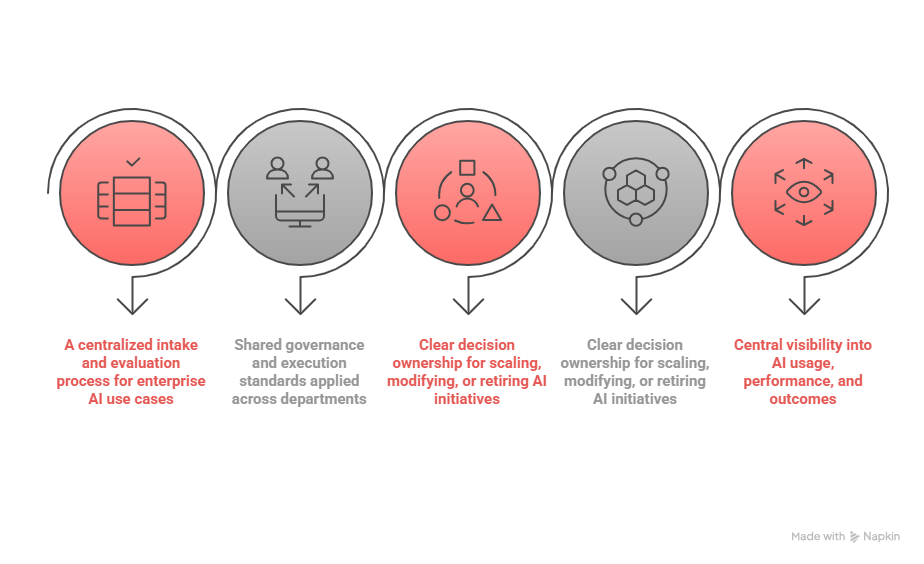
- A centralized intake and evaluation process for enterprise AI use cases
- Shared governance and execution standards applied across departments
- Clear decision ownership for scaling, modifying, or retiring AI initiatives
- Common frameworks and tools used to deploy AI into business workflows
- Central visibility into AI usage, performance, and outcomes
By defining how AI operates across the organization, an Enterprise AI Center of Excellence creates the structural foundation needed for consistent, scalable enterprise AI adoption.
Why Enterprise AI Needs a Center of Excellence
As AI adoption expands across departments and use cases, enterprises benefit from a dedicated function that coordinates how AI is applied across the organization. An Enterprise AI Center of Excellence provides this coordination by establishing shared direction, oversight, and execution alignment for AI initiatives.
Enterprises establish an AI CoE to ensure that AI adoption remains structured, intentional, and aligned with enterprise operations in the following ways:
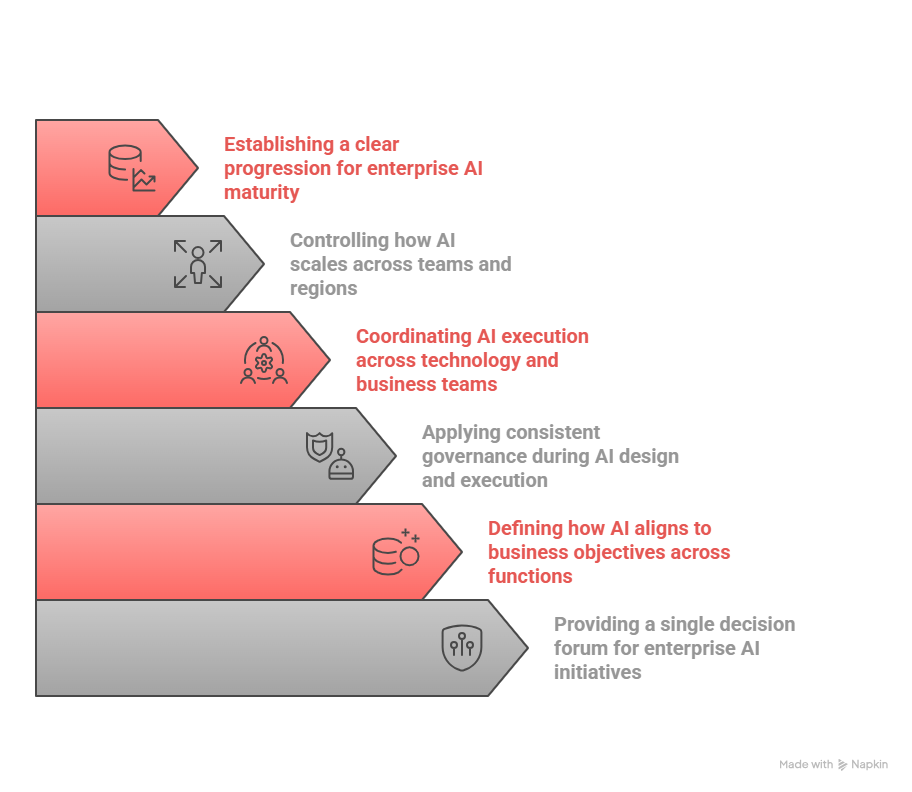
- Providing a single decision forum for enterprise AI initiatives
The AI CoE evaluates incoming AI use cases, resolves cross-department dependencies, and determines which initiatives should move forward based on enterprise priorities. - Defining how AI aligns to business objectives across functions
The CoE maps AI initiatives to concrete goals such as customer experience improvement, operational efficiency, workforce enablement, or compliance support by function and workflow. - Applying consistent governance during AI design and execution
The CoE ensures data usage, model behavior, oversight requirements, and evaluation criteria are applied uniformly as AI moves from design to deployment. - Coordinating AI execution across technology and business teams
The CoE aligns business owners, IT, data teams, and operations so AI solutions integrate smoothly into existing systems and workflows. - Controlling how AI scales across teams and regions
Successful AI implementations are reviewed, standardized, and extended through CoE-led frameworks rather than being rebuilt independently by each team. - Establishing a clear progression for enterprise AI maturity
The CoE defines benchmarks and adoption stages, helping the organization evolve from early AI usage to coordinated, enterprise-wide execution.
Together, these responsibilities demonstrate the importance of enterprise AI as a managed capability one that benefits from centralized coordination through an AI Center of Excellence to support consistency, accountability, and long-term digital maturity.
Core Responsibilities of an Enterprise AI Center of Excellence
An Enterprise AI Center of Excellence plays a central role in shaping how AI is adopted and scaled across the organization. Its responsibilities focus on enabling teams to apply AI effectively while maintaining consistency, governance, and alignment with business priorities.
Key responsibilities of an AI CoE include:
| Defining AI standards and governance frameworks Establishes shared guidelines for how AI is designed, deployed, and monitored across enterprise environments. | Identifying and prioritizing high-impact AI use cases Helps teams focus on AI initiatives that align with strategic goals and deliver measurable business value. | Enabling cross-functional collaboration and knowledge sharing Creates common frameworks, documentation, and best practices that support consistent AI adoption across departments. |
| Supporting AI execution and operational readiness Guides teams on integrating AI into workflows, systems, and roles without disrupting existing processes. | Measuring AI performance and business impact Tracks outcomes, adoption, and performance metrics to ensure AI initiatives remain aligned with enterprise objectives. | Advancing enterprise AI maturity over time Provides structure and direction as organizations progress from early adoption to more mature, scalable AI practices. |
How an AI Center of Excellence Drives Measurable Enterprise AI Value
The value of an Enterprise AI Center of Excellence is reflected in outcomes rather than activity. By bringing structure to AI adoption, a CoE helps enterprises move from isolated implementations to coordinated, value-driven execution.
An AI CoE enables measurable enterprise value by connecting governance, orchestration, and adoption with clear performance indicators.
How an Enterprise AI Center of Excellence Delivers Value
| AI CoE Focus Area | What the CoE Enables | Enterprise-Level Metrics |
| AI Governance | Consistent policies and responsible AI usage across teams | Compliance coverage, audit readiness |
| AI Orchestration | Coordinated AI execution across workflows and systems | Deployment time, AI reuse rate |
| AI Adoption | Structured rollout of AI across business functions | Adoption rate, active AI workflows |
| AI Value Realization | Alignment of AI initiatives with business outcomes | Cost efficiency, productivity improvement |
| Digital Maturity | Scalable and repeatable AI practices | AI maturity progression, expansion velocity |
By linking AI initiatives to these value drivers and metrics, an AI Center of Excellence helps enterprises demonstrate the importance of enterprise AI through tangible results. This structured approach enables organizations to scale AI with confidence while maintaining clarity, accountability, and long-term impact.
Enterprise AI Orchestration: Enabling the AI CoE in Practice
An Enterprise AI Center of Excellence defines how AI should be governed, prioritized, and scaled, but execution requires a practical layer that connects these principles to real workflows. Enterprise AI orchestration provides this layer by translating AI strategy into consistent, operational execution across systems and teams.
Platforms like GenE support this role by enabling the AI CoE to coordinate AI usage across functions without disrupting existing processes. GenE acts as an orchestration and automation layer that connects AI agents, enterprise systems, and workflows, allowing governance rules and execution standards defined by the CoE to be applied consistently in practice.
Through orchestration, the AI CoE can ensure AI initiatives are reusable, integrated, and aligned with business objectives, while still allowing teams to apply AI where it enhances day-to-day execution.
How Enterprises Build Digital Maturity with an AI Center of Excellence
Digital maturity in enterprise AI develops through structured progression rather than isolated adoption. An AI Center of Excellence plays a key role in guiding this progression by helping organizations apply AI consistently, measure outcomes, and expand usage in a controlled manner.
Enterprises build AI-driven digital maturity by:
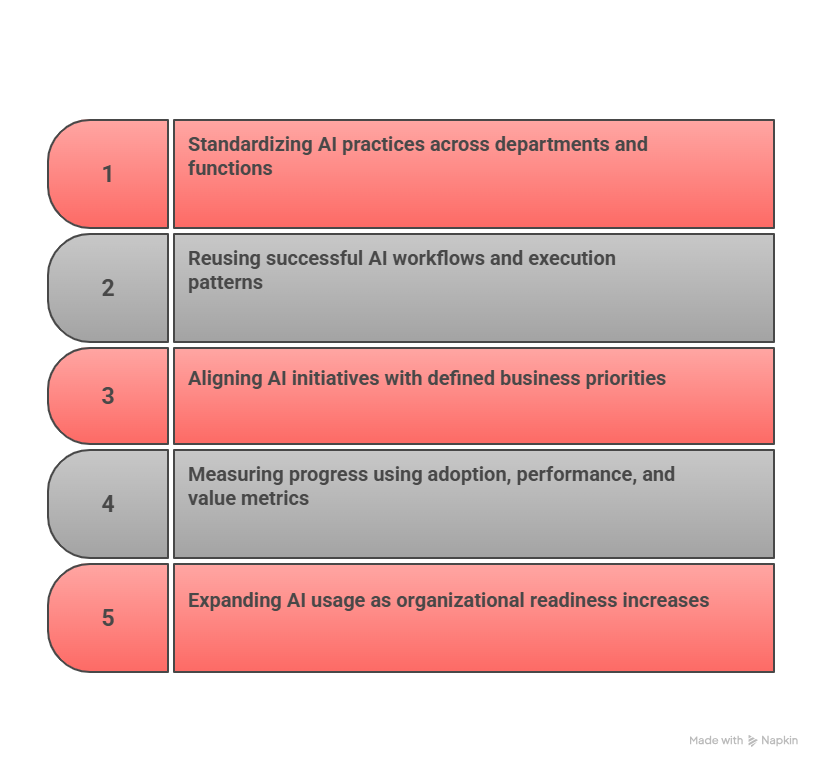
- Standardizing AI practices across departments and functions
- Reusing successful AI workflows and execution patterns
- Aligning AI initiatives with defined business priorities
- Measuring progress using adoption, performance, and value metrics
- Expanding AI usage as organizational readiness increases
Over time, this approach helps enterprises embed AI into everyday operations in a way that strengthens execution, supports long-term scalability, and advances overall digital maturity.
Key Takeaways
- The importance of enterprise AI lies in its ability to enhance execution at scale
- An Enterprise AI Center of Excellence provides structure for consistent AI adoption
- AI CoEs align strategy, governance, and execution across business functions
- Enterprise AI orchestration enables AI CoEs to operate effectively in real workflows
- Digital maturity improves when AI adoption follows a coordinated, measurable approach
Conclusion
Enterprise AI has become a foundational capability for organizations aiming to improve efficiency, decision-making, and digital maturity. As AI adoption expands, enterprises increasingly rely on structured models to ensure AI is applied consistently, responsibly, and in alignment with business objectives.
An Enterprise AI Center of Excellence plays a central role in this shift by providing governance, coordination, and direction for AI initiatives. Supported by enterprise AI orchestration, the AI CoE helps organizations move from isolated AI efforts to scalable, value-driven execution, reinforcing the long-term importance of enterprise AI in modern business operations.
