
Over the past few years, software teams have gained better tooling, faster infrastructure, and mature DevOps practices. Yet much of a developer’s day is still spent writing repetitive logic, refactoring legacy code, documenting changes, or preparing code for review. As delivery expectations increase, engineering leaders are looking for ways to support developers without adding more process.
This is where an AI engineering assistant starts to change how teams operate. Instead of acting as a standalone coding tool, AI now works alongside developers inside their existing environments generating code, improving structure, and aligning outputs with repository standards. For teams exploring AI for developers, the shift is toward intelligent assistance that understands real engineering workflows.
Platforms like Code AI represent this next step in AI-assisted software development, where AI functions as an engineering partner rather than an external tool. In this blog, we look at how Code AI supports modern software teams across development, refactoring, documentation, and delivery and why the engineering assistant is becoming a core part of modern development teams.
What an AI Engineering Assistant Means for Software Teams Today
An AI engineering assistant is best understood as an extension of the development team rather than a standalone coding tool. It supports developers across everyday engineering tasks such as generating boilerplate code, refactoring modules, and maintaining consistency across repositories. The objective is to reduce friction in development while keeping engineers focused on architectural and problem-solving work.
For modern teams adopting AI for developers, the assistant becomes part of the workflow itself operating within IDEs, repositories, and CI/CD pipelines. A mature coding assistant understands project context, coding standards, and historical patterns, enabling teams to move toward more structured AI-assisted software development without changing how developers already build software.
Introducing Code AI: An AI Engineering Assistant Built for Real Development Workflows
Code AI is designed to function as an embedded AI engineering assistant for modern software teams. Instead of operating as a standalone coding tool, it works alongside developers within existing environments, supporting how teams design, build, and maintain software across delivery cycles.
As engineering workflows become more distributed and repository-driven, teams adopting AI-assisted software development require assistants that understand context, standards, and execution environments. Code AI brings AI for developers into daily engineering work through an architecture built specifically for enterprise development teams.
Code AI is enabled through four foundational components:
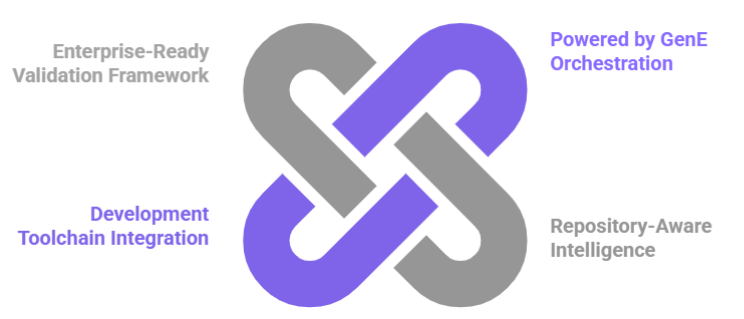
- Powered by GenE Orchestration
Built on GenE’s orchestration layer, enabling coordinated AI execution across development workflows rather than isolated code generation.
- Repository-Aware Intelligence
Connects directly with enterprise repositories to understand coding standards, historical patterns, and project context.
- Development Toolchain Integration
Operates seamlessly within IDEs, Git platforms, and CI/CD environments as a contextual coding assistant.
- Enterprise-Ready Validation Framework
Applies testing, linting, and compliance checks to ensure generated outputs align with engineering and security standards.
Together, these foundations allow Code AI to operate as a practical AI engineering assistant, supporting teams without changing how modern software engineering workflows already function.
How Code AI Assists Modern Software Engineering Teams Across the Development Lifecycle
Modern development teams work across multiple stages , writing new features, improving existing code, maintaining documentation, and ensuring delivery readiness. An effective AI engineering assistant supports each of these stages without interrupting established workflows. Code AI is designed to assist developers continuously, enabling structured AI-assisted software development across the entire engineering lifecycle.
Key capabilities include:
| Natural Language Code Generation Converts developer instructions into working modules or reusable code components. | Code Refactoring and Optimization Improves structure, readability, and performance while preserving intended functionality. | Repository-Aligned Development Generates outputs aligned with existing standards to support consistent AI for developers adoption. |
| Automated Documentation and Commenting Produces inline documentation that improves maintainability and onboarding efficiency. | Integrated Testing and Validation Applies linting and test checks before output delivery to maintain engineering quality. | Multi-Language and Framework Support Functions as a cross-stack coding assistant across enterprise and product development environments. |
By assisting across development stages, Code AI enables teams to reduce repetitive effort while maintaining control over delivery quality. The assistant becomes part of everyday engineering execution rather than an additional tool developers must manage.
Practical Use Cases: How Teams Use an AI Engineering Assistant in Daily Development
As development environments grow more complex, teams increasingly look for practical ways to integrate assistance directly into everyday engineering work. A mature AI engineering assistant supports developers across real delivery scenarios rather than isolated coding tasks. Code AI enables AI-assisted software development by assisting teams where time and coordination are most heavily spent.
❇️ Feature Development Acceleration
Developers use Code AI to generate initial service layers, APIs, and functional components from requirements. This reduces setup time and allows teams to move faster from design discussions to working implementations.
❇️ Legacy Code Refactoring and Modernization
Existing modules can be analyzed and refactored to improve maintainability and performance. Teams applying AI for developers use this capability to modernize legacy systems without altering business logic.
❇️ Automated Documentation Generation
Code AI creates inline documentation and technical explanations as code evolves. This improves knowledge transfer and reduces onboarding time for new contributors within distributed engineering teams.
❇️ Code Review Preparation and Quality Alignment
Developers prepare review-ready code by applying automated optimization and validation checks. Acting as a contextual coding assistant, Code AI helps maintain consistency before peer review begins.
❇️ Rapid Prototyping and Experimentation
Engineering teams quickly test ideas or architectural approaches by generating working prototypes. This allows teams to validate concepts early while maintaining alignment with repository standards.
Across these scenarios, Code AI supports developers without changing established workflows. The assistant enhances productivity while allowing teams to focus on architecture, problem solving, and innovation across modern software engineering environments.
Developer Productivity Impact with AI-Assisted Software Development
As engineering teams scale delivery expectations, productivity is increasingly measured by how efficiently developers can move from idea to deployment. A well-implemented AI engineering assistant supports this shift by reducing repetitive effort while maintaining development quality. Code AI enables measurable improvements across team collaboration, delivery speed, and engineering consistency.
| Productivity Area | Impact Enabled by Code AI |
| Development Speed | Accelerates feature delivery by assisting developers with generation, refactoring, and validation tasks. |
| Code Quality Consistency | Supports standardized outputs aligned with repository practices through structured AI-assisted software development. |
| Developer Focus | Allows engineers to spend more time on architecture and problem solving instead of repetitive coding work. |
| Collaboration Efficiency | Improves shared understanding through automated documentation and contextual suggestions. |
| Onboarding Time | Helps new developers understand codebases faster using repository-aware assistance. |
| Delivery Predictability | Enables teams adopting AI for developers to maintain consistent development cycles across projects. |
By embedding assistance directly into workflows, Code AI improves productivity without introducing additional process overhead. The assistant becomes a continuous support layer that scales alongside modern software engineering teams.
Best Practices for Adopting an AI Engineering Assistant in Enterprise Teams
Adopting an AI engineering assistant delivers the strongest outcomes when introduced as part of structured engineering practices rather than isolated experimentation. Enterprise teams benefit when AI assistance aligns with repositories, workflows, and delivery standards. A disciplined approach helps organizations scale AI-assisted software development consistently across teams.
✅ Integrate the assistant with existing repositories to align outputs with established coding standards.
✅ Embed the coding assistant directly within IDEs and CI/CD workflows to support developers in context.
✅ Maintain testing, linting, and review checkpoints alongside generated code outputs.
✅ Establish usage guidelines for applying AI for developers across generation, refactoring, and documentation.
✅ Begin adoption with selected teams before scaling organization-wide implementation.
✅ Use repository learning to maintain consistency across distributed engineering teams.
✅ Continuously monitor productivity and quality outcomes as AI usage expands.
When implemented thoughtfully, an AI engineering assistant becomes part of everyday engineering execution. Teams gain productivity improvements while preserving ownership, quality, and development discipline across modern software environments.
Conclusion
Software development continues to evolve as teams balance delivery speed, code quality, and growing system complexity. The role of tooling is no longer limited to enabling coding it now supports how engineering teams think, collaborate, and execute across the development lifecycle.
An AI engineering assistant like Code AI brings structured assistance directly into everyday workflows. By supporting generation, refactoring, validation, and documentation, Code AI enables practical AI-assisted software development without changing how teams already build software.
As modern engineering teams adopt AI for developers, the assistant becomes a productivity layer that scales alongside repositories, workflows, and delivery goals helping teams move faster while maintaining consistency and control.
FAQs
What is an AI engineering assistant?
An AI engineering assistant is an AI-powered development companion that supports coding, refactoring, documentation, and validation tasks within existing engineering workflows.
How does AI assist modern software engineering teams?
AI assists teams by reducing repetitive development effort, improving consistency, and supporting developers throughout the software lifecycle as part of AI-assisted software development.
Does an AI engineering assistant replace developers?
No. An AI engineering assistant functions as a collaborative support system that enhances developer productivity while engineers retain design and decision ownership.
How is Code AI different from basic coding tools?
Code AI learns from repositories, integrates with development pipelines, and operates as a contextual coding assistant aligned with enterprise workflows.
Can enterprises securely adopt AI for developers?
Yes. Enterprise-ready assistants support governance, validation, and repository alignment, enabling secure adoption of AI for developers across teams.
What teams benefit most from AI engineering assistants?
Product engineering, platform teams, modernization initiatives, and distributed development teams benefit significantly from structured AI-assisted development support.
