
Building AI agents that operate without constant human input introduces a quieter, more complex challenge: control. While it’s relatively easy to deploy agents that assist humans or automate narrow tasks, truly autonomous systems require organizations to trust LLMs with judgment, prioritization, and execution. And even the most advanced models can drift, misinterpret intent, or optimize for the wrong outcome in subtle ways.
This creates a critical question every organization must confront:
How much autonomy should an AI agent have, and where must human oversight remain non-negotiable?
There is no single right answer. A compliance team reviewing legal documents needs far stricter guardrails than a sales team enriching lead data. Workforce intelligence systems demand continuous reasoning across signals, while marketing workflows may benefit from faster, loosely supervised execution. In some cases, full autonomy unlocks scale. In others, it introduces unacceptable risk.
In this guide, we examine 12 of the most capable autonomous AI agents in 2026, each representing a different point on the autonomy-control spectrum, from no-code agents with built-in checkpoints to enterprise platforms designed to operate independently across complex systems for extended periods.
What Are Autonomous AI Agents?
An autonomous AI agent is a system that can interpret goals, plan actions, execute across tools, and adapt based on outcomes, without requiring continuous human input.
In practice, autonomous agents combine:
- Large Language Models (LLMs) for reasoning
- Memory for context persistence
- Tool access for execution
- Feedback loops for adaptation
Unlike traditional automation, autonomous AI agents are goal-driven rather than instruction-driven.
What Defines a True Autonomous AI Agent in 2026?
Before ranking tools, it’s important to clarify what autonomy actually means today.
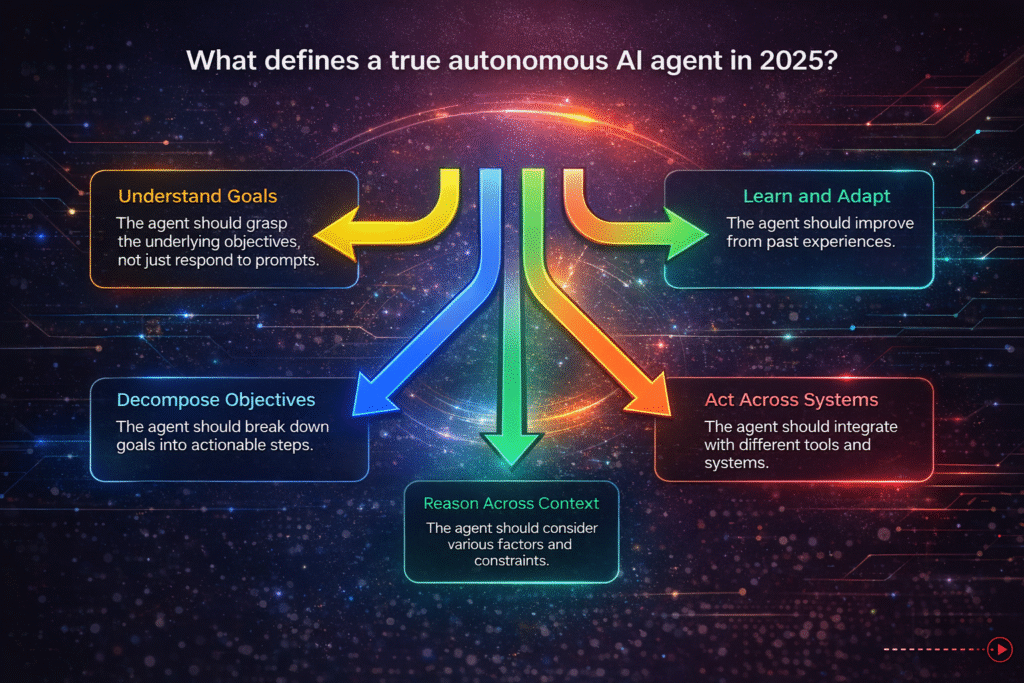
A true autonomous AI agent must do more than respond or automate tasks. It should:
- Understand goals, not just prompts
- Decompose objectives into executable steps
- Reason across context, data, and constraints
- Act across systems and tools
- Learn and adapt from outcomes
Most tools claiming “agentic AI” still rely on brittle workflows or human-triggered steps. Only a few operate as systems, not features.
Autonomous AI Agents vs Traditional Automation
| Dimension | Traditional Automation | Autonomous AI Agents |
| Control | Fixed rules and triggers | Goal-driven execution |
| Context awareness | Limited, session-bound | Persistent, cross-task |
| Decision-making | Deterministic logic | Probabilistic reasoning |
| Adaptability | Manual updates required | Learns from outcomes |
| Scope | Single workflow | Multi-system operations |
Key Autonomous AI Agent Use Cases
| Function | High-Value Use Cases |
| Enterprise Learning | Skill gap detection, adaptive learning paths |
| Workforce Planning | Readiness analysis, role-to-skill alignment |
| Sales & RevOps | Data enrichment, prospect research |
| Legal & Compliance | Contract analysis, Risk review |
| Engineering | Code generation, CI/CD execution |
| IT Operations | Legacy system automation, monitoring |
| Customer Support | Voice agents, Ticket resolution |
| Content & Docs | Classification, compliance checks |
How Autonomy is Being Tested Across Industries
The current generation of autonomous AI agents reflects:
- System-level intelligence platforms (enterprise-wide reasoning)
- Multi-agent orchestration frameworks (specialized agents working together)
- Domain-constrained agents (legal, sales, documents)
- Task-focused autonomous tools (web, voice, device automation)
The following comparison highlights how leading platforms approach autonomy in different ways.
| Tool | Category | Target Audience | Primary Use Cases |
| DTskill AI | Enterprise Autonomous Intelligence Platform | Enterprises, Universities | Skills intelligence, workforce readiness, adaptive learning, decision support |
| Relevance AI | Multi-Agent Orchestration Platform | Data & Ops Teams | Research, analysis, internal workflows |
| Lindy AI | No-Code Autonomous Agent | SMBs, Operators | Email, scheduling, CRM updates |
| Harvey AI | Domain-Specific AI Agent | Legal Teams | Contract review, legal research |
| Claude Code | Autonomous Coding Agent | Engineering Teams | Code generation, CI/CD automation |
| Clay | Sales Intelligence Agent | Sales & RevOps | Prospect enrichment, data research |
| HubSpot Breeze | CRM-Native AI Agent | Marketing & Sales Teams | Lead management, campaign automation |
| Box AI Agents | Document Intelligence Agents | Enterprises | Classification, compliance, knowledge retrieval |
| VAPI | Voice AI Agent Platform | Developers | Call automation, voice assistants |
| Browserbase Director | Web Automation Agent | QA & Ops Teams | Browser actions, scraping |
| Droidrun | Device Automation Agent | Mobile Teams | Android testing, simulation |
| Legacy-Use | Legacy System AI Agent | IT Teams | Modernizing legacy workflows |
12 Best Autonomous AI Agents – 2026 Rankings
1. DTskill AI – Best Autonomous AI Agent Platform for Enterprises
DTskill AI stands apart from other autonomous AI agents because, where most agents automate tasks, DTskill AI autonomously interprets organizational signals, skills, roles, assessments, learning behavior, and performance, and takes action based on business priorities.
Why DTskill AI Ranks #1
- Operates at system intelligence level, not task level
- Continuously reasons across multiple enterprise signals
- Designed for governance, auditability, and scale
- Aligns AI actions directly to workforce and business outcomes
Key Autonomous Capabilities
- Identifies skill gaps before they impact productivity
- Adapts learning pathways without manual rules
- Supports workforce planning and readiness decisions
- Learns from outcomes and refines future actions
Best For
Large enterprises, universities, and organizations need autonomous intelligence, not isolated automation.
2. Relevance AI — Best Multi-Agent Orchestration Platform
Relevance AI focuses on agent collaboration. Instead of relying on a single agent to handle everything, it deploys multiple specialized agents that coordinate across research, analysis, and execution.
Strengths
- Modular agent design
- Strong data reasoning and analysis
- Suitable for complex internal workflows
Limitations
- Requires thoughtful configuration
- Less domain-specific out of the box
Best For
Teams are building custom multi-agent systems for research and operations.
3. Lindy AI — Best No-Code Autonomous Agent for SMBs
Lindy AI excels at email, scheduling, CRM updates, and internal coordination.
Strengths
- Extremely accessible
- Natural-language agent creation
- Quick time-to-value
Limitations
- Limited reasoning depth
- Not designed for enterprise-scale autonomy
Best For
Founders, operators, and SMB teams.
4. Harvey AI — Best Autonomous AI Agent for Legal Work
Harvey AI is one of the strongest examples of domain-specific autonomy. It is optimized for legal reasoning, contract analysis, and compliance workflows.
Why it works
- Legal-grade reasoning accuracy
- Reduced hallucination risk
- Designed around legal workflows, not generic prompts
Best For
Law firms and enterprise legal teams.
5. Claude Code — Best Autonomous Coding Agent
Claude Code represents the evolution of AI coding assistants into autonomous development agents.
It can:
- Interpret feature requirements
- Write and refactor code
- Trigger CI/CD workflows
- Debug and iterate
Best For
Engineering teams automating development pipelines.
6. Clay — Best Autonomous Sales Intelligence Agent
Clay focuses on data enrichment autonomy, gathering, validating, and structuring sales intelligence across multiple sources.
Strengths
- Powerful enrichment logic
- Integrates with modern sales stacks
- Excellent personalization support
Best For
Revenue and growth teams.
7. HubSpot Breeze — Best CRM-Native AI Agent
Breeze benefits from deep CRM context. Instead of acting as a separate agent, it operates directly inside HubSpot workflows.
Strengths
- Seamless CRM integration
- Strong marketing and sales use cases
Limitations
- Locked into the HubSpot ecosystem
Best For
HubSpot-centric organizations.
8. Box AI Agents — Best for Document Intelligence
Box AI Agents automate document understanding, classification, compliance, and knowledge retrieval at enterprise scale.
Best For
Organizations managing large volumes of regulated content.
9. VAPI — Best Voice-First Autonomous AI Agent
VAPI enables real-time voice autonomy, supporting low-latency conversational agents for phone and voice applications.
Best For
Developers building AI voice systems.
10. Browserbase Director — Best Web Automation Agent
Director turns natural-language instructions into repeatable browser actions, bridging the gap between RPA and agentic AI.
Best For
Web testing, scraping, and automation workflows.
11. Droidrun — Best Autonomous Android Agent
Droidrun allows autonomous interaction with Android devices, including testing and simulated user flows.
Best For
Mobile QA and automation teams.
12. Legacy-Use — Best for Legacy System Automation
Legacy-Use addresses one of the hardest problems in enterprise IT: modernizing old systems without replacing them.
Best For
IT teams managing legacy infrastructure.
How to Choose the Right Autonomous AI Agent
Ask these questions before buying:
- Does the agent understand context or just tasks?
- Can it act across systems, not just one tool?
- Does it learn from outcomes?
- Is it designed for production governance?
- Does it scale from team use to enterprise use?
If your answer matters beyond automation, DTskill AI is the strongest fit.
Final Thoughts
Autonomous AI agents in 2025 are competing on judgment, governance, and system design.
The most effective platforms are those that understand context over time, reason across multiple signals, and act with clear constraints. Autonomy without structure leads to inconsistency; structure without autonomy limits impact. The platforms that succeed are those that deliberately balance both.
This is where system-level approaches, such as DTskill AI, stand apart. By treating autonomy as an intelligence capability, rather than a feature, they enable organizations to move from reactive automation to continuous, outcome-driven decision-making.
As adoption accelerates, the defining question will not be how autonomous an agent is, but how responsibly it operates at scale.
Frequently Asked Questions (FAQs)
What is an autonomous AI agent?
An autonomous AI agent is a system that can interpret goals, plan actions, execute across tools or applications, and adapt based on outcomes without constant human input. Unlike traditional automation, autonomous AI agents maintain context and make decisions dynamically using AI reasoning models.
How are autonomous AI agents different from traditional automation tools?
Traditional automation follows predefined rules and triggers. Autonomous AI agents operate on goals and context, allowing them to adapt when conditions change. This makes autonomous agents more suitable for complex, evolving workflows where static rules break down.
Are autonomous AI agents safe for enterprise use?
Autonomous AI agents are safe for enterprise use when they include governance mechanisms such as constraints, auditability, human checkpoints, and outcome monitoring. Platforms designed for enterprise environments prioritize controlled autonomy rather than unrestricted execution.
What are the most common use cases for autonomous AI agents in 2025?
Common use cases include workforce and skills intelligence, sales data enrichment, legal document analysis, software development automation, IT operations, customer support, and enterprise content management. The level of autonomy varies by risk tolerance and domain complexity.
How do I choose the right autonomous AI agent for my organization?
Choosing the right autonomous AI agent depends on the decisions it will influence, the systems it must interact with, and the level of oversight required. Organizations should prioritize platforms that align autonomy with business outcomes, offer strong governance, and scale reliably across teams.
