
Sales teams today deal with far more than closing conversations. They manage enquiries from multiple channels, customer data spread across systems, complex pricing rules, approvals, inventory checks, and follow-ups that directly impact revenue.
As sales cycles become longer and more complex, manual coordination slows execution, introduces errors, and causes deals to stall. Information lives in too many systems, approvals take too long, and critical follow-ups are missed simply because execution depends on people remembering what comes next.
This is why many organizations are moving toward AI sales workflow automation.
Instead of automating isolated tasks, AI workflows connect the entire sales process from first enquiry to deal closure. Each step progresses with the right data, the right approvals, and the right timing, without relying on manual handoffs.
In this guide, we break down 12 sales workflows you can automate with AI, explain how they work in practice, and show where automation delivers the most impact across modern sales operations.
What Are AI Workflows for Sales?
AI workflows for sales are end-to-end processes that automate how sales work moves across stages, systems, and teams.
A typical sales workflow begins when an enquiry enters the organization. It continues through CRM updates, lead qualification, quote preparation, approvals, order validation, and deal follow-ups. Each step depends on the previous one being completed correctly and on time.
In real sales environments, these workflows do not live inside a single system. They span CRM platforms, ERP tools, pricing engines, inventory systems, and communication channels. Executing them reliably requires an orchestration layer that coordinates how data and actions move across systems, enforces sequencing, and maintains visibility throughout the sales cycle.
GenE fulfills this role by sitting above CRM, ERP, and pricing systems, coordinating workflow execution while allowing sales teams to work in their existing tools.
Why Sales Teams Are Focusing on Workflow Automation
Sales teams focus on workflow automation to manage volume, complexity, and execution consistency across the sales cycle.
As enquiries increase and deals involve more data, steps, and approvals, coordinating sales activities manually becomes inefficient.
Workflow automation provides a structured way to move work from enquiry to closure without relying on individual coordination.
Sales workflow automation helps teams standardize how sales work is executed.
It ensures CRM updates, lead scoring, quote preparation, and deal follow-ups follow a defined sequence.
Teams adopt workflow automation to:
| Ensure consistent sales executionStandardizes how enquiries, quotes, and follow-ups are handled across deals. | Reduce turnaround time Moves sales activities forward without delays caused by manual coordination. | Improve CRM automation and data qualityKeeps customer and opportunity records accurate and up to date. |
| Support reliable lead scoring Applies the same qualification logic across all incoming leads. | Minimize missed steps in the sales cycleEnsures approvals, follow-ups, and handoffs are not overlooked. | Scale sales operations efficientlyAllows teams to handle higher volumes without adding operational complexity. |
With workflow automation in place, sales execution becomes more predictable.
Sales operations gain better visibility, and teams can scale without adding operational overhead.
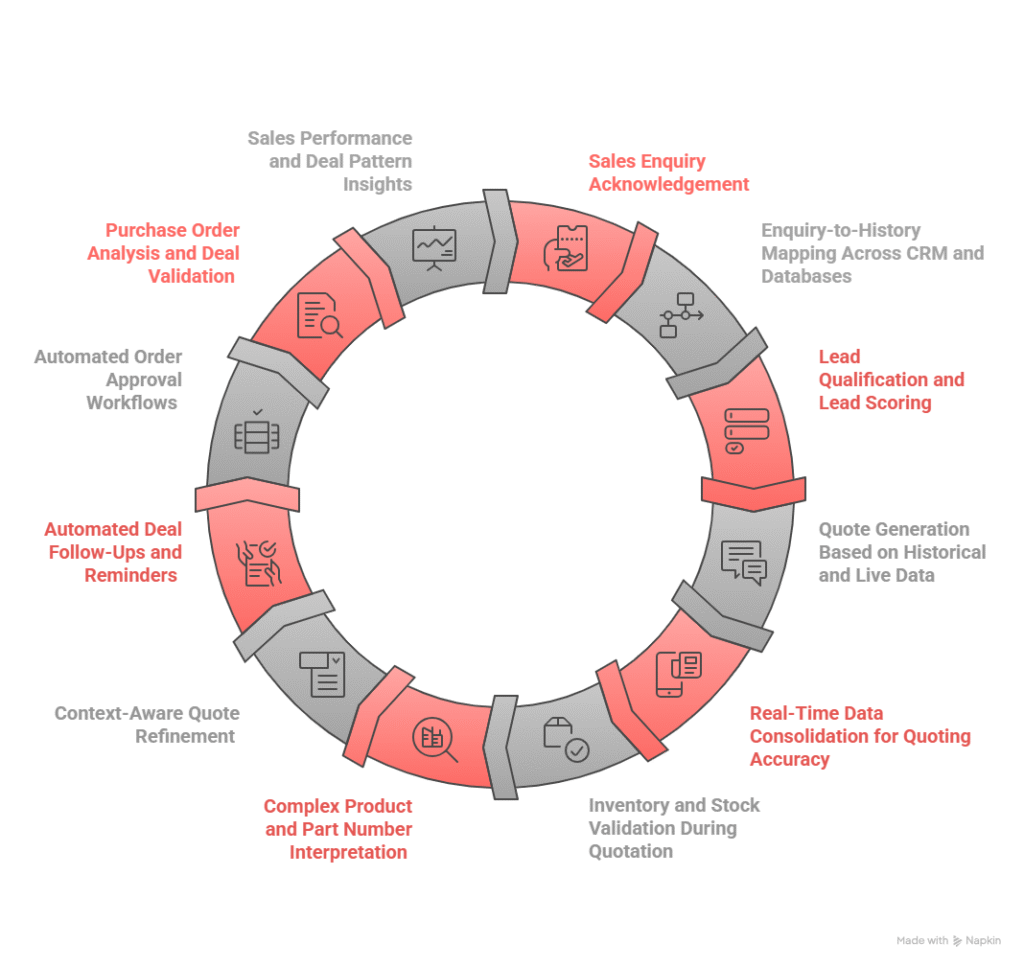
12 Sales Workflows You Can Automate with AI
Sales workflows span multiple stages, systems, and decision points.
Automating these workflows helps sales teams manage execution consistently while reducing delays and manual coordination.
The workflows below represent common sales activities that benefit from workflow automation.
Each example shows where automation fits in the sales cycle and how it supports faster, more reliable execution.
1. Sales Enquiry Acknowledgement
Sales enquiry acknowledgement is the process of receiving, registering, and responding to incoming sales enquiries. It ensures enquiries are captured with essential details and routed to the right sales owner.
This workflow establishes the first system record of customer intent. It also sets response expectations and triggers the next sales action. Accurate acknowledgement is critical for maintaining pipeline visibility from the start.
| Enquiry Acknowledgement without automation | Enquiry Acknowledgement with AI automation |
Enquiries are manually reviewed and acknowledged based on team availability, often leading to delays.CRM updates and follow-ups depend on individual discipline, resulting in inconsistent execution. | AI analyzes incoming enquiries in real time to understand intent, urgency, and context, even from unstructured messages.Relevant customer and product details are extracted consistently across channels and formatsGenE orchestrates these AI decisions across CRM and communication systems so acknowledgement, routing, and follow-up occur as one coordinated workflow. |
Steps to automate this workflow
- AI extracts customer, product, and intent signals from incoming enquiries
- AI classifies enquiries based on urgency, type, and sales context
- GenE coordinates CRM record creation or updates and ownership assignment
- Context-aware acknowledgements and follow-up actions are triggered automatically
2. Enquiry-to-History Mapping Across CRM and Databases
Every new sales enquiry carries context from past interactions. Enquiry-to-history mapping connects the current request with previous quotes, orders, conversations, and engagement records.
It helps sales teams understand who the customer is and how the relationship has evolved. This prevents teams from responding without awareness of past discussions or decisions. Strong history mapping supports continuity and more informed sales conversations.
| Enquiry-to-History Mapping without Automation | Enquiry-to-History Mapping with AI Automation |
| Sales teams manually search CRM systems, emails, and documents to reconstruct customer history.Context depth depends on time availability and familiarity with the account. | Incoming enquiries are interpreted to determine customer identity and relevance to past interactions.Historical signals are derived from both structured CRM data and unstructured sources such as emails or documents.GenE ensures this contextual view is assembled and surfaced within the sales record at the moment the enquiry is logged. |
Steps to automate the workflow
- Extract customer identifiers and enquiry context from incoming requests
- Retrieve related historical interactions, quotes, and orders
- Link relevant records across structured and unstructured systems
- Present a consolidated customer history within the CRM
3. Lead Qualification and Lead Scoring
Not every enquiry requires the same level of sales effort. Lead qualification determines whether a lead aligns with sales priorities and capacity.
Lead scoring assigns relative importance based on defined business signals. This workflow helps sales teams focus on opportunities that are more likely to convert. Consistent qualification improves overall pipeline health.
| Lead Qualification Without Automation | Lead Qualification With AI Automation |
| Leads are reviewed manually using limited and often incomplete information.Scoring criteria vary across teams and depend heavily on individual judgment. | Enquiry details, customer attributes, and engagement signals are evaluated together to determine lead quality.Scoring logic is applied consistently and adapts based on patterns from past conversions.GenE routes high-priority leads automatically so sales teams engage at the right moment. |
Steps to automate the workflow
- Interpret enquiry content and customer attributes
- Apply qualification logic informed by historical outcomes
- Rank leads based on readiness and relevance
- Route qualified leads to the appropriate sales teams
4. Quote Generation Based on Historical and Live Data
Quote generation transforms a sales enquiry into a commercial proposal. It requires aligning product details, pricing logic, and customer-specific conditions. This workflow directly influences deal momentum and customer confidence. Sales teams must balance speed with pricing accuracy. Reliable quote generation supports consistent and competitive selling.
| Quote Generation Without Automation | Quote Generation With AI Automation |
Quotes are prepared manually using spreadsheets, reference documents, and past experience.Turnaround time depends on individual expertise and data availability. | Enquiry details are interpreted and matched with relevant historical quotes and pricing patterns.Live inputs, such as cost changes or commercial terms, are factored into pricing decisions.GenE coordinates these inputs across pricing systems and CRM to produce structured draft quotes. |
Steps to automate the workflow
- Derive product, quantity, and requirement details from the enquiry
- Surface relevant historical pricing and deal context
- Incorporate current cost and commercial inputs into pricing logic
- Assemble a draft quote and route it for sales review
5. Real-Time Data Consolidation for Quoting Accuracy
Accurate quoting depends on having reliable data at the right time. This workflow brings together pricing, cost, inventory, and customer information. It reduces inconsistencies caused by fragmented systems. Sales teams gain confidence in the numbers they share with customers. Data consolidation supports smoother approvals and fewer revisions.
| Data Consolidation Without Automation | Data Consolidation With AI Automation |
Sales teams rely on multiple systems that may not reflect the latest data.Manual cross-checks introduce delays and increase the risk of inconsistencies. | Required data sources are identified dynamically based on the quote context.Updates from pricing, cost, and inventory systems are pulled together in near real time.GenE ensures consolidated data flows into the quoting workflow without manual intervention. |
Steps to automate the workflow
- Determine which data sources are required for the specific quote
- Retrieve current pricing, cost, and inventory information
- Reconcile discrepancies across systems using defined validation logic
- Attach consolidated data directly to the quote record
6. Inventory and Stock Validation During Quotation
Inventory validation confirms whether requested products can be fulfilled. It connects sales commitments with actual stock or production capacity. This workflow helps prevent delivery issues after a quote is accepted. Stock visibility is especially important in manufacturing sales. Accurate validation protects both delivery timelines and customer trust.
| Inventory Validation Without Automation | Inventory Validation With AI Automation |
Sales teams request stock checks from operations or supply teams.Response times depend on coordination and availability across teams. | Product and quantity requirements are interpreted directly from the quote context.Availability is assessed using current inventory and production signals.GenE coordinates validation outcomes, so quotes reflect realistic fulfillment expectations. |
Steps to automate the workflow
- Extract product and quantity requirements from the quote context
- Evaluate availability against real-time inventory and capacity data
- Identify shortages, constraints, or lead-time risks
- Confirm availability status before quote finalization
7. Complex Product and Part Number Interpretation
Many sales enquiries include complex product descriptions rather than standardized part numbers. In manufacturing sales, these descriptions often combine multiple specifications, dimensions, or compliance requirements. Sales teams must interpret this information accurately before pricing or quoting. Errors at this stage can lead to incorrect quotes or rework later in the cycle. This workflow ensures product intent is understood before downstream sales actions begin.
| Product Interpretation Without Automation | Product Interpretation With AI Automation |
Sales teams manually read enquiry text and interpret specifications based on experience.Interpretation varies across individuals and can lead to inconsistencies or rework. | Product intent is derived from unstructured enquiry text, including emails and attachments.Specifications, attributes, and configurations are interpreted even when terminology varies.GenE ensures interpreted product data flows into quoting and inventory workflows in a structured form. |
Steps to automate the workflow
- Parse enquiry content to extract product specifications and attributes
- Normalize variations in terminology and formats
- Map extracted details to internal product definitions
- Pass structured product intent into pricing and availability workflows
8. Context-Aware Quote Refinement
Initial quotes often require refinement before being shared with customers. Refinement may depend on customer history, urgency, order volume, or strategic importance. This workflow adjusts quotes using contextual signals rather than static rules. It helps sales teams align pricing with business intent. Thoughtful refinement improves both competitiveness and deal confidence.
| Quote Refinement Without Automation | Quote Refinement With AI Automation |
Sales teams manually adjust quotes based on judgment and limited visibility into context.Refinements are applied inconsistently and may delay responses. | Customer history, deal patterns, and urgency signals are considered together.Refinement suggestions are informed by outcomes from similar past deals.GenE coordinates refined pricing logic across quoting and approval workflows |
Steps to automate the workflow
- Review customer history and deal characteristics
- Identify contextual signals such as urgency or strategic value
- Apply refinement logic based on comparable scenarios
- Present an adjusted quote for final review
9. Automated Deal Follow-Ups and Reminders
Deal follow-ups are essential for maintaining momentum throughout the sales cycle. Every interaction, delay, or unanswered message affects how a deal progresses. This workflow ensures follow-ups are not dependent on memory or individual habits. It aligns follow-up actions with deal stage, customer activity, and response patterns. Consistent follow-ups help sales teams stay engaged without overwhelming the customer.
| Deal Follow-Ups Without Automation | Deal Follow-Ups With AI Automation |
Follow-ups rely on individual reminders and manual tracking.Important actions may be delayed or missed during busy periods. | Engagement signals and deal stage progression are continuously monitored.Follow-up timing adapts based on activity, responses, or inactivity.GenE ensures reminders and engagement tasks remain aligned with deal status. |
Steps to automate the workflow
- Monitor deal stage changes and engagement signals
- Determine appropriate follow-up timing based on activity patterns
- Schedule reminders and outreach tasks dynamically
- Record follow-up outcomes within the CRM
10. Automated Order Approval Workflows
Order approval ensures sales commitments align with pricing, policy, and operational constraints. Approvals often involve multiple stakeholders across finance, operations, and sales. Delays at this stage can slow revenue recognition. This workflow structures approvals to move efficiently.
Clear approval paths reduce bottlenecks.
| Order Approval Without Automation | Order Approval With AI Automation |
Approvals are requested through emails or manual tools. Tracking approval status across stakeholders is difficult and time-consuming. | Approval requirements are determined based on order attributes and exceptions.Relevant context is surfaced for each approver to speed decisions.GenE coordinates approval routing, tracking, and escalation automatically. |
Steps to automate the workflow
- Evaluate order details to determine approval requirements
- Route approval requests to appropriate stakeholders
- Monitor response timelines and escalate when needed
- Confirm approvals before order processing proceeds
11. Purchase Order Analysis and Deal Validation
A purchase order represents formal confirmation of a customer’s buying intent. Before execution begins, it must align with quoted terms, pricing, and conditions. This workflow validates that alignment to avoid downstream conflicts. It identifies discrepancies early, before fulfillment or invoicing starts. Accurate purchase order validation supports smoother delivery and revenue recognition.
| PO Validation Without Automation | PO Validation With AI Automation |
| Purchase orders are reviewed manually against quotes and contracts.Discrepancies are often identified late in the process. | Key PO details are compared against approved quotes and deal terms.Exceptions and mismatches are flagged for review.GenE ensures validation outcomes are reflected before fulfillment workflows continue. |
Steps to automate the workflow
- Extract relevant fields from incoming purchase orders
- Compare PO terms with approved quotes and conditions
- Highlight discrepancies or deviations
- Confirm deal validity before fulfillment or invoicing
12. Sales Performance and Deal Pattern Insights
Sales performance insights help teams understand what drives successful deals. Analyzing patterns across wins, losses, and deal cycles reveals actionable signals. This workflow turns sales activity data into structured learning. It supports continuous improvement across sales strategies and execution. Reliable insights help teams make informed adjustments over time.
| Performance Analysis Without Automation | Performance Analysis With AI Automation |
| Insights rely on periodic reports and manual analysis.Patterns are identified late and often lack depth. | Deal data is examined continuously across the sales lifecycle.Patterns in timing, pricing, and engagement are surfaced as insights.GenE aggregates these signals to support planning and execution decisions. |
Steps to automate the workflow
- Collect deal and activity data across sales systems
- Identify recurring patterns and outcome drivers
- Generate actionable insights for teams and leaders
- Feed learnings back into qualification, pricing, and follow-up workflows
AI Workflow Automation in Sales: Summary View
| Sales Workflow | Role of AI in the Workflow | Operational Benefit |
| Sales Enquiry Acknowledgement | Captures enquiries and prepares them for immediate routing | Faster response times and fewer missed enquiries |
| Enquiry-to-History Mapping | Links incoming enquiries with past customer interactions | Better context for accurate sales engagement |
| Lead Qualification and Scoring | Evaluates and prioritizes leads using consistent criteria | Improved pipeline focus and sales efficiency |
| Quote Generation | Converts enquiries into structured quotes using historical and live data | Faster quote turnaround with higher accuracy |
| Real-Time Data Consolidation | Brings pricing, cost, and customer data into a single view | Reduced errors and fewer quote revisions |
| Inventory and Stock Validation | Confirms product availability during quote preparation | Realistic delivery commitments and higher trust |
| Product and Part Interpretation | Interprets complex product descriptions and specifications | Fewer quoting errors in complex sales |
| Context-Aware Quote Refinement | Adjusts quotes using customer history and deal context | More competitive and relevant pricing |
| Deal Follow-Ups and Reminders | Schedules follow-ups based on deal stage and activity | Improved deal momentum and conversion rates |
| Order Approval Workflows | Routes orders through structured approval paths | Reduced approval delays and bottlenecks |
| Purchase Order Validation | Verifies POs against approved quotes and terms | Fewer disputes and smoother execution |
| Sales Performance Insights | Analyzes deal patterns and sales outcomes | Better planning and continuous improvement |
How GenE Orchestrates AI Workflows for Sales
Sales workflows span CRM systems, pricing tools, ERP platforms, and communication channels. GenE orchestrates these workflows by coordinating how data and actions move across systems. This ensures each workflow step operates with continuity rather than in isolation.
GenE manages workflow execution across stages of the sales cycle. It connects enquiry intake, CRM automation, quoting, approvals, and follow-ups into a single flow. This allows sales teams to work within familiar systems while workflows run consistently in the background.
As sales operations scale, governance and reliability become critical. GenE enforces workflow logic, sequencing, and control across systems. This helps organizations maintain accuracy, visibility, and compliance as sales complexity grows.
Conclusion
AI workflows for sales help organizations automate how sales work, moving from enquiry to closure.
They bring structure, consistency, and speed to sales execution across systems and teams.
By automating key sales workflows such as lead qualification, quote generation, and deal follow-ups, sales teams reduce manual coordination and improve accuracy. Workflow automation supports predictable execution in complex sales environments.
Platforms like GenE enable this at scale by orchestrating workflows across CRM, ERP, and sales systems.
This allows organizations to adopt AI workflows for sales with confidence, control, and long-term impact.
FAQs
What are AI workflows for sales?
AI workflows for sales are end-to-end processes that automate how sales work moves across stages, systems, and teams. They connect enquiries, CRM updates, lead scoring, quoting, and follow-ups into a single workflow.
Which sales workflows can be automated with AI?
Sales workflows such as enquiry handling, lead qualification, CRM automation, quote generation, inventory validation, deal follow-ups, and order approvals can be automated using AI.
How does AI improve CRM automation in sales?
AI improves CRM automation by updating customer and deal records automatically as sales activities occur, ensuring data remains accurate and consistent without manual entry.
What is the difference between task automation and sales workflow automation?
Task automation handles individual actions, while sales workflow automation coordinates multiple actions into a defined sequence across the sales cycle.
How do AI workflows support complex B2B and manufacturing sales?
AI workflows support complex sales by interpreting unstructured enquiries, connecting them with internal systems, and preparing structured sales actions with greater accuracy and speed.
