AI is entering every part of the enterprise.
Sales. Procurement. Operations. Service. Training.
Each function is adopting automation in its own way, with its own tools, its own workflows, and its own data paths.
What leaders are now realizing is this:
AI at scale is not just a technology decision; it is a governance decision.
Every automated step needs visibility.
Every decision needs traceability.
Every workflow needs to operate under one consistent compliance and security framework.
This is where most organizations pause.
Not because AI isn’t working, but because the control layer underneath it isn’t unified.
From my experience working with enterprise teams, the organizations that succeed with AI share one common foundation:
a centralized orchestration layer that connects every workflow to the same governance and security model.
That is the role GenE fills inside the DTskill ecosystem.
It sits between enterprise workflows and enterprise data, coordinating AI agents, enforcing policy logic, and maintaining a single source of compliance across systems, functions, and departments.

In this blog, we break down the three layers that define secure, enterprise-ready AI:
the workflow layer, the orchestration layer, and the compliance + security layer, and how each one is strengthened when unified through GenE.
Enterprise Workflows: How AI Strengthens Every Function
Every enterprise function follows the same pattern:
intake → decision → action → escalation → completion.
The differences lie in how information flows, how policies are applied, and how quickly work moves from one team to another.
AI strengthens these workflows by giving every step more context, consistency, and traceability. And when these enhancements run through GenE’s orchestration layer, the workflow becomes aligned across systems, departments, and compliance rules.
Below is a clear view of how core enterprise functions work today and how they operate when GenE sits at the center.
Enterprise Workflow Transformation with GenE
| Function | How Workflows Operate Today | How Workflows Operate with GenE |
|---|---|---|
| Sales | Follow-ups depend on manual notes, scattered CRM history, and individual judgment. | GenE provides contextual summaries, next-step recommendations, and unified customer context across tools, reducing delays and improving accuracy. |
| Procurement | Vendor data, compliance checks, and approvals move across disconnected systems. | GenE aligns purchase decisions with policies, budgets, and risk thresholds in real time, ensuring every step is traceable and compliant. |
| Operations | Teams reconcile information from ERPs, planners, and dashboards to make scheduling or capacity decisions. | GenE routes operational signals automatically, assisting in scheduling, exception handling, and cross-team coordination. |
| Service | Ticket classification, prioritization, and SLA tracking vary across regions or tools. | GenE normalizes routing, classification, and responses with consistent logic, improving both SLA adherence and customer experience. |
| Training & Enablement | Learning paths are static; content updates depend on manual review cycles. | GenE adapts training flows, content, and assessments based on real-time performance data and role requirements. |
These improvements are meaningful on their own, but the real advantage comes from how consistently they operate across the enterprise.
GenE creates that consistency.
It connects every workflow, sales, procurement, operations, service, and training to the same AI agents, the same governance model, and the same security layer.
This is how enterprises scale AI without introducing fragmentation or compliance risk.
The Orchestration Layer: Where Enterprise AI Becomes Operational
AI creates value when it can understand context, connect systems, and make decisions across a workflow without breaking governance. That requires a layer built specifically to coordinate intelligence, policy, and execution across the enterprise.
GenE serves as that orchestration layer.
It sits between workflows and data, aligning AI agents, enterprise systems, and compliance rules so every automated step moves under a unified operational model.
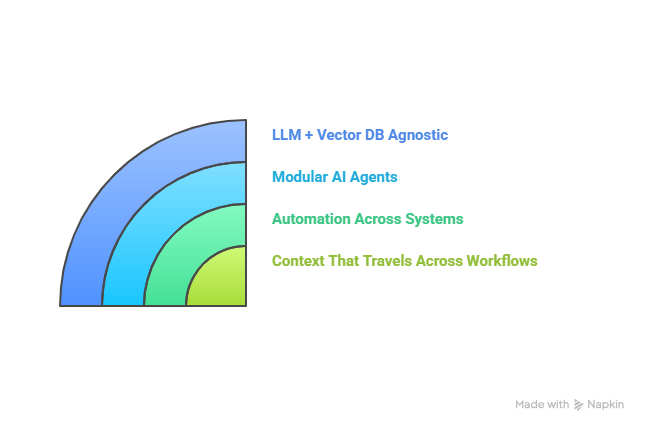
| LLM + Vector DB AgnosticEnterprises use multiple models for different needs, some commercial, some open-source. GenE integrates with all of them, so workflows don’t depend on a single vendor or architecture. The model selection remains flexible; the orchestration remains consistent. | Modular AI AgentsEnterprise processes rarely move in a straight line. GenE uses modular agents that each perform a defined function, extracting, interpreting, validating, generating, or escalating, and coordinates them so the workflow moves cleanly from start to finish. |
| Automation Across SystemsMost workflows span CRMs, ERPs, ticketing systems, data warehouses, and internal tools. GenE plugs into these systems without restructuring them, allowing AI-driven steps to be executed where work already happens. | Context That Travels Across WorkflowsBecause GenE sits at the center, it carries context across teams and systems. That means a procurement decision, a sales request, a support issue, or an operational escalation moves with the right history, policy logic, and security parameters already applied. |
The result:
AI doesn’t operate as a collection of isolated tools.
It functions as one coordinated system capable of supporting decisions, routing actions, and maintaining governance at every step of the workflow.
Centralized Compliance & Security
As AI begins to support more decisions and actions across the enterprise, the control structure behind those workflows becomes critical. Automation only scales when every step is traceable, every rule is applied consistently, and every workflow operates under a unified security model.
That’s why centralized compliance and security form the foundation of enterprise AI.

Unified Policy Enforcement
GenE applies governance rules directly within the workflow, ensuring every action follows approved policies instead of relying on manual checks or distributed controls.
Real-Time Compliance
Compliance becomes part of execution, not a retrospective review. GenE captures decisions, exceptions, and approvals as they occur, keeping workflows aligned with organizational standards.
Security Embedded in the Flow
Identity checks, access validation, and action-level restrictions are built into each step, maintaining a consistent security posture across sales, procurement, service, operations, and training.
With a centralized model, enterprises gain stability:
one policy framework, one security layer, and one audit path all reinforced through GenE’s orchestration.
GenE: The Layer That Unifies Enterprise Workflows, Orchestration, and Governance
Each layer of workflows, orchestration, and compliance delivers value on its own. But the real impact appears when they operate as one coordinated system. GenE provides that unified foundation.
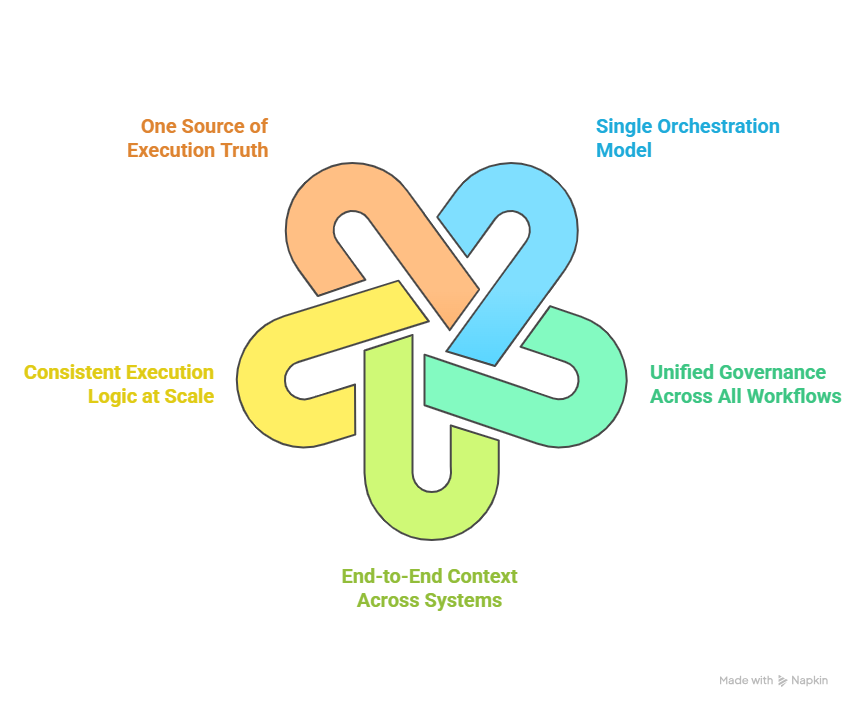
➡️A Single Orchestration Model
GenE coordinates AI agents, workflow signals, and enterprise data under one operational structure, ensuring every function moves with consistent intelligence.
➡️Unified Governance Across All Workflows
Policies, permissions, and security rules are applied uniformly, eliminating variations and keeping automation aligned with enterprise standards everywhere it runs.
➡️End-to-End Context Across Systems
Because GenE sits between workflows and data, context travels cleanly from sales to procurement to operations and service, reducing duplication and manual reconciliation.
➡️Consistent Execution Logic at Scale
Every automated action classification, routing, validation, and approval follows the same ruleset, creating predictable outcomes across teams and regions.
➡️One Source of Execution Truth
GenE captures what was triggered, how decisions were made, and which rules guided them, giving leaders complete visibility and auditability across the enterprise.
With GenE acting as the enterprise control plane, AI becomes operational at scale, coordinated, compliant, and secure across every workflow it touches.
Extended Capabilities Across the DTskill Ecosystem
When enterprises standardize their workflows, orchestration, and governance under GenE, specialized AI capabilities can be introduced without creating new silos.
DTskill’s solutions build on this unified foundation, each addressing a specific operational need while adhering to the same compliance and security model.
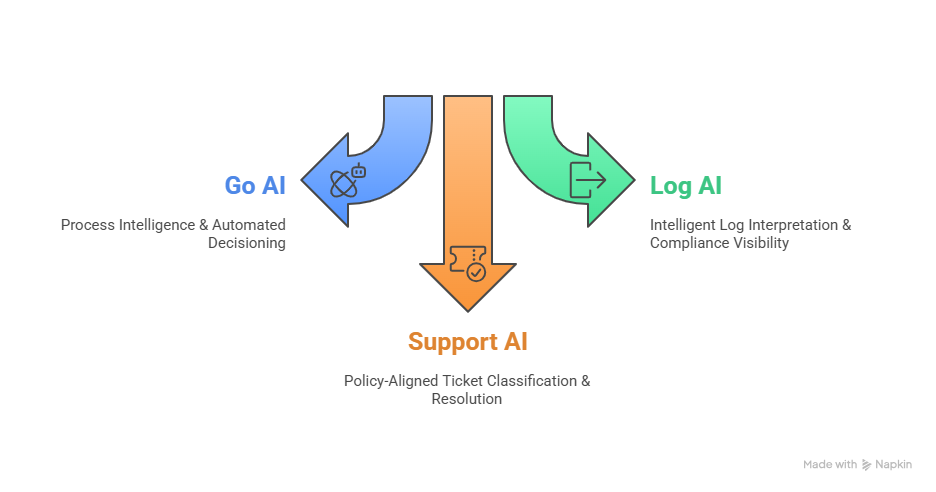
1. Go AI – Process Intelligence & Automated Decisioning
Go AI analyzes live process data, identifies patterns, and recommends or executes actions directly within the workflow.
Under GenE, these decisions follow the same governance logic used across the enterprise, ensuring every automated step is both informed and compliant.
2. Log AI – Intelligent Log Interpretation & Compliance Visibility
Log AI continuously interprets application, infrastructure, and security logs to detect anomalies and policy deviations.
Because it operates within GenE’s control plane, insights flow directly into governed workflows, enabling faster triage and consistent auditability.
3. Support AI – Policy-Aligned Ticket Classification & Resolution
Support AI classifies, routes, and prioritizes tickets based on SLAs, business rules, and historical patterns.
With GenE orchestrating the underlying logic, every response path remains aligned with enterprise standards, regardless of channel or region.
Together, these solutions extend the reach of the GenE ecosystem, bringing process intelligence, operational visibility, and consistent execution into more parts of the organization, all under the same secure, compliant framework.
Conclusion
As enterprises scale AI across sales, procurement, operations, service, and training, the priority is no longer adopting more tools; it’s ensuring the entire system moves with one set of rules, one source of context, and one governance framework.
That stability is what allows automation to scale responsibly.
GenE provides that foundation.
It brings workflows, orchestration, and compliance into one coordinated control plane, ensuring every action is consistent, traceable, and secure.
And when specialized solutions like Go AI, Log AI, and Support AI operate on top of this structure, each one strengthens enterprise intelligence without introducing new silos.
The outcome is a unified model for enterprise AI:
workflows stay connected, automation remains governed, and every function operates with greater clarity and confidence.
This is how organizations amplify their processes with AI while maintaining the governance standards that define them.
