In most IT service organizations, the helpdesk has long been the anchor where every incident begins, where urgency meets process, and where customer experience is tested in real time.
Over the years, these desks have evolved into digital platforms of dashboards, workflows, and alerts. Yet even with the most sophisticated tools, IT teams often find themselves caught between reactive firefighting and the promise of proactive service.
That’s where AI-powered helpdesk workflows come into play. They don’t just automate responses; they redefine operational intelligence.
From L1 ticket automation and predictive escalation & SLA management to root-cause analysis AI, and knowledge base automation, these systems learn from patterns, correlate signals, and anticipate what comes next, turning every ticket into a data point for improvement.
For IT services and consulting leaders, this evolution is more than an upgrade. It’s a cultural shift from managing workloads to managing knowledge. And as ITSM automation with AI becomes central to modern operations, the line between service management and intelligence continues to blur.
The sections ahead explore how this shift unfolds from rethinking ticketing systems to orchestrating entire operations through GenE AI orchestration, bringing together insight, efficiency, and adaptability across the IT ecosystem.
Understanding the IT Helpdesk
The IT helpdesk is the first line of assurance when systems falter, users face disruptions, or technology slows down business flow. It stands as the frontline of enterprise reliability where every incident, request, or change is translated into structured action that keeps operations moving.
At its core, an IT helpdesk operates on principles of consistency, traceability, and responsiveness. Every request or incident becomes a record of a ticket that moves through defined stages of identification, classification, resolution, and closure. Behind this flow lies a disciplined framework known as IT Service Management (ITSM), which governs how technology services are delivered, maintained, and improved.
In most enterprises, helpdesks are responsible for:
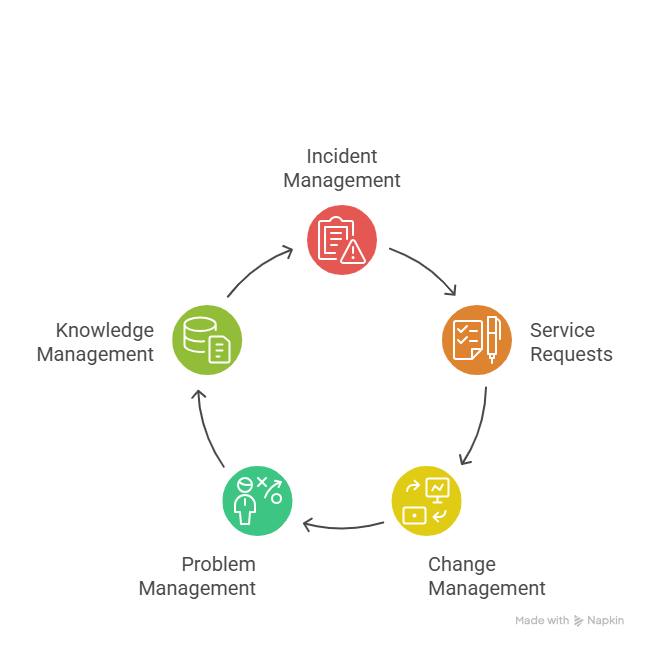
- Incident management: Addressing disruptions that affect user productivity or business operations.
- Service requests: Handling access, permissions, and routine technical tasks.
- Change management: Coordinating updates and deployments while ensuring minimal downtime.
- Problem management: Identifying recurring issues and documenting long-term fixes.
- Knowledge management: Creating and maintaining documentation for faster, repeatable resolutions.
Whether powered by ServiceNow, Jira, or other ITSM platforms, the helpdesk functions as both a command center and a communication bridge. It connects users, systems, and support teams, ensuring that technology remains an enabler, not an obstacle, to enterprise progress.
Core Functions and Daily Operations of the IT Helpdesk
Every enterprise runs on a foundation of continuity, and the IT helpdesk quietly upholds it. It is the operational layer that ensures people, processes, and platforms stay in sync even when technology falters.
In large organizations, this structure operates as both a command center and a coordination hub. It connects business units, service providers, and end-users through a defined system of workflows and accountability.
Over time, these functions have matured into a disciplined service model where every task, no matter how small, plays a role in maintaining enterprise reliability.
Below are the key day-to-day functions that define an IT helpdesk’s rhythm:
| Ticket Management Every helpdesk begins with ticketing, the systematic process of logging, categorizing, and prioritizing incidents or service requests. Tickets serve as digital records that document each step of an issue’s lifecycle, ensuring transparency and structured response management across teams. | User Support & Troubleshooting Helpdesks act as the first point of contact for users facing technical challenges, from login failures to system slowdowns. Support teams combine diagnostic tools with institutional knowledge to provide quick resolutions, often balancing speed with empathy to minimize user disruption. | System Monitoring Beyond reactive support, helpdesk operations continuously monitor the health of applications, servers, and networks. This proactive vigilance allows teams to detect early warning signs and intervene before minor anomalies grow into service outages. |
| Incident Escalation Not every issue can be resolved at the first level. Escalation protocols ensure that unresolved or complex cases are swiftly routed to specialized teams. This structured handoff minimizes downtime and keeps accountability clear across service tiers. | Knowledge Documentation Each resolution adds to the organization’s collective intelligence. By documenting procedures and solutions, helpdesks create a searchable knowledge base that enables faster resolutions and self-service options for future incidents. | SLA Tracking & Reporting Service Level Agreements define the performance expectations of IT support. Helpdesks meticulously track resolution times, ticket volumes, and service compliance metrics not just to meet benchmarks, but to demonstrate reliability and operational maturity. |
Together, these functions form the operational core of enterprise technology support. They translate every technical interruption into a measurable, accountable process, ensuring that IT services not only resolve problems but also continuously reinforce business resilience.
The Role of AI in Modern Helpdesk Workflows
The introduction of AI-powered helpdesk workflows has redefined what IT service management can achieve. Where human expertise once handled volume through structure, AI now brings pattern recognition, prediction, and self-learning capabilities to enhance every layer of support.
At its essence, an AI helpdesk for IT services operates as a learning system. It absorbs millions of historical tickets, interactions, and resolutions to recognize context, suggest actions, and automate repetitive processes.
Natural language models understand how employees describe problems, while predictive models identify trends before they escalate. This combination turns static ticket systems into responsive, evolving ecosystems.
When combined, these capabilities evolve the helpdesk from a reactive support channel into a proactive intelligence layer. Each workflow becomes more adaptive, every resolution more informed, and every agent more empowered to act strategically rather than operationally.
And it’s in orchestrating these intelligent layers where platforms like GenE AI orchestration redefine enterprise IT, connecting tools, models, and teams into one unified intelligence fabric.
The GenE Ecosystem in IT Helpdesk Intelligence
Within enterprise IT operations, orchestration defines maturity. The GenE AI orchestration framework brings together AI systems, data, and human expertise into one connected network where automation isn’t scattered, but sequenced with purpose. Around this core lies the broader DTskill AI ecosystem, each product addressing a specific need in the IT service chain.
| GenE – The Orchestration Layer Connects systems like ServiceNow or Jira, managing data flow and synchronizing AI-powered helpdesk workflows across the enterprise. | WorkshopAI – Building AI-Ready Teams Equips IT teams with practical AI skills to design, manage, and collaborate with automated helpdesk systems. | GOAI – Rapid AI Deployment for ITSM Accelerates AI integration within ITSM platforms, ensuring automation scales without disrupting compliance or workflows. |
| Support AI – Intelligent Service Assistance Automates ticket classification, routing, and response, reducing manual effort and improving turnaround times. | Log AI – Real-Time Operational Insight Monitors and analyzes event logs to identify anomalies and root causes before they affect users. | QA AI – Continuous Quality and Compliance Validates AI workflows and resolutions, ensuring consistent performance and governance across helpdesk operations. |
Use Cases Across the IT Helpdesk:
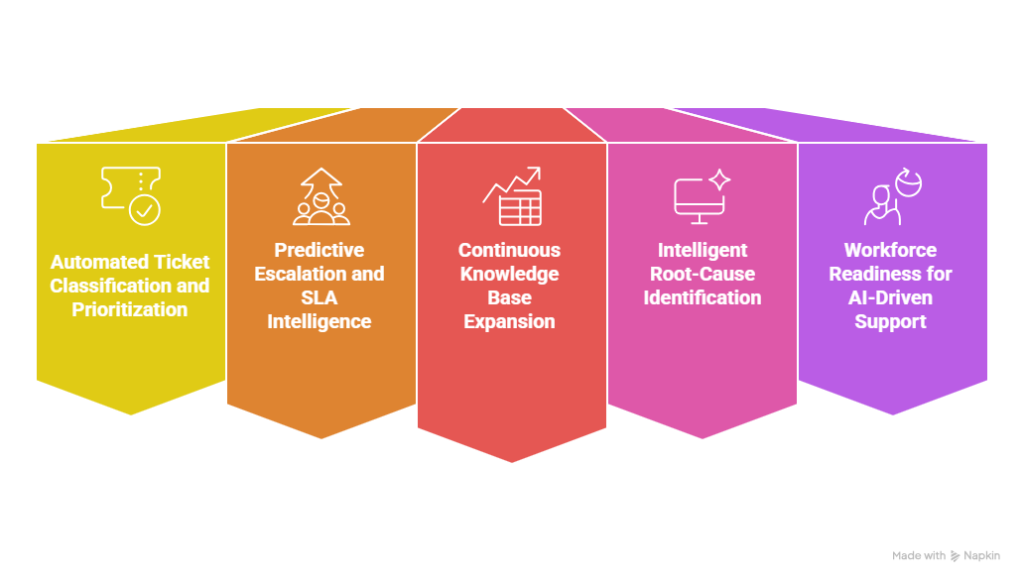
Automated Ticket Classification and Prioritization
In most IT service environments, incoming tickets vary widely in language, urgency, and context. AI-powered helpdesk workflows now analyze these inputs instantly, classifying and assigning them based on historical patterns and user intent.
A system like Support AI, when orchestrated through GenE, ensures that tickets are routed accurately the first time, reducing back-and-forth resolution cycles and freeing up human agents for higher-value problem-solving.
Predictive Escalation and SLA Intelligence
Traditional escalation models rely on fixed thresholds, time-based, or volume-based triggers that don’t account for real-world workload fluctuations. When GOAI and Log AI work together under GenE AI orchestration, the system anticipates potential SLA breaches before they occur, rerouting tasks and notifying the right teams proactively.
This form of Predictive escalation & SLA management transforms helpdesks from reactive responders to preventive service managers.
Continuous Knowledge Base Expansion
Every resolved ticket carries learning value. Yet, in many organizations, this knowledge remains trapped in chat logs or emails. Through QA AI, new solutions are automatically documented, validated, and added to the enterprise knowledge repository.
Over time, this drives knowledge base automation, allowing support agents and users to find answers faster and ensuring that expertise grows continuously with every closed ticket.
Intelligent Root-Cause Identification
When incidents span multiple systems, identifying the underlying issue can take hours of manual investigation. Log AI, using AIOps for helpdesk, correlates logs, user reports, and telemetry data across infrastructure layers to pinpoint the source.
This enables near-real-time root-cause analysis AI, shortening the feedback loop between detection and resolution, and improving overall system reliability.
Workforce Readiness for AI-Driven Support
Even the most sophisticated tools deliver limited value without human readiness. WorkshopAI ensures support teams understand how AI fits into their day-to-day decisions, from triage and ticket handling to data-driven escalation.
This capability development is critical for enterprises looking to scale AI responsibly, keeping human oversight central while allowing automation to handle the repetitive flow of operations.
In essence, the GenE AI orchestration ecosystem doesn’t replace IT helpdesks; it evolves them. Every interaction becomes a data point, every workflow a learning loop, and every agent a participant in an intelligent, continuously improving system.
Support Channels Integrated with Modern Ticketing Systems
Modern IT helpdesks handle far more than email queries. They operate across chat platforms, collaboration tools, and even machine-generated alerts, each carrying unique data and urgency. Without a unified orchestration layer, these channels remain disconnected, forcing agents to chase context instead of delivering quick resolutions.
GenE AI orchestration brings coherence to this complexity, integrating every channel into a single, intelligent workflow that connects directly with ServiceNow/Jira ticket automation.
Integrated Support Channels:
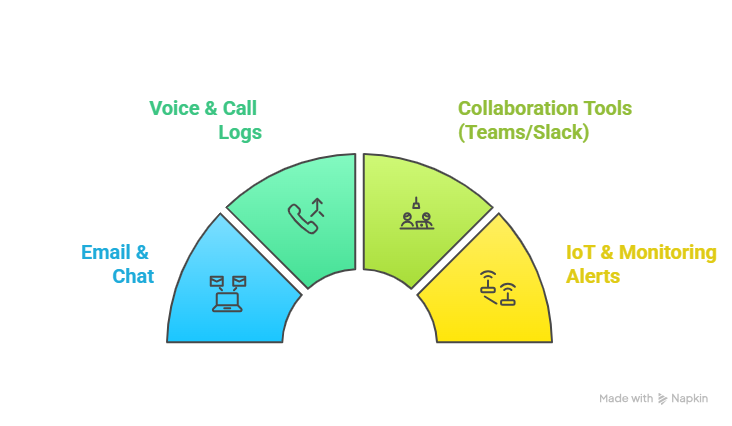
- Email & Chat – Every message or inquiry automatically converts into a structured ticket using L1 ticket automation. Priority, category, and user intent are extracted instantly, ensuring that even if the conversation moves across threads, the ticket retains full context and traceability.
- Voice & Call Logs – Voice interactions are transcribed in real time, analyzed for sentiment and intent, and linked back to existing tickets. This allows support teams to respond with full knowledge of what was discussed, not just what was documented.
- Collaboration Tools (Teams/Slack) – Instead of manually updating tickets, GenE connects these channels directly to ITSM platforms. A message in Teams or Slack automatically updates task notes, maintains SLA timelines, and keeps everyone aligned without workflow disruption.
- IoT & Monitoring Alerts – Machine alerts, system logs, or infrastructure warnings are captured, classified, and routed through AIOps for helpdesk frameworks. This enables predictive responses, turning potential system failures into preemptive resolutions.
With this multi-channel orchestration in place, every issue follows a unified lifecycle from the first report to the final resolution. The result is a truly connected helpdesk where communication becomes continuous, and insight builds naturally across platforms, all powered by GenE AI orchestration.
Operational Transformation and Measurable Impact
When AI-powered helpdesk workflows are orchestrated through GenE, IT operations move from reactive service handling to predictive, data-driven management.
The impact is felt not just in faster response times but in how operations evolve. Routine tasks are automated, recurring issues are preempted, and escalation paths become smarter with Predictive escalation & SLA management.
Agents spend less time on repetitive resolution loops and more time interpreting insights, improving service quality where it truly matters.
Here’s how the core helpdesk metrics shift under GenE AI orchestration:
| Metric | Before AI | After AI Orchestration |
| Ticket Handling Time | 8–10 hours avg. | <2 hours avg. |
| Manual Workload | 100% L1 tickets handled manually | 30–40% automated via L1 ticket automation |
| SLA Compliance | 70–75% | 95%+ with Predictive escalation & SLA management |
| User Satisfaction | Moderate | Significantly improved through an AI helpdesk for IT services |
| Recurring Issues | High | Reduced by 40–50% through Root-cause analysis AI |
Every gain in this table represents more than a statistic; it reflects a structural transformation in how IT teams operate. ITSM automation with AI doesn’t just speed up tasks; it builds institutional memory, learning from every ticket to make the next one easier to resolve.
Over time, this intelligence compounds, creating a helpdesk that not only supports operations but actively strengthens them.
Conclusion
The modern IT helpdesk is evolving from a support function into a source of operational intelligence. Through AI-powered helpdesk workflows, organizations gain a cohesive system that anticipates needs, prioritizes with context, and resolves with speed.
Each interaction adds to a growing body of insight shaping decisions that strengthen service reliability and user trust.
With GenE AI orchestration at its core, the helpdesk transforms into an intelligent command layer that unites people, systems, and workflows.
It enables IT service teams to operate with precision, learn continuously, and deliver consistency at scale. In this new model, the helpdesk builds a foundation for smarter, more adaptive IT operations.
