AI is present across most enterprises today.
Dashboards are smarter.
Chatbots are faster.
Reports generate themselves.
But these improvements focus on visibility, not the operations where decisions, handoffs, and approvals actually determine performance.
Where enterprises need AI most is inside the workflows that move the business forward, coordinating teams, validating data, enforcing policies, and connecting decisions across systems.
From working with large organizations, one pattern is consistent:
AI creates meaningful impact only when it supports the full flow from data → decision → action.
GenE is designed for that layer.
It unifies decision paths, automates cross-functional steps, and embeds intelligence and compliance directly into enterprise operations.
This blog explores where AI is commonly applied today and where it truly matters when orchestrated through a platform like GenE.
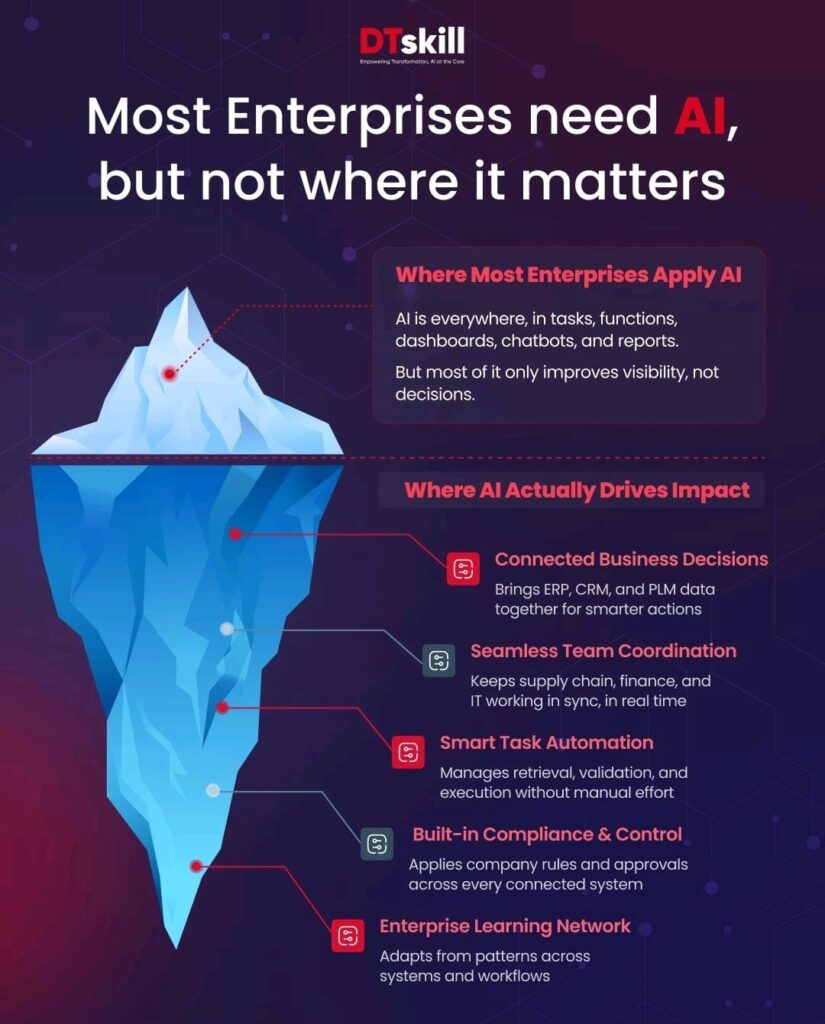
Where Enterprises Commonly Apply AI
Most organizations have already adopted AI, but primarily in areas that improve visibility rather than the operations that determine performance. These implementations deliver value, yet they sit on the surface of the enterprise rather than inside the processes where decisions and actions take place.
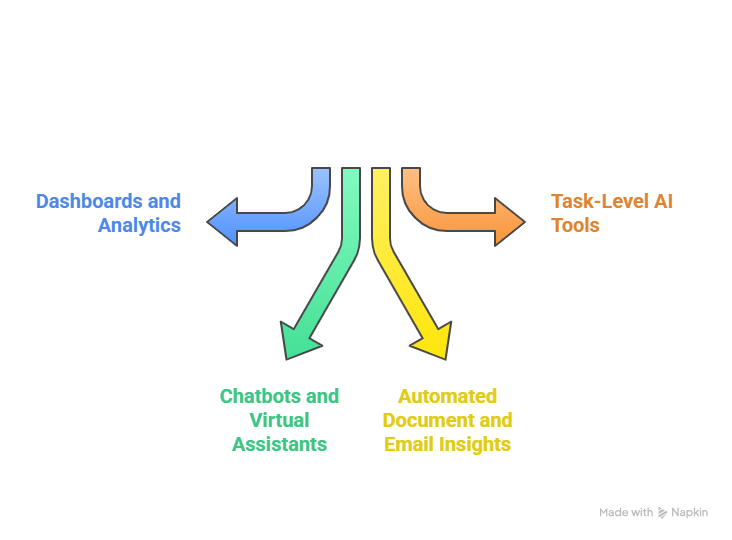
| Dashboards and Analytics AI enhances reporting with automated summaries, trend detection, and predictive insights. Leaders get clearer visibility into performance, but the outputs rarely feed directly into coordinated actions across teams or systems. | Chatbots and Virtual Assistants They handle FAQs, support basic troubleshooting, and speed up routine interactions. Useful for frontline efficiency, but they operate at the edges of the business and have limited influence on deeper operational workflows. |
| Automated Document and Email Insights AI scans contracts, emails, and internal communication to extract patterns and generate recaps.These insights reduce manual review time but often remain isolated within departments. | Task-Level AI Tools Teams adopt AI plugins inside CRMs, ticketing systems, and productivity apps. These tools streamline individual tasks, but they don’t address cross-functional handoffs, dependencies, or compliance-driven steps. |
These capabilities create visibility and convenience, but they don’t change how the enterprise moves, how decisions are coordinated, how work progresses, or how policies guide execution.
This is why many organizations feel the gap: AI is present in their tools, but not embedded in the operations where it matters most.
Where AI Actually Drives Impact
AI creates measurable value only when it supports the flow of work, not just the visibility around it.
This happens inside the operational layer, the part of the enterprise where decisions, actions, and cross-functional coordination determine outcomes.
This is where AI matters most:
- where systems feed each other information,
- where approvals and validations shape the next step,
- where timing affects both cost and performance,
- where compliance must be applied in real time,
- where teams depend on shared context to move work forward.
Enterprises gain real impact when AI operates here inside the processes that carry work across functions, systems, and policy frameworks.
That is the layer GenE is built for:
The operational flow where data becomes a decision, a decision becomes an action, and an action becomes a governed outcome.
The sections that follow break down the core areas where AI elevates enterprise performance when orchestrated through this central layer.
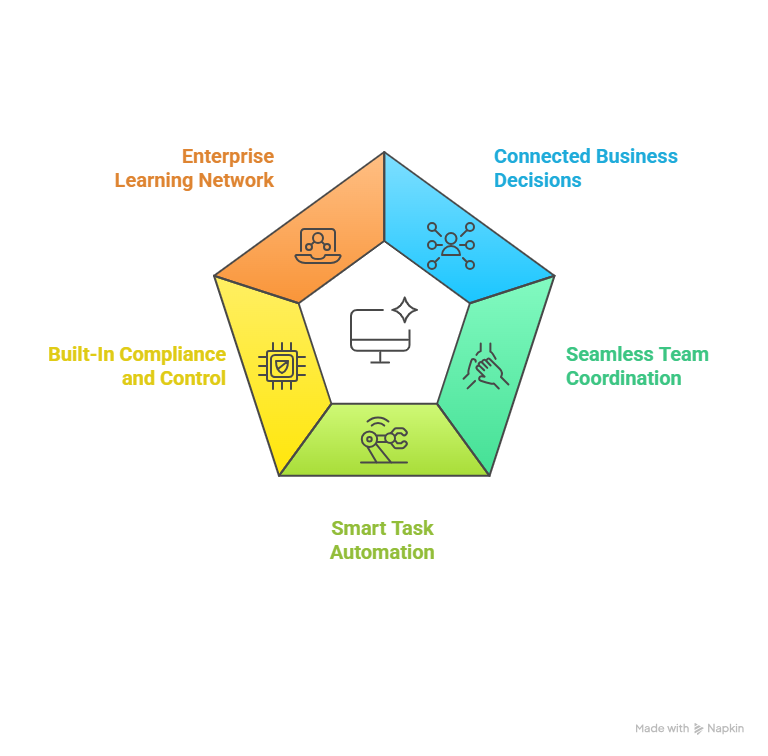
- Connected Business Decisions
Enterprise decisions rarely come from a single system.
A pricing decision depends on CRM history.
A production adjustment depends on ERP capacity data.
A change request depends on PLM updates and supply chain constraints.
Every meaningful choice is shaped by information spread across tools, teams, and timelines.
This is where AI creates immediate value: by connecting these data paths so decisions are made with complete, contextual insight.
When AI supports connected decisions, enterprises gain:
- A unified view of customer, operational, and financial data
- Faster alignment between planning, procurement, and fulfillment
- Fewer manual reconciliations across systems
- Clear traceability behind each approved action
GenE strengthens this layer by orchestrating the flow from data → decision → next step.
It pulls relevant context from ERP, CRM, PLM, and operational systems so each function works with a shared understanding of what needs to happen next.
The result is not just better visibility, but better decisions supported by complete information and routed through a consistent governance framework.
- Seamless Team Coordination
Most enterprise delays don’t occur within a single team; they occur between teams.
Supply chain waits on procurement.
Finance waits on operations.
IT waits on business approval.
And each relies on different systems, formats, and timelines.
AI improves coordination when it supports these cross-functional handoffs with shared context and governed routing.
With AI-enabled coordination, enterprises gain:
- Real-time alignment between supply chain, finance, IT, and operations
- Fewer escalations caused by missing or incomplete information
- Faster cycle times for approvals and exceptions
- Clear handoff paths that follow the same rules across regions and departments
GenE strengthens this layer by carrying context across systems and keeping every step aligned with policy. Work doesn’t pause for translation or validation; it moves with clarity from one team to the next.
- Smart Task Automation
Enterprise workflows contain thousands of micro-tasks that determine how smoothly work progresses.
Data retrieval.
Validation checks.
Exception routing.
Documentation updates.
Each one is small, but together they define operational speed.
AI adds value here by automating these steps with consistency and accuracy, especially in processes that rely on multiple systems.
Smart automation enables:
- Automatic retrieval and verification of data
- Trigger-based routing of tasks and exceptions
- Policy-aligned execution of routine steps
- Reduced dependency on manual intervention
GenE coordinates these automations through modular AI agents that work across the enterprise stack.
Actions follow the same governance logic, ensuring speed never compromises control.
- Built-In Compliance and Control
Every enterprise decision sits inside a policy framework.
Budgets. Approvals. Access rights. Contract terms.
These rules shape how work should move, but they are difficult to enforce consistently when spread across teams and systems.
AI strengthens compliance when it is embedded directly into the workflow rather than applied later as a review step.
Built-in compliance enables:
- Approvals that follow standardized rules
- Real-time validation against policy and risk thresholds
- Automatic checks for data integrity and access
- Complete traceability of every action and decision
GenE applies governance logic at the point of execution.
Compliance becomes part of how work proceeds, ensuring every automated action follows enterprise standards.
- Enterprise Learning Network
The strongest enterprises are not the ones with the most data; they are the ones whose systems learn from how work actually happens.
Every workflow creates patterns.
Every exception reveals a rule.
Every approval carries context about priorities and constraints.
AI creates meaningful value when these patterns inform future decisions.
An enterprise learning network supports:
- Continuous improvement across workflows
- Better predictions based on real operational behavior
- Context-aware recommendations across teams and systems
- Stronger decision support over time
GenE reinforces this learning loop by connecting signals from different functions and capturing how decisions are made across the organization.
The enterprise becomes more coordinated not because teams work harder but because the system gets smarter with every workflow.
GenE at the Point of Execution
AI creates real enterprise value when it supports the steps where decisions turn into actions.
This is the execution layer, the part of the workflow where timing, validation, and coordinated responses determine outcomes.
The table below summarizes how core execution steps operate today, how they change with GenE, and the measurable impact enterprises gain when AI is embedded directly into operational flows.
| Execution Step | How It Works Today | How It Works With GenE | Measurable Impact |
| Data Retrieval & Context Gathering | Teams pull information manually from ERP, CRM, PLM, emails, and shared folders. Context is often incomplete. | GenE retrieves, consolidates, and structures context automatically across connected systems. | 30–50% reduction in time spent gathering context per workflow cycle. |
| Validation & Policy Checks | Rules are interpreted differently across teams; approvals depend on individual judgment. | GenE applies policy logic consistently at every step, with rule-based validations. | Fewer policy exceptions, higher first-pass accuracy, and a reduction in rework cycles. |
| Routing & Coordination | Tasks move through emails, chats, and meetings; delays appear between functions. | GenE routes work based on governance rules, SLAs, and business priorities. | 20–40% faster cycle times across supply chain, finance, and operations. |
| Execution of Actions | Staff manually update multiple systems; actions depend on availability and workload. | GenE executes actions across connected systems through modular AI agents. | Significant reduction in manual entry, lowering operational effort and error rates. |
| Auditability & Traceability | Teams compile logs manually; information is scattered across systems and formats. | GenE captures decisions, actions, rules applied, and exceptions in a unified audit trail. | Improved audit readiness and faster compliance reporting, often cutting review time by half. |
| Exception Handling | Exceptions pause workflows and require multi-level review. | GenE detects exceptions early and routes them with full context and pre-validated information. | Faster exception resolution, reducing operational downtime and bottlenecks. |
Conclusion
Most enterprises already use AI, but only in places that increase visibility.
The real shift happens when AI supports the work that determines outcomes, the decisions, validations, and actions that move across systems and teams every day.
That’s where GenE creates measurable impact.
It connects data to decisions, coordinates cross-functional steps, automates execution, and embeds compliance into each action. AI stops being an accessory to analytics and becomes part of how the enterprise operates.
With GenE, organizations don’t just monitor performance;
They move it forward with clarity, consistency, and control.
