Every aerospace manufacturer today is generating more supply chain data than ever before , ERP transactions, supplier performance records, inventory signals, procurement histories, production schedules, logistics updates, and semiconductor availability insights.
Across many aerospace electronics manufacturing environments, procurement and sourcing teams still spend significant operational time reconciling disconnected supplier data, responding to unexpected component shortages, coordinating manual sourcing workflows, and managing volatile lead times across global supplier networks. That operational lag directly impacts production continuity, inventory efficiency, sourcing agility, and long-term supply chain resilience.
By combining predictive analytics, supplier intelligence, procurement automation, inventory visibility, and real-time risk monitoring, aerospace organizations are transforming sourcing operations into proactive supply chain intelligence.
Organizations implementing AI-powered sourcing and forecasting systems are reporting up to 20% reduction in procurement lead times, improved inventory accuracy, and stronger supplier resilience across aerospace electronics supply chains.
This transformation is redefining how avionics manufacturers forecast demand, secure components, manage risks, and sustain production continuity.
AI-Powered Demand Forecasting in Aerospace Manufacturing
Key Capabilities
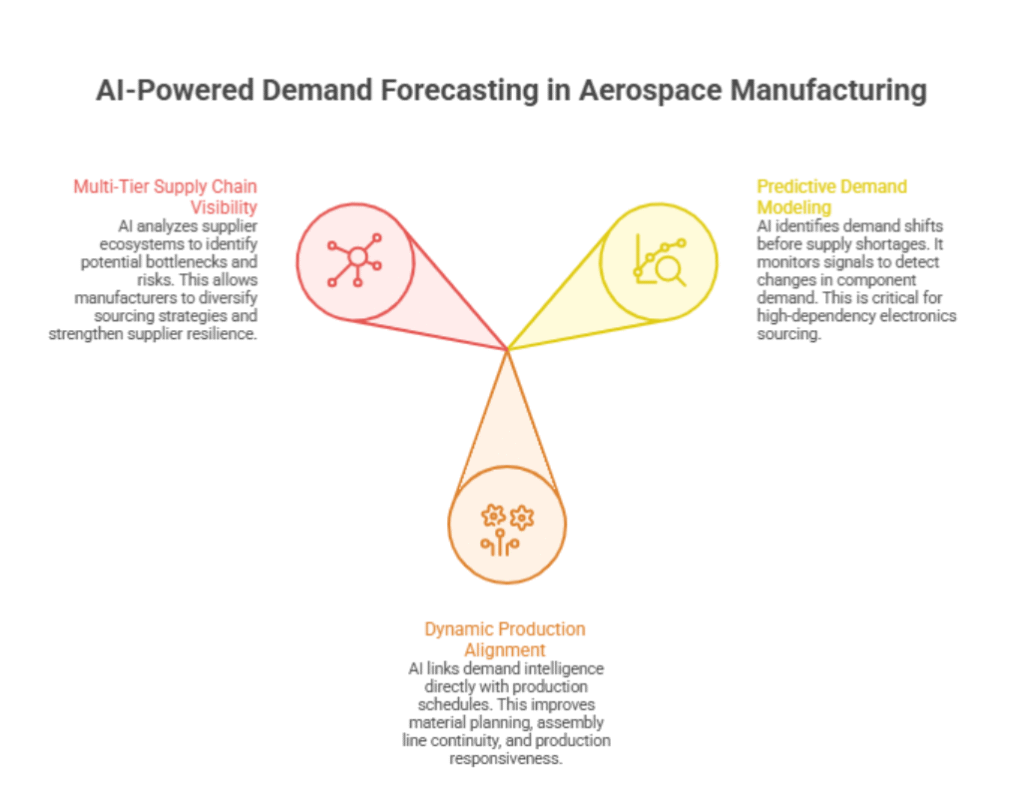
Predictive Demand Modeling
One of the biggest advantages of AI-powered forecasting is its ability to identify demand shifts before supply shortages begin affecting production. AI systems, however, continuously monitor operational and market signals to detect early changes in component demand patterns.
For aerospace manufacturers, this is especially critical in high-dependency electronics sourcing environments where long lead-time components can quickly become supply bottlenecks.
AI forecasting models can help manufacturers anticipate
- Increased demand for flight control semiconductors
- Future shortages in high-temperature capacitors
- Avionics PCB consumption based on aircraft delivery schedules
- Procurement exposure for long lead-time electronic assemblies
This early visibility enables procurement teams to secure inventory earlier, improve supplier coordination, and reduce sourcing pressure during volatile market conditions.
Companies such as IBM Watson Supply Chain and Kinaxis RapidResponse are increasingly integrating predictive analytics and AI forecasting capabilities into aerospace supply chain environments.
Dynamic Production Alignment
Forecasting accuracy alone is not enough if procurement planning remains disconnected from manufacturing operations. AI systems improve forecasting effectiveness by linking demand intelligence directly with production schedules and operational priorities.
This allows manufacturers to improve
- Material planning accuracy
- Assembly line continuity
- Production-material synchronization
- Manufacturing responsiveness
- Work-in-progress optimization
In aerospace electronics manufacturing, where production downtime can create major financial and operational impact, even small improvements in forecast alignment can significantly improve production continuity and sourcing efficiency.
Multi-Tier Supply Chain Visibility
Limited visibility across Tier-2 and Tier-3 supplier networks remains a major challenge for aerospace procurement teams. Many sourcing disruptions originate far beyond direct supplier relationships, making traditional supplier monitoring insufficient.
AI-powered supply chain intelligence platforms analyze supplier ecosystems continuously to identify
- Potential sourcing bottlenecks
- Single-source supplier dependencies
- Supplier financial instability
- Geopolitical sourcing risks
- Logistics and transportation vulnerabilities
This proactive visibility allows aerospace manufacturers to diversify sourcing strategies, strengthen supplier resilience, and respond to disruptions earlier before they impact avionics production schedules.
Supply chain visibility platforms from Infor Nexus and Blue Yonder are helping manufacturers improve multi-tier supplier intelligence and disruption monitoring.
How AI Cuts Aerospace Component Lead Times by 20%
Faster Supplier Identification
Supplier identification remains one of the most time-consuming stages in aerospace procurement. Manual sourcing workflows often depend on manual RFQs, supplier email coordination, spreadsheet-based vendor comparison, and delayed approval cycles. In fast-changing supply environments, these manual processes slow procurement responsiveness and increase sourcing risks.
AI is helping aerospace manufacturers accelerate supplier discovery and qualification significantly.
AI-powered sourcing systems analyze
- Historical sourcing data
- Supplier qualification databases
- Real-time component availability
- Delivery performance trends
- Lead-time prediction models
This enables procurement teams to identify qualified suppliers in minutes instead of days while improving sourcing accuracy across critical avionics and aerospace electronics components.
Platforms such as Coupa Supply Chain Design & Planning and SAP Ariba are increasingly integrating AI supplier intelligence and procurement automation capabilities.
Intelligent Alternate Component Matching
Many aircraft programs continue operating for decades, while electronic component lifecycles continue shrinking.
AI systems help procurement and engineering teams respond faster by identifying
- Form-fit-function alternatives
- Approved substitute components
- Cross-certified suppliers
- Compatibility-based sourcing options
This reduces engineering review cycles, minimizes sourcing delays, and improves continuity across long-lifecycle aerospace production programs.
Real-Time Risk Monitoring
Modern aerospace supply chains are highly vulnerable to external disruptions that can rapidly impact procurement timelines. AI-powered supply chain intelligence platforms continuously monitor operational and global risk signals in real time.
These systems track
- Supplier disruptions
- Port congestion
- Export restrictions
- Natural disasters
- Political instability
- Semiconductor market volatility
When sourcing risks emerge, AI systems automatically trigger procurement alerts, alternate sourcing recommendations, or inventory protection strategies before disruptions escalate into production delays.
This proactive visibility helps aerospace manufacturers reduce last-minute procurement crises and improve supply continuity.
Organizations are increasingly adopting AI risk intelligence platforms from Everstream Analytics and Resilinc to improve disruption monitoring and supplier risk analysis.
Procurement Workflow Automation
Manual procurement workflows often create delays across sourcing operations, especially when approvals, compliance checks, and supplier coordination occur across disconnected systems.
AI-powered procurement automation streamlines
- RFQ generation
- Vendor comparison
- Compliance verification
- Purchase order prioritization
- Supplier communication workflows
By reducing manual coordination and administrative bottlenecks, aerospace manufacturers can improve procurement speed, strengthen sourcing agility, and reduce component lead times across aerospace electronics manufacturing environments.
| Aerospace Supply Chain Area | Traditional Procurement Approach | AI-Powered Supply Chain Approach | Operational Impact |
| Demand Forecasting | Historical planning with static forecasting cycles | Real-time predictive forecasting using AI and machine learning | Faster response to demand fluctuations and supply disruptions |
| Supplier Identification | Manual RFQs and spreadsheet-based vendor evaluation | AI-driven supplier discovery and qualification analysis | Faster supplier onboarding and reduced sourcing delays |
| Component Sourcing | Reactive procurement after shortages occur | Predictive sourcing recommendations based on supply risk signals | Earlier inventory securing and reduced lead times |
| Alternate Component Matching | Manual engineering review for substitute parts | AI-based form-fit-function compatibility analysis | Faster obsolescence response and reduced procurement bottlenecks |
| Inventory Planning | Static inventory thresholds and reactive replenishment | Dynamic inventory optimization using live demand and supply signals | Reduced excess stock and improved material availability |
| Supplier Risk Monitoring | Periodic supplier reviews and delayed disruption visibility | Continuous AI monitoring of supplier performance and market risks | Faster mitigation of sourcing disruptions |
| Production Alignment | Disconnected forecasting and manufacturing schedules | AI-connected production and procurement planning | Improved assembly line continuity and reduced downtime |
| Multi-Tier Supply Chain Visibility | Limited visibility into Tier-2 and Tier-3 suppliers | AI-powered ecosystem-wide supplier intelligence | Better identification of hidden sourcing vulnerabilities |
| Logistics and Delivery Tracking | Reactive shipment tracking and manual coordination | AI-based logistics monitoring and predictive disruption alerts | Reduced transportation and delivery delays |
| Procurement Workflows | Manual approvals and fragmented communication workflows | Automated RFQ generation, compliance checks, and vendor comparison | Faster procurement cycles and operational efficiency |
| Obsolescence Management | Reactive replacement planning after EOL announcements | AI-driven lifecycle prediction and sourcing alternatives | Improved long-term avionics production continuity |
| Supply Chain Decision-Making | Historical analysis with delayed operational visibility | Real-time predictive procurement intelligence | Up to 20% reduction in aerospace component lead times |
AI Use Cases Across Aerospace Avionics Production
Semiconductor Procurement Optimization
AI-powered procurement systems help manufacturers improve semiconductor sourcing by analyzing
- Global fabrication capacity trends
- Supplier allocation patterns
- Historical procurement behavior
- Inventory consumption rates
- Aircraft production schedules
- Semiconductor market volatility
This enables procurement teams to identify potential shortages earlier, prioritize high-risk components, and secure inventory before lead times increase significantly.
Semiconductor sourcing intelligence capabilities from Siemens Digital Industries Software and Ansys are increasingly supporting aerospace electronics manufacturers in supply continuity planning.
Obsolescence Management
Managing long-term component availability has become a major operational challenge across avionics manufacturing.
AI systems help manufacturers identify
- Components approaching end-of-life status
- High-risk legacy electronic dependencies
- Replacement sourcing opportunities
- Lifetime-buy planning requirements
- Alternate component compatibility options
This improves long-term production continuity while reducing redesign delays and unexpected procurement disruptions.
Counterfeit Component Detection
AI-powered sourcing platforms analyze
- Supplier credibility patterns
- Procurement anomalies
- Certification inconsistencies
- Historical quality incidents
- Supplier performance behavior
This helps aerospace manufacturers strengthen supplier validation, improve component traceability, and reduce sourcing risks across avionics production programs.
Inventory Optimization
Traditional inventory strategies often create a difficult balance between excess stock and component shortages. Overstocking increases working capital costs, while understocking creates production risks.
AI inventory planning systems continuously analyze
- Demand fluctuations
- Supplier lead times
- Inventory movement trends
- Production priorities
- Procurement risk exposure
This allows manufacturers to maintain more accurate inventory levels while improving sourcing flexibility and reducing operational disruptions across aerospace electronics manufacturing environments.
Predictive Supplier Risk Analysis
Supplier instability can quickly impact aerospace production timelines, especially when sourcing highly specialized electronic components from limited vendor ecosystems.
AI-powered supply chain intelligence systems continuously evaluate
- Supplier delivery performance
- Financial risk indicators
- Geographic sourcing exposure
- Compliance history
- Logistics reliability
This proactive visibility enables aerospace manufacturers to diversify sourcing strategies earlier and reduce dependency risks before disruptions affect avionics production continuity.
Benefits of AI Aerospace Component Sourcing
Operational Benefits
As aerospace electronics supply chains become more volatile and procurement cycles grow increasingly complex, manufacturers are adopting AI-powered sourcing and forecasting systems to improve operational efficiency and supply continuity.
By combining predictive analytics, supplier intelligence, inventory optimization, and procurement automation, AI helps organizations reduce sourcing delays and improve decision-making across avionics manufacturing environments.
Organizations implementing AI aerospace sourcing strategies are seeing measurable improvements across several operational areas.
| Area | Operational Impact |
| Procurement Lead Times | Up to 20% reduction in sourcing and procurement delays |
| Forecast Accuracy | Improved planning precision and demand visibility |
| Supplier Risk Visibility | Faster identification of supplier disruptions and sourcing risks |
| Inventory Optimization | Reduced excess inventory and improved stock availability |
| Production Continuity | Lower risk of assembly line interruptions and downtime |
| Procurement Efficiency | Faster sourcing cycles and improved procurement responsiveness |
| Obsolescence Management | Reduced redesign delays and improved lifecycle planning |
| Supplier Collaboration | Better coordination across multi-tier supplier networks |
| Component Availability | Improved access to high-risk and long lead-time components |
| Supply Chain Resilience | Stronger response to geopolitical and logistics disruptions |
Challenges Slowing AI Adoption in Aerospace Supply Chains
Legacy Procurement Infrastructure
Many aerospace manufacturers still rely on fragmented ERP systems, disconnected procurement platforms, and siloed supplier databases. AI sourcing and forecasting systems require connected and real-time operational data, making integration with legacy infrastructure a significant challenge.
Limited Supplier Visibility
Aerospace supply chains often extend across complex Tier-2 and Tier-3 supplier networks with limited transparency. This lack of visibility can reduce forecasting accuracy and delay proactive sourcing decisions during supply disruptions.
Data Quality Issues
AI models depend on accurate procurement records, supplier performance data, inventory visibility, and production schedules. Inconsistent or outdated operational data can weaken forecasting precision and sourcing intelligence.
Compliance and Engineering Constraints
Aerospace sourcing involves strict certification, traceability, and regulatory approval requirements. Even when AI identifies alternate components or suppliers, engineering validation and compliance processes can still extend procurement timelines.
Workforce and Process Transformation
AI implementation also requires procurement and sourcing teams to adapt to predictive planning models, automated recommendations, and real-time supply chain monitoring systems. Operational adoption remains a key part of successful transformation.
Final Thoughts
AI is fundamentally reshaping aerospace electronics manufacturing supply chains, especially in the critical area of component sourcing.
By combining predictive demand forecasting, intelligent procurement automation, supplier risk analytics, and real-time sourcing intelligence, aerospace manufacturers can significantly reduce operational bottlenecks and improve production continuity.
The outcome is a smarter, more resilient aerospace supply chain capable of adapting to volatility, managing component shortages, reducing sourcing risk, and sustaining complex avionics production programs.
As semiconductor uncertainty, geopolitical disruptions, and supply chain complexity continue to rise, AI-powered sourcing will become a defining capability for next-generation aerospace manufacturing organizations.
FAQs
1. How does AI improve aerospace component sourcing?
AI improves aerospace component sourcing by analyzing supplier performance, predicting shortages, automating procurement workflows, identifying alternate components, and reducing sourcing delays through predictive analytics.
2. Why are lead times so challenging in aerospace electronics manufacturing?
Aerospace electronics manufacturing involves highly specialized components, strict compliance requirements, long qualification cycles, and limited supplier ecosystems, all of which contribute to extended procurement lead times.
3. Can AI reduce semiconductor shortages in aerospace manufacturing?
AI cannot eliminate shortages entirely, but it helps manufacturers predict supply risks earlier, optimize inventory, diversify suppliers, and secure critical semiconductors before disruptions worsen.
4. What role does predictive forecasting play in avionics production?
Predictive forecasting helps avionics manufacturers anticipate future component demand, align procurement with production schedules, and avoid inventory shortages that can delay aircraft assembly.
5. How does AI support aerospace supply chain resilience?
AI enhances resilience by providing real-time risk monitoring, supplier intelligence, disruption forecasting, and adaptive sourcing recommendations across multi-tier aerospace supply chains.
6. What are the biggest barriers to AI adoption in aerospace procurement?
Common barriers include fragmented supplier data, legacy ERP systems, regulatory compliance complexity, limited real-time visibility, and the need for standardized procurement processes.
