
Enterprise IT operations have continually evolved as organizations adopt technologies that simplify how systems are managed and governed.
Automation has played a major role in this progress, helping IT teams streamline infrastructure management, standardize workflows, and reduce the operational effort required to maintain large, complex environments.
Now, Generative AI is introducing a new layer of intelligence into Enterprise Automation. AI systems can analyze operational data, generate compliance documentation, identify governance risks, and assist IT teams in managing systems more proactively.
According to IBM, AI-enabled automation is becoming a key driver for improving operational resilience and reducing manual IT workloads across modern enterprises.
For IT leaders, building responsible IT automation means designing AI systems that improve operational efficiency while maintaining governance, regulatory compliance, and clear operational control across the enterprise.
In this blog, we explore how organizations can build responsible IT automation by integrating AI into operations while maintaining governance, regulatory compliance, and the control required to manage complex enterprise IT environments effectively.
What Responsible IT Automation Means
Responsible IT automation refers to implementing AI automation systems in ways that align with governance policies, regulatory requirements, and organizational accountability.
Rather than allowing automation tools to operate independently, responsible automation ensures that AI works as a controlled operational assistant. It helps IT teams perform tasks faster while remaining subject to clear policies, oversight mechanisms, and compliance standards.
Several principles define responsible automation in modern IT environments.
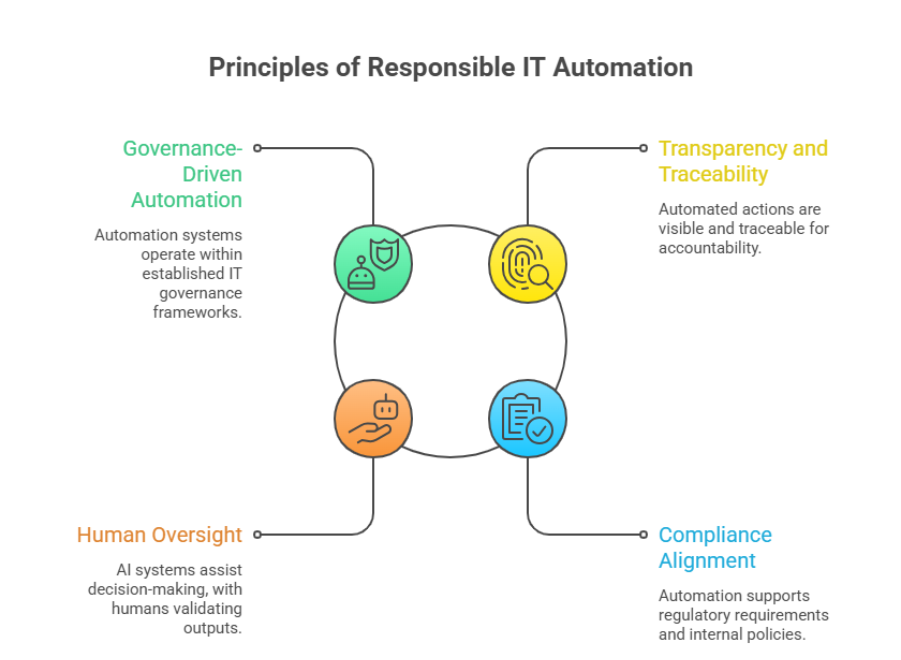
Governance-Driven Automation
Automation systems should operate within established IT governance frameworks. Policies related to data access, operational procedures, and risk management must guide how automated systems behave.
Transparency and Traceability
Every automated action should be visible and traceable. Organizations need clear records of how automation decisions are made, especially when AI is involved in interpreting data or recommending actions.
According to Google’s Responsible AI Practices, transparency and explainability are critical for maintaining trust in AI systems that influence operational processes.
Human Oversight
AI systems should assist decision-making rather than replace it. Human experts remain responsible for evaluating risks, validating automated outputs, and ensuring operations remain aligned with business priorities.
Compliance Alignment
Automation must support regulatory requirements such as data protection laws, security standards, and internal governance policies. Responsible automation ensures that efficiency improvements do not compromise compliance.
By combining these principles, organizations can build automation systems that deliver operational value while maintaining accountability.
Why Responsible AI Matters in IT Operations
Responsible AI has become an important concept across industries. At its core, responsible AI focuses on ensuring that artificial intelligence systems operate in ways that are ethical, transparent, fair, and accountable.
When applied to IT operations, responsible AI ensures that automation systems support organizational goals without introducing unnecessary risks.
Protecting Data and Infrastructure
IT automation tools often interact with sensitive infrastructure and operational data. Responsible AI frameworks ensure these systems follow strict data security practices and prevent unauthorized access.
Maintaining Operational Accountability
As automation becomes more sophisticated, it becomes essential to understand how decisions are made. Responsible AI practices ensure that automated systems remain explainable and auditable.
The NIST AI Risk Management Framework stresses that AI systems used in operational environments must support traceability and auditability to reduce enterprise risk.
Supporting Trust in Automation
For IT teams to rely on AI systems, they must trust that automation will operate predictably and within defined limits. Responsible automation builds this trust by maintaining transparency and control.
Organizations that embed responsible AI principles into automation strategies are better positioned to scale technology safely and sustainably.
Where AI Improves IT Automation
Generative AI and advanced analytics are transforming IT operations by helping teams interpret large volumes of system data, automate documentation, and detect risks earlier.
The following areas show where AI delivers the most measurable improvements in modern IT automation environments.
| IT Automation Area | How AI Enhances IT Operations | Operational Impact for Enterprises |
| Automated Incident Analysis | AI analyzes logs, telemetry data, and alerts to generate structured summaries of incidents. It can detect patterns across system events and suggest potential root causes. | Faster incident triage, reduced investigation time, and improved response coordination. |
| Compliance Documentation | AI can automatically generate documentation from operational data, including system activity logs, workflow histories, and change management records. | Organizations maintain audit-ready records with less manual documentation effort, improving regulatory readiness and reducing compliance workload. |
| Governance Monitoring | AI continuously analyzes system behavior against governance policies. It can detect anomalies, policy violations, unusual system access patterns, or configuration drift. | Early detection of compliance risks, stronger policy enforcement, and improved governance across complex IT infrastructures. |
| Operational Insights | By analyzing historical system data, AI identifies recurring incidents, performance bottlenecks, and operational inefficiencies that may not be visible through manual monitoring. | IT leaders gain data-driven insights to optimize infrastructure, improve service reliability, and refine automation strategies. |
| Change Impact Analysis | AI can evaluate historical system changes and predict the potential impact of new updates, deployments, or configuration changes before they occur. | Reduces deployment risk and helps prevent service disruptions caused by poorly assessed system changes. |
| Knowledge Base Automation | AI can automatically convert incident resolutions, system fixes, and operational procedures into structured knowledge base articles for IT teams. | Improves knowledge sharing, speeds up future troubleshooting, and strengthens organizational learning across IT teams. |
Balancing AI, Compliance, and Control
Introducing AI into IT automation requires careful balance. While automation improves efficiency, organizations must ensure that governance and compliance remain central to operational design.
Several practices help organizations maintain this balance.
Establish Governance Policies First
Automation should be built around clearly defined policies. Governance frameworks determine how AI systems interact with infrastructure, data, and operational workflows.
Maintain Visibility into Automation Actions
Organizations should maintain logs and audit trails for automated processes. This ensures transparency and simplifies compliance reporting.
Keep Humans in the Decision Loop
AI can provide recommendations, but critical decisions should still involve human evaluation. This helps prevent unintended consequences and ensures strategic alignment.
Monitor and Improve Automation Continuously
Automation systems should be evaluated regularly. Monitoring performance helps organizations refine workflows and ensure AI continues to operate responsibly.
By combining these practices, organizations can ensure automation delivers value without compromising governance.
Building a Responsible IT Automation Framework
Creating responsible automation requires more than deploying AI tools. Organizations must design operational frameworks that integrate automation with governance structures.
A responsible automation framework typically includes
Policy integration: Automation workflows that align with IT governance standards.
Data security controls: Mechanisms that protect sensitive information handled by automated systems.
Operational transparency: Systems that record and explain automated actions.
Continuous monitoring: Processes that evaluate automation performance and identify potential risks.
These components ensure automation operates as a controlled extension of IT operations rather than an independent system.
| Best Practice | Why It Matters |
| Define governance policies before automation | Ensures AI systems operate within approved operational frameworks |
| Maintain human validation for AI-generated insights | Prevents incorrect interpretations from affecting operational decisions |
| Integrate AI tools with existing IT management platforms | Supports seamless adoption within established workflows |
| Maintain audit logs of automated actions and recommendations | Helps organizations demonstrate compliance during audits |
| Monitor the impact of AI automation over time | Allows teams to refine governance strategies and improve operational outcomes |
Applying these practices allows organizations to introduce automation responsibly without disrupting existing governance structures.
Final Thoughts
AI is reshaping the way organizations approach IT automation. With the ability to analyze operational data, generate insights, and support decision-making, generative AI has the potential to significantly improve how IT teams manage complex environments.
Yet the adoption of AI must be accompanied by strong governance and compliance practices. Responsible IT automation ensures that intelligent systems operate within clear policies while maintaining transparency and human oversight.
Organizations that successfully balance AI capability with compliance and operational control will be able to scale automation confidently. By embedding responsible AI principles into IT automation strategies, enterprises can build systems that are not only efficient but also trustworthy and sustainable.
FAQs
What is responsible IT automation?
Responsible IT automation refers to implementing AI-driven automation systems while maintaining governance policies, regulatory compliance, transparency, and human oversight across IT operations.
Why is responsible AI important in IT automation?
Responsible AI ensures that automation systems operate safely and transparently, protecting sensitive data, supporting compliance requirements, and maintaining operational accountability.
How does generative AI improve IT automation?
Generative AI can analyze system data, summarize incidents, generate compliance documentation, and provide insights that help IT teams manage infrastructure more efficiently.
Can AI fully replace human oversight in IT operations?
No. AI assists IT teams by analyzing data and automating repetitive tasks, but human experts remain responsible for evaluating risks and making critical operational decisions.
How can organizations start building responsible IT automation?
Organizations should begin by defining governance policies, integrating AI tools within controlled workflows, maintaining transparency through audit logs, and continuously monitoring automation performance.
