As AI scales across the enterprise, the focus naturally shifts from experimentation to structure. At that stage, the Digital Transformation Officer is no longer evaluating models alone but defining how AI operates across systems, teams, and governance layers.
Responsible adoption requires more than intent. It calls for a clear DTO responsible AI framework that embeds AI governance for digital transformation officers directly into execution. This is where a structured enterprise responsible AI playbook becomes practical, not theoretical.
The Digital Transformation Officer’s Responsible AI Playbook brings governance architecture, oversight, orchestration, and monitoring into one operating model so responsible AI is designed into enterprise workflows from the start.
Why Digital Transformation Officers Need a Responsible AI Framework at Enterprise Scale
As AI moves beyond experimentation and becomes embedded across functions, the responsibility of structuring adoption naturally shifts to the Digital Transformation Officer. At enterprise scale, AI touches multiple systems, departments, and decision flows. What matters at this stage is not just capability, but consistency.
A defined DTO responsible AI framework helps create that consistency. It ensures AI initiatives are aligned with governance standards, operating principles, and long-term transformation goals. Without a shared structure, adoption can move at different speeds across teams, making coordination more complex over time.
At scale, Digital Transformation Officers typically need clarity across several dimensions:
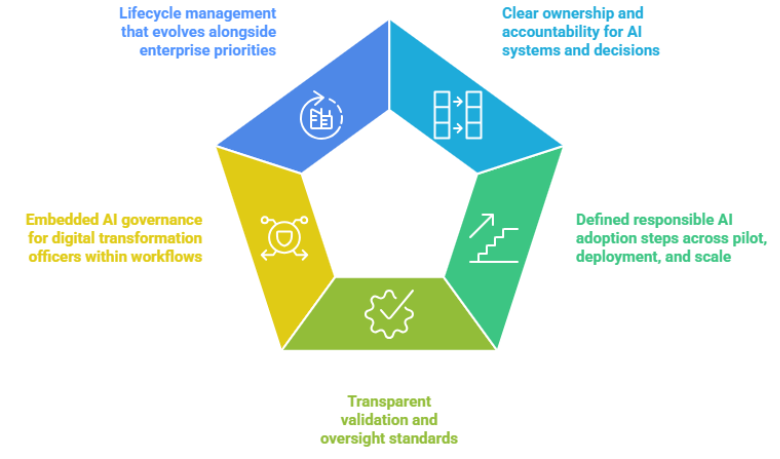
- Clear ownership and accountability for AI systems and decisions
- Defined responsible AI adoption steps across pilot, deployment, and scale
- Transparent validation and oversight standards
- Embedded AI governance for digital transformation officers within workflows
- Lifecycle management that evolves alongside enterprise priorities
A structured enterprise responsible AI playbook provides a practical way to align these elements. It allows AI to expand across departments while maintaining a coherent governance architecture, ensuring that innovation and oversight develop together as part of the broader digital transformation strategy.
The Digital Transformation Officer’s Responsible AI Playbook: 6 Core Components
A practical Digital Transformation Officer’s Responsible AI Playbook is built around structured operating components. These elements ensure responsible AI adoption is designed into architecture, execution, and oversight from the beginning.
1. Governance Architecture for Responsible AI
Responsible AI starts with defined ownership, accountability, and operating principles. Governance architecture clarifies who approves AI initiatives, who monitors outcomes, and how policies apply across departments. This foundation supports a scalable DTO responsible AI framework that aligns AI programs with enterprise transformation goals.
2. Model Oversight and Validation Standards
As AI models are introduced across workflows, oversight becomes continuous rather than periodic. Model oversight includes validation standards, traceability of decisions, and defined review cycles. For Digital Transformation Officers, this ensures AI governance for digital transformation officers is measurable and structured rather than informal.
3. Workflow Integration for Responsible AI Execution
Responsible AI becomes operational when it is embedded directly into enterprise processes. Instead of operating in isolation, AI decisions must align with approval paths, compliance rules, and operational checkpoints. Clear integration ensures responsible AI adoption steps are reflected within daily workflows.
4. Risk Controls and Policy Alignment
Risk controls ensure AI-driven outputs align with enterprise policies and regulatory expectations. This includes defining thresholds, escalation paths, and monitoring criteria. A structured enterprise responsible AI playbook ensures that innovation progresses within defined guardrails.
5. Scalable AI Orchestration Across Systems
As AI spans departments, coordination becomes critical. Scalable orchestration connects data sources, models, and enterprise systems into a unified execution layer. This enables consistent oversight while allowing AI initiatives to expand across functions without fragmentation.
6. Continuous Monitoring and Accountability
Responsible AI is sustained through ongoing monitoring. Performance metrics, decision logs, and operational impact must be tracked consistently. Continuous monitoring allows Digital Transformation Officers to evaluate how AI systems are performing and adjust governance mechanisms as adoption evolves.
Together, these six components form a practical operating structure. When implemented cohesively, they allow responsible AI to scale across the enterprise while remaining aligned with transformation objectives.
Responsible AI Adoption Steps for Enterprise Digital Transformation Officers
Once the framework is defined, the next step for any Digital Transformation Officer is execution. Responsible AI adoption becomes practical when it is phased deliberately, with governance embedded into each stage rather than introduced later. A structured rollout ensures alignment across teams, systems, and oversight functions.
| Adoption Stage | Focus Area | Responsible AI Consideration |
| Strategy Definition | Define enterprise AI priorities | Align initiatives with the Digital Transformation Officer’s Responsible AI Playbook and governance principles |
| Pilot Deployment | Test AI within controlled scope | Apply defined responsible AI adoption steps including validation and oversight checkpoints |
| Workflow Integration | Embed AI into business processes | Ensure AI decisions align with policies and AI governance for digital transformation officers |
| Scale Across Functions | Expand to additional departments | Maintain consistent standards through the DTO responsible AI framework |
| Continuous Review | Monitor and refine AI systems | Track performance, traceability, and enterprise impact over time |
By approaching adoption in structured stages, Digital Transformation Officers create clarity around ownership and accountability. Responsible AI becomes a managed transformation program rather than a collection of independent deployments.
How to Operationalize Responsible AI Governance with Orchestration Infrastructure
Designing a framework is one part of the journey. Making it operational requires infrastructure that can coordinate AI execution, validation, and monitoring across enterprise systems. For Digital Transformation Officers, governance becomes sustainable when it is embedded directly into how AI workflows run.
To operationalize the Digital Transformation Officer’s Responsible AI Playbook, enterprises typically need:
- A centralized orchestration layer that coordinates models, data sources, and workflow triggers
- Structured validation checkpoints aligned with the DTO responsible AI framework
- Transparent logging and traceability mechanisms to support AI governance for digital transformation officers
- Modular model management to support lifecycle updates without disrupting operations
- Cross-system integration that embeds responsible AI adoption steps directly into enterprise workflows
This is where GenE becomes relevant as execution infrastructure. By orchestrating AI agents, validation logic, and workflow integration across systems, GenE enables responsible AI to function as an operational discipline. Governance is not layered on top of AI systems; it is coordinated alongside them, supporting scalable and structured enterprise adoption.
Enterprise Impact of a Structured Responsible AI Operating Model
When responsible AI is structured through a defined operating model, its impact extends beyond governance alignment. For Digital Transformation Officers, the objective is to create an environment where innovation, oversight, and operational performance move forward together.
| Impact Area | How a Structured Playbook Supports the Enterprise |
| Governance Consistency | The Digital Transformation Officer’s Responsible AI Playbook ensures policies and oversight standards are applied uniformly across departments. |
| Innovation with Oversight | A defined DTO responsible AI framework allows teams to deploy AI while maintaining accountability and validation standards. |
| Operational Clarity | Responsible AI adoption steps are embedded within workflows, reducing ambiguity around ownership and review cycles. |
| Cross-System Coordination | Orchestration infrastructure supports AI governance for digital transformation officers across multiple platforms and business functions. |
| Scalable AI Expansion | A structured enterprise responsible AI playbook allows AI initiatives to expand without fragmenting governance controls. |
By formalizing responsible AI into a structured operating model, Digital Transformation Officers create long-term stability for AI initiatives. Innovation becomes repeatable, governance becomes measurable, and AI adoption aligns more closely with enterprise transformation objectives.
Conclusion
For Digital Transformation Officers, responsible AI is not an abstract commitment. It becomes part of how enterprise systems operate, how decisions are validated, and how accountability is structured across departments. As AI adoption expands, leadership shifts from experimentation to operational discipline.
The Digital Transformation Officer’s Responsible AI Playbook provides that discipline. By aligning governance architecture, model oversight, workflow integration, risk controls, orchestration, and monitoring, enterprises can scale AI while maintaining clarity and accountability. Responsible adoption becomes embedded into execution rather than layered on afterwards.
With structured orchestration infrastructure, organizations can translate framework into practice. Responsible AI evolves alongside digital transformation priorities, supporting innovation that is measurable, governed, and sustainable over time.
FAQs
How should a digital transformation officer adopt responsible AI?
Digital Transformation Officers should begin with a defined DTO responsible AI framework, embed governance into workflows, and implement structured responsible AI adoption steps that scale across departments.
What framework should DTOs use for responsible AI?
A structured Digital Transformation Officer’s Responsible AI Playbook that includes governance architecture, model oversight, workflow integration, risk controls, orchestration, and continuous monitoring provides a practical foundation.
What are the responsible AI adoption steps in an enterprise?
Responsible AI adoption typically progresses through strategy definition, controlled pilot deployment, workflow integration, enterprise scaling, and continuous oversight aligned with AI governance for digital transformation officers.
How does governance scale as AI expands across departments?
Governance scales through a consistent enterprise responsible AI playbook, centralized orchestration, and defined accountability structures that apply across systems and business functions.
How does orchestration support responsible AI?
Orchestration infrastructure coordinates model execution, validation checkpoints, and monitoring across workflows. This ensures the Digital Transformation Officer’s Responsible AI Playbook operates as an integrated system rather than isolated policies.
