The volume of information that flows through a sales organization has never been higher, including calls, emails, proposals, product updates, buyer questions, internal notes, and pipeline reviews.
That’s where AI tools are beginning to shift how sales work actually gets done.
The strongest platforms today support core selling motions by:
- interpreting buyer signals with greater precision
- preparing reps for conversations across every channel
- automating steps that traditionally slow down deals
- strengthening pipeline visibility for managers and leaders
To identify the tools that create real impact, we evaluated platforms across qualification, outreach, follow-ups, coaching, forecasting, and deal movement. We analyzed workflow integration depth, adoption patterns, and the measurable lift these tools deliver inside active sales cycles.The result is a curated list of 12 AI tools that consistently help sales teams operate with more clarity, consistency, and confidence. This guide breaks down what each tool solves, how it works, and where revenue teams see the biggest gains.
How We Evaluated the Best Sales AI Tools
Our evaluation focused on how these platforms operate inside real sales environments.
We prioritized tools that strengthen decision-making, speed up execution, and improve the consistency of customer-facing work.
These are the six criteria we used:
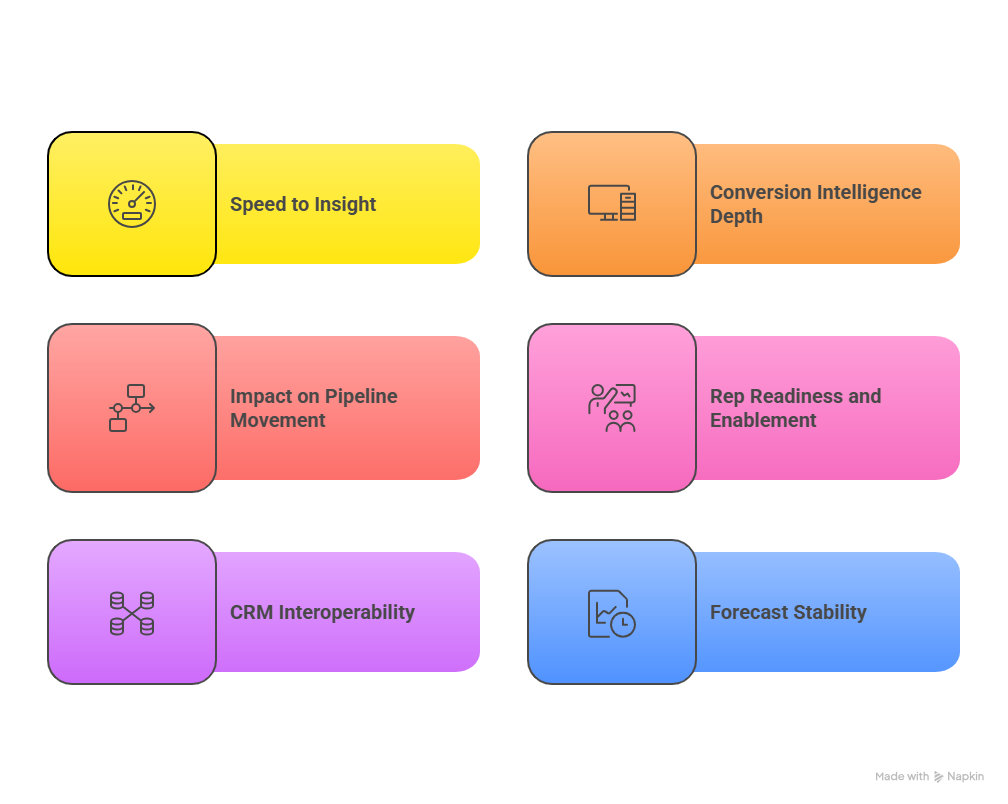
| ➡️Speed to InsightHow quickly the tool interprets buyer signals, conversation context, account history, and next-step recommendations. |
| ➡️ Conversation Intelligence Depth The tool’s ability to analyze sales calls, uncover intent, highlight risks, and provide actionable coaching points. |
| ➡️ Impact on Pipeline MovementWhether the platform meaningfully improves qualification quality, follow-up precision, deal progression, or meeting readiness. |
| ➡️ Rep Readiness and Enablement How effectively the tool helps new and experienced reps prepare for conversations, practice scenarios, and maintain consistency. |
| ➡️ CRM Interoperability Clean integration with Salesforce, HubSpot, or enterprise CRMs without adding manual work or disrupting existing processes. |
| ➡️ Forecast Stability The tool’s ability to surface deal risks, validate next steps, and create a more predictable, evidence-based forecast. |
These criteria ensured we selected tools that support the rhythm of sales work, tools that help reps stay prepared, leaders stay informed, and pipelines move with clarity.
The 12 Best AI Tools Every Sales Team Should Use in 2026
These platforms were selected based on measurable impact inside real sales workflows, qualification, conversations, coaching, forecasting, and deal movement.
Here are the 12 tools that consistently improve how sales teams operate.

1. DTskill GenE
GenE helps sales teams manage qualification accuracy, conversation readiness, and multi-step follow-ups across fast-moving cycles. It strengthens deal execution by interpreting buyer signals, preparing reps for conversations, and coordinating CRM tasks automatically.
The platform reduces fragmentation by unifying coaching, enablement, content retrieval, and workflow automation under one AI layer. Sales leaders gain a consistent rhythm for forecasting, call prep, and pipeline progression across every region and operating model.
GenE is especially powerful for teams needing structure, repeatability, and high-quality execution at scale.
Proven Impact in Sales Environments
- Higher-quality discovery through contextual prep intelligence
- Faster and more accurate follow-ups across accounts
- Stronger coaching and replication across global teams
- Cleaner pipeline hygiene with automated CRM actions
How the AI Works in Real Sales Workflows
GenE uses modular agents to handle discovery prep, follow-up generation, objection-handling practice, and opportunity progression. Agents pull data from CRM, past calls, product libraries, and internal playbooks to deliver context-specific guidance.
The system automates repetitive actions, logging notes, drafting next steps, updating fields, and triggering workflows. This ensures reps spend less time on admin tasks and more time on actual selling moments.
Sales Teams That Benefit Most: Organizations needing a unified AI layer across enablement, coaching, and deal execution. Teams operating across regions and products who require consistency and structured sales motions.
2. Gong
Gong helps sales teams understand what’s happening inside calls, emails, and meetings by analyzing buyer intent, objections, risks, and next steps. It gives leaders a clear, objective view of deal health and coaching needs, while helping reps refine messaging and improve follow-through.
The platform reduces guesswork and brings factual visibility into pipeline movement and rep performance.
Proven Impact in Sales Environments
- Clearer insight into deal risks and buyer signals
- Better coaching consistency across managers
- More predictable pipeline reviews and forecasts
- Strong lift in rep messaging and objection handling
How the AI Works in Real Sales Workflows
Gong analyzes conversations across voice, video, and email to identify patterns and interpret sentiment. It surfaces call highlights, recommended actions, and behavior insights for each opportunity.
Managers receive structured coaching cues, while reps get clear next-step recommendations based on buyer conversations.
Sales Teams That Benefit Most: Teams focused on improving deal execution and conversation quality. Organizations that need accurate visibility into pipeline momentum.
3. Clari
Clari provides a unified system to understand pipeline health, deal risks, and forecast accuracy across the revenue organization. It reduces manual spreadsheet work and ensures leaders see where deals are moving, stalling, or needing attention.
Clari aligns forecasts, activities, and rep behavior into one predictable revenue rhythm.
Proven Impact in Sales Environments
- Stronger forecast accuracy quarter over quarter
- Clear risk detection across opportunities
- Better pipeline discipline for reps
- Faster deal inspections for managers
How the AI Works in Real Sales Workflows
Clari analyzes CRM data, activity signals, call notes, and rep behavior to score risk and momentum. It provides deal insights, pipeline roll-ups, and forecast recommendations across sales hierarchies.
Leaders get real-time updates, while reps get clarity on next steps to keep deals progressing.
Sales Teams That Benefit Most: Organizations needing structured forecasting and predictable revenue calls. Sales teams managing complex, multi-stage enterprise deals.
4. Outreach
Outreach helps reps manage outbound sequences, follow-ups, and buyer engagement across multi-touch campaigns. Its AI prioritizes accounts, recommends timing, and identifies engagement patterns to increase conversion rates.
Outbound teams use it to maintain consistency while personalizing outreach at scale.
Proven Impact in Sales Environments
- Higher reply rates across sequences
- Better prioritization of engaged prospects
- More consistent outbound motions
- Reduced manual follow-up workload
How the AI Works in Real Sales Workflows
Outreach tracks prospect signals, analyzes engagement behavior, and adapts messaging based on responses. AI suggests next steps, updates sequences, and pushes reminders into rep workflows.
The platform syncs with CRM to automate multi-step outreach actions end-to-end.
Sales Teams That Benefit Most: SDR and AE teams running high-volume outbound workflows. Organizations needing predictable, multi-step engagement at scale.
5. Apollo AI
Apollo AI gives SDRs real-time lead intelligence, contact insights, and buying signals to improve top-of-funnel targeting. It helps teams prioritize accounts with higher conversion potential and build better lists based on intent and ICP alignment.
The platform saves time on research and accelerates pipeline creation.
Proven Impact in Sales Environments
- Better-quality prospect lists and ICP targeting
- Faster pipeline generation for SDR teams
- Higher response rates driven by intent signals
- More efficient outbound research workflows
How the AI Works in Real Sales Workflows
Apollo analyzes millions of data points to surface leads that match ICP criteria and active intent signals. AI automates prospecting workflows, enriches contact info, and prioritizes accounts with buying activity.
Reps get guided recommendations on who to contact next and why.
Sales Teams That Benefit Most: Outbound SDR teams focused on top-of-funnel velocity. Organizations expanding into new accounts or markets.
6. Lavender
Lavender improves the clarity, tone, and structure of sales emails to increase reply rates. It helps reps create concise, relevant messaging by highlighting friction points and rewriting weak sections.
Teams rely on it to improve outbound personalization without losing speed.
Proven Impact in Sales Environments
- Higher open and reply rates
- Stronger personalization at scale
- Reduced time writing outbound emails
- Better alignment with best-practice messaging
How the AI Works in Real Sales Workflows
Lavender evaluates an email draft in real time and scores it based on clarity, length, tone, structure, and relevance. The AI suggests edits, highlights weak phrasing, and recommends personalization opportunities.
The tool integrates directly into email workflows so reps never need to switch tools.
Sales Teams That Benefit Most: Teams relying heavily on outbound email for pipeline. SDRs and AEs needing fast, high-quality messaging support.
7. Seamless AI
Seamless AI helps outbound teams find verified contact data, job titles, and company insights with minimal manual lookup. It eliminates research-heavy tasks and ensures reps spend more time engaging than searching.
The platform improves list quality, accuracy, and coverage across industries.
Proven Impact in Sales Environments
- Faster lead list creation
- Better contact accuracy at scale
- Reduced manual research workload
- Higher outbound efficiency for SDRs
How the AI Works in Real Sales Workflows
Seamless AI uses an AI-driven data engine to verify contact details in real time. It enriches accounts with job titles, emails, firmographics, and intent signals.
The platform syncs with CRM and outbound tools to streamline list building.
Sales Teams That Benefit Most: SDR teams creating large prospect lists. Organizations entering new territories or industries.
8. HubSpot AI
HubSpot AI enhances lead scoring, follow-up recommendations, pipeline management, and deal insights inside a unified CRM. It helps reps stay organized while automating routine tasks and improving visibility into active opportunities.
Leaders use it to standardize processes across teams.
Proven Impact in Sales Environments
- Better lead qualification accuracy
- Faster follow-up cycles
- Improved pipeline alignment across teams
- Reduced time spent on CRM updates
How the AI Works in Real Sales Workflows
HubSpot AI analyzes contact behavior, deal activity, and past conversion patterns to recommend next actions. It drafts follow-ups, summarizes calls, and automates tasks such as lead assignment and pipeline updates.
Reps receive guidance directly within the CRM interface.
Sales Teams That Benefit Most: SMB and mid-market sales organizations. Teams wanting an all-in-one CRM with built-in AI.
9. Salesforce Einstein
Einstein gives Salesforce users AI-driven insights, scoring, and task automation across opportunities, accounts, and interactions. It strengthens prioritization by highlighting risks, recommending next steps, and automating manual CRM tasks.
The platform helps reps stay productive inside high-volume Salesforce environments.
Proven Impact in Sales Environments
- More accurate opportunity scoring
- Faster CRM task automation
- Clearer account and deal signals
- Higher pipeline visibility for leaders
How the AI Works in Real Sales Workflows
Einstein analyzes CRM data, historical patterns, and engagement signals to recommend actions and score opportunities. It automates routine updates, drafts emails, and surfaces insights inside Salesforce objects.
The AI adapts to each organization’s workflows and sales processes.
Sales Teams That Benefit Most: Teams fully operating inside Salesforce ecosystems. Organizations needing deeper AI intelligence within core CRM workflows.
10. Regie AI
Regie AI accelerates the creation of outbound sequences, sales messaging, and persona-specific content. It reduces time spent drafting emails and helps reps align outreach with ICPs, product narratives, and campaign goals.
Teams use it to maintain relevance while increasing volume.
Proven Impact in Sales Environments
- Faster sequence creation at scale
- Higher personalization with less effort
- Better alignment with ICP and personas
- Improved outbound consistency across reps
How the AI Works in Real Sales Workflows
Regie AI analyzes ICP attributes, product messaging, and persona insights to generate tailored sequences. It optimizes content based on performance metrics and adjusts messaging for tone and relevance.
Reps can generate emails, scripts, and campaigns directly within their outbound tools.
Sales Teams That Benefit Most: Outbound teams running high-volume personalization. Organizations needing fast, scalable messaging production.
11. Amplemarket AI
Amplemarket consolidates lead sourcing, outreach, follow-ups, and multichannel automation into one platform. It helps reps stay consistent across email, LinkedIn, and phone sequences while adapting messaging based on buyer behavior.
Outbound teams rely on it for speed and multi-touch coverage.
Proven Impact in Sales Environments
- Better response rates across channels
- More consistent multi-touch campaigns
- Faster outbound execution cycles
- Improved targeting from buyer signals
How the AI Works in Real Sales Workflows
Amplemarket uses AI to analyze engagement signals and adjust sequence steps accordingly. It automates follow-ups, enriches lead data, and personalizes outreach across channels.
The platform integrates with CRM and email systems for smooth execution.
Sales Teams That Benefit Most: SDR teams running sophisticated, multi-channel outbound. Organizations wanting automation without losing personalization depth.
12. Drift
Drift captures inbound intent by engaging website visitors in real time, qualifying them, and routing them to the right rep. It reduces response time on inbound leads and converts interest into meetings faster.
Sales teams use it to create an earlier, higher-quality pipeline.
Proven Impact in Sales Environments
- Faster inbound qualification
- Higher conversion from website traffic
- Reduced the delay between interest and booking
- Stronger routing for territory teams
How the AI Works in Real Sales Workflows
Drift’s AI chatbot interacts with visitors, asks qualification questions, and identifies buying intent. It connects prospects directly to reps based on routing rules and availability.
The platform syncs data with CRM to ensure a clean handoff and follow-up.
Sales Teams That Benefit Most: Organizations with strong inbound traffic needing fast qualification. Revenue teams optimizing website-to-pipeline conversion.
Comparison of the Top 12 Sales AI Tools
| Tool | Category | Primary Sales Impact | Workflow Strength | Pricing Band |
| DTskill GenE | AI sales enablement + workflow orchestration | Stronger qualifications, consistent readiness, and cleaner deal execution | Discovery prep, follow-ups, coaching intelligence, automated CRM actions | Medium–High |
| Gong | Conversation intelligence | Real-time deal and call insights | Meeting analysis, risk signals, next-step guidance | High |
| Clari | Revenue intelligence & forecasting | Predictable, data-backed forecast accuracy | Deal inspection, pipeline visibility | High |
| Outreach | Sales engagement | Higher outbound consistency | Multi-step sequences, automated follow-ups | Medium–High |
| Apollo AI | Prospecting & lead intelligence | Better top-of-funnel quality | ICP targeting, intent scoring, contact intel | Medium |
| Lavender | Email intelligence | Higher reply rates | Email scoring, clarity, and personalization | Low–Medium |
| Seamless AI | Contact enrichment | Faster outbound list building | Contact search, real-time enrichment | Low–Medium |
| HubSpot AI | CRM + automation | Stronger pipeline discipline | Lead scoring, call summaries, workflows | Medium |
| Salesforce Einstein | CRM AI assistant | Better prioritization & deal signals | Opportunity scoring, automation | Medium–High |
| Regie AI | AI content generation | Better sales messaging quality | Sequence creation, persona messaging | Medium |
| Amplemarket AI | Sales automation | Multi-channel outbound efficiency | Sequences, follow-ups, lead insights | Medium |
| Drift | Conversational sales | Faster inbound conversion | Chat qualification, instant routing | Medium |
Where These Tools Improve Sales Performance
AI tools create impact when they support the real moments that define a sales cycle.
The tools in this list strengthen the steps where clarity, timing, and consistency matter most.
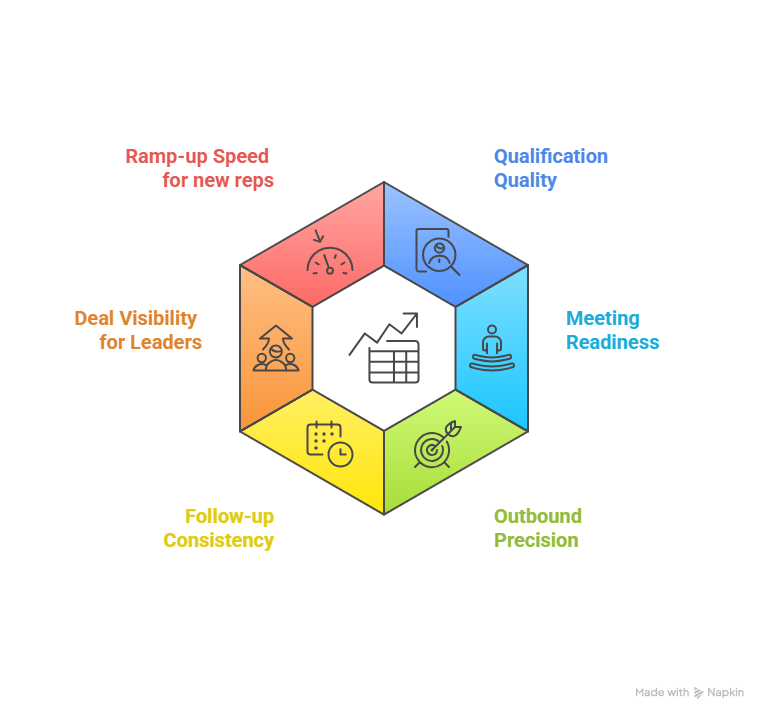
- Qualification quality
Clearer signals from calls, emails, and buyer behavior help reps qualify faster and with more confidence. - Meeting readiness
Simulation, coaching insights, and conversation analysis prepare reps for the discussions that move deals forward. - Outbound precision
Stronger lead targeting, intent scoring, and message guidance improve top-of-funnel efficiency. - Follow-up consistency
Automated reminders, email assistance, and multi-channel sequences reduce gaps between interactions. - Deal visibility for leaders
Forecast tools surface risk, next steps, and engagement signals without relying solely on manual updates. - Ramp-up speed for new reps
AI-powered coaching and real-time feedback shorten the time it takes for new hires to be customer-ready.
These improvements help sales teams operate with steadier execution and more predictable outcomes, two essentials for revenue performance.
Conclusion
AI is becoming part of how sales teams prepare, communicate, and move deals forward.
These tools support the moments that shape revenue outcomes: the first email, the discovery call, the follow-up, and the forecast review.
They help reps stay ready, managers stay informed, and leaders see the pipeline with more accuracy.
The goal is not to replace the human elements of selling.
It is to strengthen the systems around them so conversations are clearer, forecasts are steadier, and execution is more consistent.
As sales teams plan for 2025, these AI tools offer a practical, measurable path toward stronger performance and a more predictable rhythm of selling.
FAQs
Which AI tools actually improve win rates?
Tools that strengthen conversation quality and deal visibility, such as Gong, Clari, and Vista AI + Trainer AI have the clearest impact on win rates.
How do AI tools help new reps ramp faster?
Simulation, coaching insights, and guided practice reduce the time needed to understand objections, messaging, and buyer expectations.
Can AI tools integrate with Salesforce or HubSpot without disruption?
Yes.
Most leading platforms offer clean integrations, minimizing manual updates and syncing automatically with CRM fields.
What improvements appear first after adopting sales AI?
Better email response rates, stronger qualification patterns, and clearer next-step recommendations often show up within the first few weeks.
Where does AI help most in enterprise vs SMB sales cycles?
Enterprise teams benefit from forecasting clarity and call intelligence.
SMB and mid-market teams see better speed, outbound consistency, and lead quality.
