
Every enterprise leader knows the distance between an AI idea and its execution can feel endless. Teams map use cases, prepare data, align models, and run validations, yet weeks pass before a single agent goes live.
The ambition for AI is high, but orchestration across models, data, and governance often stretches timelines far beyond plan.
What is an AI Agent Implementation Timeline?
The AI Agent Implementation Timeline represents the journey from an idea to a fully functional, production-ready agent. It includes every step from defining objectives and preparing data to model alignment, deployment, and governance integration.
In most enterprises, this process stretches across weeks or even months due to fragmented systems and complex validation loops. But what if intelligence could be deployed in hours, not weeks? That’s exactly what we’ll explore: how GenE redefines the AI Agent Deployment Process through connected orchestration and accelerated execution.
Factors Influencing the Average AI Agent Implementation Timeline
The AI Agent Implementation Timeline depends not just on technical readiness, but on how deeply AI aligns with existing systems, processes, and people. For most organizations, it’s not the algorithm that slows them down; it’s the orchestration around it.
Before we look at how GenE shortens this curve, it’s important to understand what really shapes an AI Agent Deployment Process and why most teams take months to do what could be done in hours.
| 1. Data Preparedness and Integration A strong data foundation is the cornerstone. When information is scattered across silos, teams spend weeks cleaning and aligning it before agents can even start learning, slowing down the Enterprise AI Integration process. | 2. Process Complexity and Customization Each department runs on its own rules, workflows, and tech stacks. Aligning an AI agent with these systems without disrupting operations adds significant time to the AI Agent Deployment Process. |
| 3. Validation, Testing, and Compliance From accuracy benchmarks to governance approvals, enterprises need every agent to pass through layers of validation. These compliance steps often become one of the biggest AI Implementation Challenges, extending timelines unnecessarily. | 4. Change Management and Team Alignment Even the most advanced agents need human adoption. Getting teams comfortable with new processes and decision flows determines whether the AI Orchestration Platform scales fast or stalls midway. |
When you look closely, none of these delays comes from the technology itself. They come from how it’s orchestrated. And that’s where GenE changes the equation by turning Accelerated AI Deployment into a repeatable, enterprise-ready process.
The Average AI Agent Implementation Timeline
In most enterprises, the AI Agent Implementation Timeline follows a structured path that takes an idea from concept to deployment. Each phase is deliberately designed to ensure precision, compliance, and alignment with business goals. While every organization’s journey is unique, these five steps form the foundation of a standard implementation.
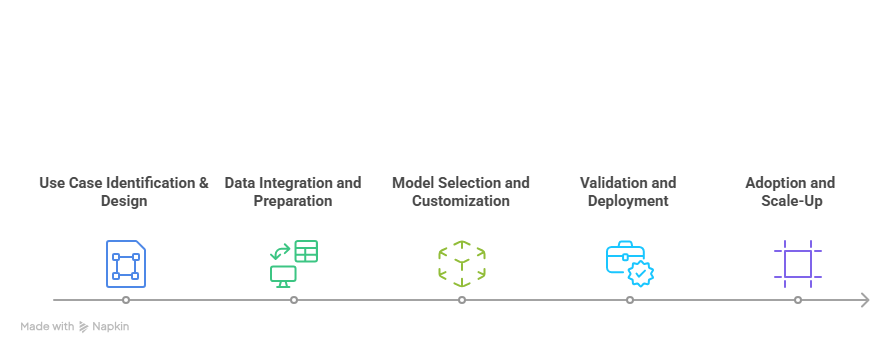
1. Use Case Identification & Design
This is where teams define what they want AI to do, gathering use cases, mapping workflows, and identifying integration points. It’s the stage that frames the entire implementation, setting the direction for all that follows.
2. Data Integration and Preparation
Next comes data collection, cleansing, and connection to enterprise systems. The more fragmented the data sources, the longer this phase takes, making it one of the most time-intensive parts of Enterprise AI Integration.
3. Model Selection and Customization
Teams evaluate LLMs, test prompts, and fine-tune models to match business context. This involves cycles of experimentation and iteration to ensure reliability before deployment.
4. Validation and Deployment
After model testing and compliance reviews, the agent moves into controlled environments for pilot runs. Multiple layers of validation make this a critical but often lengthy stage in the AI Agent Deployment Process.
5. Adoption and Scale-Up
Once the agent proves its value, teams begin integrating it into wider workflows, followed by user onboarding, performance monitoring, and continuous optimization steps that shape long-term success.
Together, these five stages typically span three to six months from concept to production, depending on scope, complexity, and the level of readiness across teams, defining what most organizations consider a standard AI Agent Implementation Timeline.
Step 1: Use Case Identification & Design with GenE
Teams begin by identifying where AI can add value, mapping processes, defining agent roles, and aligning them with business outcomes. This often involves multiple workshops across departments, reviewing workflows, and drafting detailed design documents. Aligning stakeholders on objectives alone can consume several rounds of review before moving forward.
Average duration: 1–2 weeks.
Duration with GenE: 4–6 hours.
With GenE:
GenE simplifies the start of the AI Agent Implementation Timeline through pre-built orchestration templates and modular agent frameworks. Teams can choose functional blueprints, for example, sales follow-up automation or procurement validation, and tailor them instantly.
The AI Orchestration Platform handles mapping and alignment automatically, ensuring that clarity and consensus are achieved faster, enabling Accelerated AI Deployment from day one.
Step 2: Data Integration & Preparation with GenE
Teams collect, clean, and connect data from CRMs, ERPs, and legacy systems. Each dataset must be standardized and validated before it supports AI agents. For large enterprises, fragmented architectures and siloed ownership turn this into the most time-consuming stage of the AI Agent Deployment Process. Reconciliation between teams often adds several additional review cycles to ensure accuracy.
Average duration: 3–4 weeks.
Duration with GenE: 6–8 hours.
With GenE:
GenE’s AI Orchestration Platform integrates seamlessly with enterprise data ecosystems, connecting to databases, APIs, and tools without disruption. Modular agents handle data extraction, validation, and enrichment automatically, ensuring unified access across systems.
The process delivers clean, contextualized data ready for production use, completing in a single workday to accelerate Enterprise AI Integration.
Step 3: Model Selection & Customization with GenE
After data readiness, teams evaluate multiple LLMs, fine-tune prompts, and customize models for specific workflows. This experimentation loop testing, benchmarking, and iterating often delays production timelines. In many cases, multiple proof-of-concept models are built before one is selected, extending development further.
Average duration: 2–3 weeks.
Duration with GenE: 5–7 hours.
With GenE:
GenE’s LLM-agnostic architecture allows instant integration with any model GPT, Claude, LLaMA, or others, along with the preferred vector database. Pre-configured agent templates simplify model alignment with business objectives, reducing manual tuning cycles.
Teams can switch or compare models seamlessly, achieving production-level precision and Accelerated AI Deployment without losing flexibility or control.
Step 4: Validation & Deployment with GenE
Once models are finalized, teams conduct validation for accuracy, compliance, and reliability. Each review requires coordination across IT, governance, and business units, extending timelines and creating dependency loops in the AI Agent Implementation Timeline. Additional pilot testing is often needed before full rollout, adding more time to deployment.
Average duration: 2–3 weeks.
Duration with GenE: 4–5 hours.
With GenE:
GenE integrates automated validation pipelines directly into the AI Orchestration Platform. Built-in governance checks ensure performance and compliance in real time, eliminating repetitive manual reviews.
Once benchmarks are met, agents can be safely deployed across live systems, compressing a multi-week review process into less than half a day.
Step 5: Adoption & Scale-Up with GenE
After deployment, organizations focus on user onboarding, performance tracking, and expanding agents across functions. Each rollout requires custom setup, retraining, and manual oversight, slowing scalability and long-term success. New department rollouts often repeat much of the original setup, limiting momentum across the Enterprise AI Integration journey.
Average duration: 3–4 weeks.
Duration with GenE: 1–2 days.
With GenE:
GenE’s modular, plug-and-play architecture accelerates enterprise-wide scaling. Once an agent is deployed, it can be cloned, customized, and rolled out across teams without rebuilding from scratch.
Continuous learning loops help agents evolve with workflows, while centralized orchestration ensures consistent governance supporting sustained, enterprise-grade Accelerated AI Deployment.
Why Implementation Speed is the New Competitive Edge
The faster an organization can move from idea to impact, the greater its competitive advantage. A shorter AI Agent Implementation Timeline means faster insights, faster optimization, and faster business outcomes.
This is where platforms like GenE redefine what’s possible. By collapsing the AI Agent Deployment Process from months to hours, GenE enables continuous iteration and adaptation.
Enterprises can test, deploy, and scale agents without waiting for lengthy integrations or validation cycles, turning agility into a measurable business strength.
Rapid execution also means enterprises can address AI Implementation Challenges before they become blockers.
When every process is orchestrated through a single AI Orchestration Platform, teams gain real-time visibility, governance, and control. This creates an environment where innovation compounds; every new agent adds exponential value to the next.
Ultimately, Accelerated AI Deployment is about competitive resilience. Enterprises that deploy faster learn faster, and in the era of intelligent automation, that learning speed is the true measure of leadership.
Measurable Business Impact
With GenE’s unified AI Orchestration Platform, every stage of the AI Agent Deployment Process becomes transparent and optimized. Teams spend less time waiting for approvals, integrations, or manual validations and more time improving workflows that directly impact revenue and efficiency. This is how Accelerated AI Deployment delivers business value that scales across departments.
| Key Metric | Traditional AI Agent Implementation | With GenE Orchestration |
| Time to Production | 12–16 weeks from design to deployment | 24–48 hours end-to-end |
| Integration Effort | Multiple systems, high dependency on IT | Seamless Enterprise AI Integration through GenE connectors |
| Iteration Cycle | 2–3 weeks per test or update | Continuous, real-time iteration and feedback loops |
| Operational Visibility | Limited reporting and manual oversight | Centralized dashboards with governance and audit controls |
| ROI Realization | Often after 6–9 months | Measurable within the first operational week |
Conclusion
The average AI Agent Implementation Timeline doesn’t have to be a bottleneck. With GenE, it becomes a competitive advantage. By reducing implementation from weeks to hours, GenE enables enterprises to transform their AI Agent Deployment Process into a cycle of continuous innovation.
This acceleration isn’t about shortcuts; it’s about smarter orchestration. By bringing every agent, workflow, and decision under one AI Orchestration Platform, enterprises turn fragmented initiatives into a cohesive network of intelligence.
That’s the real measure of Accelerated AI Deployment, not just doing AI faster, but doing it right, at scale, and with impact that compounds over time.
